Hook Kick Kickboxing With Partner
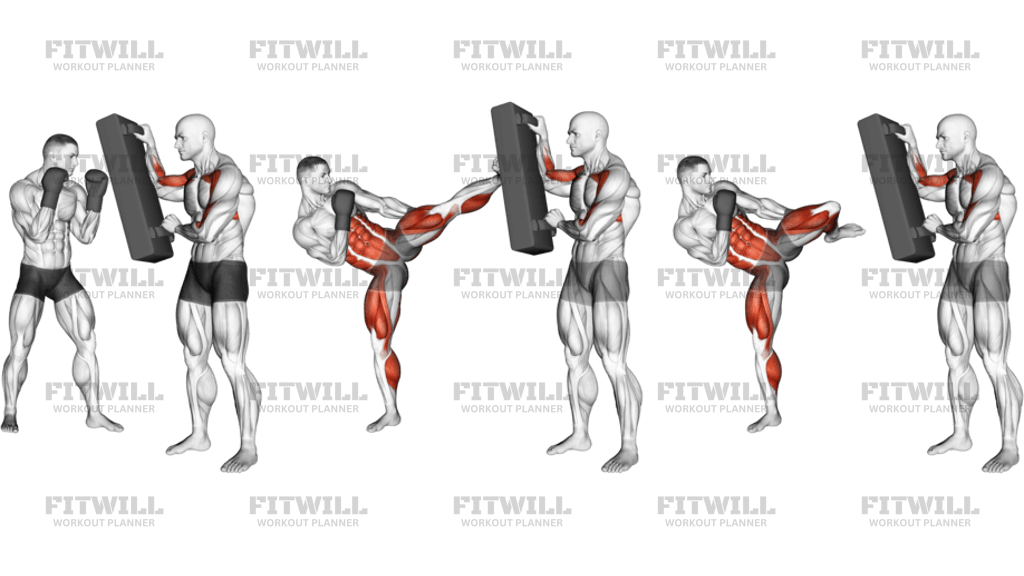
Hook Kick Kickboxing with Partner is a partner drill built around the hook kick: a fast, arcing strike that travels around the outside of the target and lands with control on a pad or shield. It trains kicking mechanics, balance, hip coordination, trunk stiffness, and the timing needed to place a clean shot without overreaching or collapsing the stance.
The partner and pad placement matter as much as the kick itself. If the shield is too close, the leg never has room to chamber and whip through the arc. If it is too far away, the kicker starts reaching with the knee and loses the rotation that makes the hook kick smooth. A stable fighting stance, an active guard, and a clear target line let the athlete practice the same setup rep after rep.
The movement starts with a compact chamber: lift the knee, pivot the support foot, and rotate the hip so the kicking leg can swing across the body and back toward the pad. The striking surface is usually the heel or heel edge, depending on style and pad angle. Good reps look controlled before impact, sharp at contact, and disciplined on the return so the foot comes back under the body instead of drifting past the target.
This drill works well in kickboxing rounds, skill work, conditioning circuits, or warmups when the goal is to sharpen technique under light to moderate fatigue. Keep the contact level appropriate for the partner, build speed only after the distance is consistent, and stop if the kick turns into a reach, the standing knee collapses inward, or the landing becomes unstable. The best set is the one where every rep looks identical and the partner can hold the shield in the same place with confidence.
Fitwill
Log Workouts, Track Progress & Build Strength.
Achieve more with Fitwill: explore over 9600 exercises with images and videos, access built-in and custom workouts, perfect for both gym and home sessions, and see real results.
Start your journey. Download today!




Instructions
- Stand in a fighting stance facing your partner, hands up and the pad set at about chest height.
- Adjust your distance so the kick can chamber first instead of reaching for the shield.
- Lift the kicking knee across your body and pivot the support foot as you prepare the strike.
- Rotate the hip and whip the lower leg in a hooked arc around the outside of the target.
- Contact the pad with the heel or heel edge while keeping the non-kicking hand high.
- Exhale at impact and keep the torso tall so the strike stays driven by the hip, not a lean.
- Re-chamber the leg immediately after contact and bring the foot back under you.
- Reset your stance and wait for the partner to stabilize the shield before the next rep.
Tips & Tricks
- Set the pad high enough to match your hip line; a target that is too low usually turns the hook kick into a side swipe.
- Pivot the support foot as soon as the knee chambers so the hip can open without torquing the standing knee.
- Aim to hit with the heel, not the toes; toe-first contact usually means the leg is reaching instead of hooking.
- Keep your guard up on the non-kicking side so the upper body does not fold toward the target.
- If the kick feels cramped, take a small step back before the next rep instead of trying to force extra range.
- Have the partner brace the shield into their body; a loose pad makes the arc harder to control and judge.
- Build speed only after the chamber and return stay clean at slow tempo.
- Stop the set if the standing heel stays stuck, the knee caves inward, or the landing turns noisy and off-balance.
Frequently Asked Questions
What does Hook Kick Kickboxing with Partner train most?
It trains kicking coordination, hip rotation, balance, trunk control, and the timing needed to land a clean arcing strike on a partner-held pad.
Is this a good beginner drill?
Yes, as long as the partner holds the shield steadily and the kicker stays light, slow, and focused on chambering before striking.
Where should the pad be held for a hook kick?
Usually around chest height and slightly in front of the body, so the kicker can swing around the outside of the target instead of reaching straight at it.
What part of the foot should make contact?
Most hook kick variations land with the heel or heel edge. That contact point matches the arcing path shown in the drill.
Why does the support foot need to pivot?
The pivot lets the hip turn over cleanly and reduces stress on the ankle and knee of the standing leg.
What is the biggest technical mistake?
Reaching for the shield instead of chambering first. If the knee never comes across the body, the kick loses its hook and power.
Should the strike be full power?
Not by default. Start with controlled contact so the partner can hold the pad consistently and you can repeat the same arc every rep.
Can I use this in conditioning rounds?
Yes. It fits well in kickboxing rounds or circuits, but the technique should stay crisp even when fatigue starts to build.