Single-Arm Push-Up Supported Wall
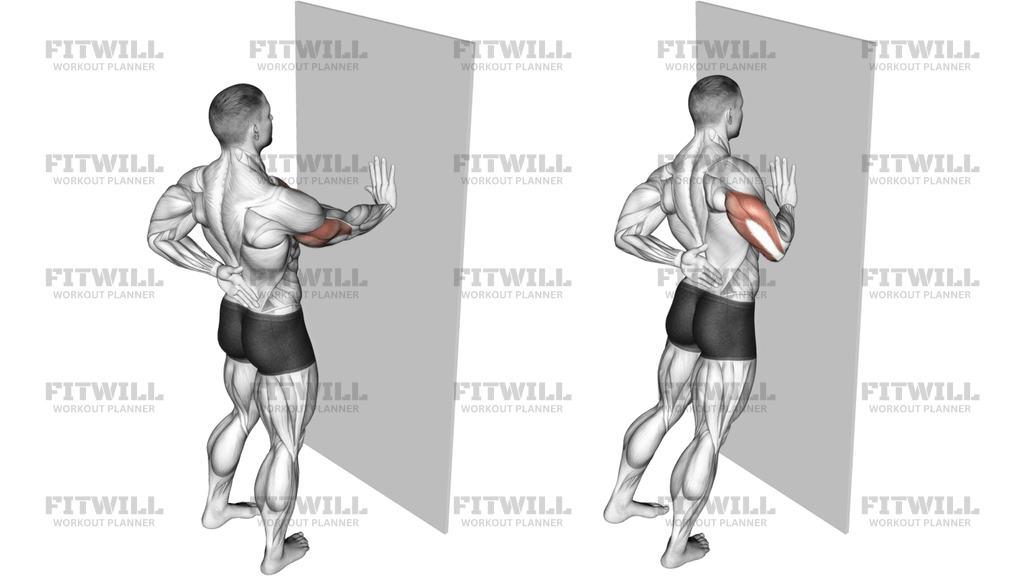
Single-Arm Push-Up Supported Wall is a wall-based pressing drill that lets you train one side of the upper body while keeping the load light enough to control. It builds pressing strength, body control, and anti-rotation stability without needing a floor push-up yet, which makes it useful as a regression, a warm-up drill, or a bridge toward harder one-arm pressing work.
The main work comes from the chest and triceps, with the front shoulders helping to drive the press and the core resisting the twist created by working one side at a time. Because the body is standing and angled into a wall, the exercise also teaches you how to keep the ribcage, pelvis, and shoulder girdle organized while one arm does most of the pushing. That makes the movement more than just an easier push-up variation; it is also a control exercise.
Set up facing a wall with one palm flat on the wall at about chest height, fingers pointing up and the wrist stacked under the shoulder. Step the feet back so your body is angled forward, then stagger the stance and place the free hand on the lower back or across the hip. Keep the working-side shoulder level, the non-working side from opening, and the back heel lightly lifted so you can stay balanced while pressing.
Lower by bending the working elbow and letting the chest travel toward the wall in one smooth line. Keep the elbow at roughly a 30 to 45 degree angle from the torso instead of flaring it wide, and stop when the shoulder, chest, and nose approach the wall without collapsing the trunk. Press the wall away through the whole palm, exhale through the effort, and finish each rep with the elbow straight but not slammed out.
Single-Arm Push-Up Supported Wall works well when you want clean pressing volume without the joint stress of a floor variation. It is also a practical option for beginners, anyone returning from a layoff, or lifters who want to build one-sided control before moving to a lower incline or the floor. Keep the setup honest, keep the torso square, and choose a wall distance that lets you repeat smooth reps instead of chasing range you cannot control.
[ Workout Log & Planner ]
Put your next workout in Fitwill
Keep your plan and training log ready when you are.


Instructions
- Face a wall and place one palm flat on it at chest height, with your fingers pointing up and your wrist stacked under your shoulder.
- Step your feet back far enough to create a forward lean, then stagger your stance and keep the free hand on your lower back or hip.
- Tighten your abs and glutes so your torso stays long instead of arching as you press.
- Keep the working elbow angled slightly out from your ribs and lower your chest toward the wall in one controlled line.
- Let the shoulder and chest move forward together, but do not let the torso twist open to the free-hand side.
- Pause briefly when your chest is close to the wall and your elbow is bent under control.
- Press the wall away through the full palm, exhale as you drive up, and finish with the elbow straight but not locked hard.
- Reset your stance after each rep, then switch sides after the set is complete.
Tips & Tricks
- The farther your feet are from the wall, the harder the press becomes; shorten the stance if your torso starts twisting.
- Keep the free hand glued to your lower back so you can feel rotation before it turns into a rep.
- Aim the working elbow about 30 to 45 degrees from your torso instead of flaring it straight out.
- Spread the fingers and press through the whole palm so the wrist stays steady on the wall.
- If your shoulder shrugs toward your ear, move a little closer to the wall and keep the neck long.
- Use a slow lowering phase to build control, especially if your hips want to drift toward the wall.
- Stop the descent before the chest collapses into the wall; clean position matters more than forcing extra depth.
- Breathe out as you press away so your ribcage does not pop open and your lower back does not arch.
- Once you can keep the torso square for every rep, lower the wall angle before you chase more repetitions.
Frequently Asked Questions
What muscles does Single-Arm Push-Up Supported Wall work?
It mainly trains the chest and triceps, with the front shoulders and core helping to stabilize the body against rotation.
Is Single-Arm Push-Up Supported Wall good for beginners?
Yes. The wall angle makes it much easier than a floor one-arm push-up, so beginners can learn pressing mechanics and torso control safely.
Where should my hand go on the wall for Single-Arm Push-Up Supported Wall?
Place the hand about chest height with the wrist under the shoulder. That position keeps the press efficient and makes it easier to control the shoulder.
Why do I keep the other hand on my lower back?
It stops you from opening the torso and turning the exercise into a regular two-sided push. It also makes the anti-rotation demand clearer.
How far away should I stand from the wall?
Start close enough that you can lower smoothly without twisting. Step farther back only when you can keep the ribs, hips, and shoulders square.
What is the most common mistake in Single-Arm Push-Up Supported Wall?
Letting the torso rotate open or shrugging the shoulder toward the ear. Both usually mean the stance is too hard or the hand is too high.
How do I make Single-Arm Push-Up Supported Wall harder?
Step your feet farther back, lower the hand slightly, or slow the descent before moving to a lower surface like a countertop or bench.
Can I use Single-Arm Push-Up Supported Wall as a warm-up?
Yes. A few controlled reps per side can wake up the chest, triceps, and shoulder stabilizers before heavier pressing.