Kneeling Hip Thrust
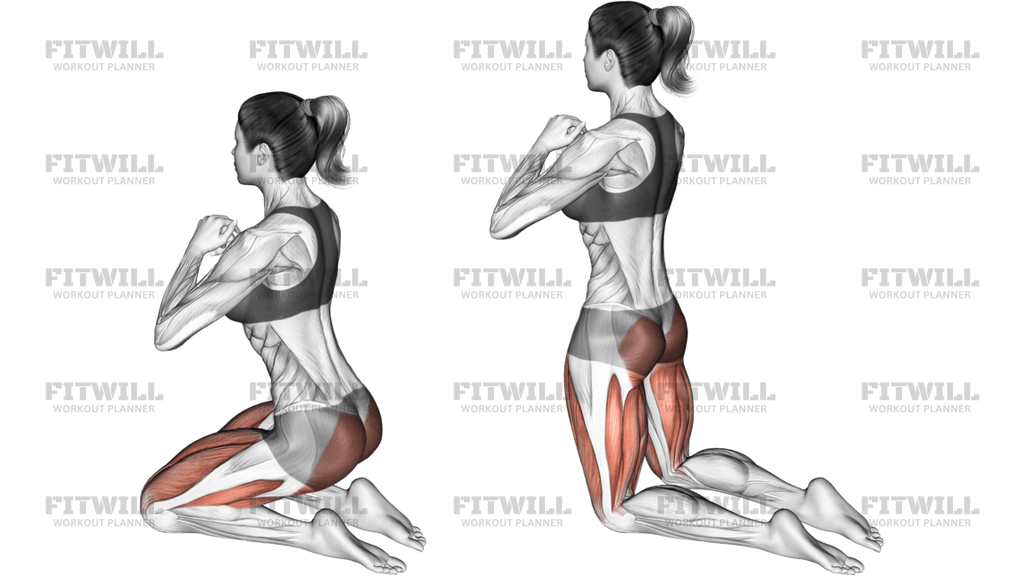
Kneeling Hip Thrust is a floor-based glute exercise performed from tall kneeling. You start on both knees with the shins and tops of the feet on the floor, then drive the hips forward into a tall, stacked position before returning under control. The movement is simple, but the quality of the rep depends on how well you keep the pelvis, ribs, and spine organized through the entire range.
This exercise mainly targets the glutes, with the hamstrings and core helping to stabilize the pelvis and keep the torso from flaring or collapsing. In anatomy terms, the primary work comes from the Gluteus maximus, with support from Biceps femoris, Rectus abdominis, and Erector spinae. Because the body is supported on the knees, it is easy to feel whether the hips are doing the work or whether the lower back is taking over.
The setup matters more here than in many other hip drills. Kneel on a cushioned surface if needed, keep the knees about hip-width apart, and start with the torso tall, ribs stacked over the pelvis, and hands held at the chest. From that position, let the hips travel back only as far as you can keep control, then reverse the motion by squeezing the glutes and bringing the hips forward into a tall kneeling finish. The rep should feel like a clean hip extension, not a back bend or a chest-led lean.
Use a short pause at the top if you want to make the glutes work harder without adding load. The best repetitions look smooth from start to finish, with no bouncing, twisting, or shifting from side to side. If the lower back starts to dominate, shorten the range and slow the descent. Beginners can learn the pattern with bodyweight first, while more advanced lifters can add resistance only if they can still keep the pelvis quiet and the torso stacked.
This movement fits well in warmups, accessory blocks, glute-focused sessions, or rehabilitation-style training when you want controlled hip extension without a large external load. It is also useful when you want to reinforce glute tension in a kneeling position and teach the body to finish the hips without overextending the spine.
Fitwill
Log Workouts, Track Progress & Build Strength.
Achieve more with Fitwill: explore over 9600 exercises with images and videos, access built-in and custom workouts, perfect for both gym and home sessions, and see real results.
Start your journey. Download today!




Instructions
- Kneel on a padded floor with your knees about hip-width apart, shins flat, and the tops of your feet resting on the ground.
- Keep your torso tall, clasp your hands at your chest, and stack your ribs over your pelvis before the first rep.
- Gently brace your abs and squeeze your glutes so your hips start from a controlled, neutral kneeling position.
- Inhale and sit your hips back only as far as you can while keeping your spine long and your weight centered over the knees.
- Drive your hips forward by squeezing the glutes, bringing your torso back to a tall kneeling position.
- Finish the rep with the hips extended, glutes tight, and the lower back still long rather than arched.
- Exhale as you drive forward, then inhale again as you return under control to the same kneeling setup.
- Pause briefly at the top or bottom if needed to keep each rep smooth and evenly controlled.
- Repeat for the planned number of repetitions, then reset your posture before standing out of the position.
Tips & Tricks
- Use a folded mat or pad under the knees if the floor makes the kneeling position uncomfortable.
- Keep the movement in the hips; if your chest is swinging forward, the rep has become a lean instead of a thrust.
- A small posterior pelvic tilt at the top helps the glutes finish the rep without turning it into a low-back arch.
- Think about bringing the hips forward together, not shifting your weight onto one knee or rotating the torso.
- Stop the descent before you lose the long spine position; the bottom of the rep is a control point, not a stretch contest.
- If your hamstrings cramp, shorten the range and slow the lowering phase so the glutes can stay in charge.
- Keep the chin slightly tucked and the neck relaxed so you do not compensate with upper-back extension.
- Bodyweight is usually enough to learn the pattern; add a band or load only after the tall kneeling finish stays clean.
- The rep should feel smooth and deliberate, not explosive, because momentum makes it easier to overextend the lumbar spine.
- Stop the set when you can no longer keep the pelvis stacked over the knees.
Frequently Asked Questions
What muscle does Kneeling Hip Thrust target most?
The glutes are the main target, especially the Gluteus maximus.
Can beginners perform this exercise?
Yes. Beginners can learn it with bodyweight first, as long as the knees are comfortable and the torso stays stacked.
Where should my knees and feet be in the kneeling setup?
Keep the knees about hip-width apart with the shins on the floor and the tops of the feet relaxed against the ground.
How far should I sit back before driving forward again?
Only as far as you can keep your spine long and your pelvis controlled. If the lower back rounds or the chest collapses, the range is too deep.
Why do I feel this in my lower back instead of my glutes?
That usually means you are finishing with a back arch or leaning through the chest. Shorten the range and squeeze the glutes to bring the hips forward.
Can I add resistance to make the kneeling hip thrust harder?
Yes. A light band or external load can work well, but only after you can keep the tall kneeling finish clean and steady.
What is the biggest mistake on this exercise?
The most common mistake is turning the rep into a chest-led lean or a low-back arch instead of a controlled hip drive.
Is this the same as a glute bridge?
No. A glute bridge is done lying on your back, while this exercise uses a kneeling setup and a tall kneeling hip drive.
How should I breathe during the rep?
Inhale as you return to the back position, then exhale as you drive the hips forward into the tall kneeling finish.