Weighted Donkey Calf Raise
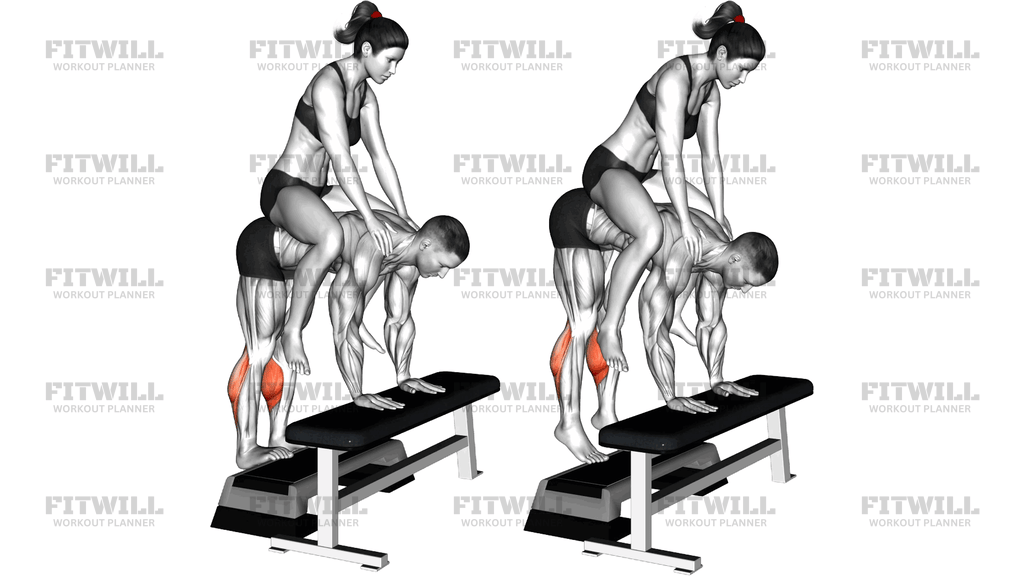
Weighted Donkey Calf Raise is a bent-over calf exercise that loads the lower legs while your torso stays hinged over a bench. In the setup shown here, you brace your hands on the bench and accept load across the hips and lower back area, which lets the calves work through a long stretch and a hard top contraction.
The exercise mainly targets the gastrocnemius, with the soleus and other lower-leg stabilizers helping you keep the ankles steady. Because the knees stay almost straight and the torso is folded forward, the calves take on more of the work than they would in a seated raise. That also makes the setup important: if the hips drift, the lower back rounds, or the load shifts too high, the tension leaves the calves and the movement turns sloppy.
Start with the balls of your feet planted on a flat floor or a small step, heels free to rise and fall. Keep your hands fixed on the bench, hinge at the hips, and hold a long spine while the weight settles into the pelvis or upper glutes. From there, lower the heels under control until you feel a strong calf stretch, then drive straight up through the forefoot without bouncing.
This version is useful for building calf size, ankle strength, and lower-leg endurance because it gives the muscles a loaded stretch at the bottom and a clear squeeze at the top. It works well after squats, deadlifts, or leg presses, or as a focused calf accessory session on its own. Keep the motion strict and predictable so the calves stay loaded rep after rep.
Because the body is hinged forward and the load sits on the back side of the body, balance and pressure points matter. Use a setup that feels stable, keep the neck relaxed, and stop the set if the load starts sliding or the lower back begins to take over. Clean reps matter more here than chasing extra weight.
[ Workout Log & Planner ]
Put your next workout in Fitwill
Keep your plan and training log ready when you are.


Instructions
- Place the balls of your feet on a flat floor or small step, with your heels free to move, then hold a bench or support in front of you and hinge forward until your torso is nearly parallel to the floor.
- Keep your feet about hip-width apart and let a partner or other secure load settle across your hips and upper glutes, not on your lower spine.
- Keep your knees softly bent, your spine long, and your neck neutral while you fix your hands on the bench and brace your midsection.
- Lower your heels slowly until your calves reach a deep, controlled stretch without letting your weight roll to the inside or outside of the feet.
- Exhale and drive the balls of your feet into the floor as you raise your heels as high as possible.
- Pause for a brief squeeze at the top and keep your ankles stacked rather than wobbling or twisting.
- Lower back down under control to the same stretch point, keeping the torso angle and hand position unchanged.
- Reset the load if needed, then repeat for the planned number of reps before carefully stepping away.
Tips & Tricks
- Keep the load low on the hips or upper glutes; if it sits on the lower back, the movement usually feels unstable and the spine takes over.
- A slight knee bend is enough. Locking the knees tends to shift stress away from the calves and can make the stretch feel harsh.
- Use the same torso angle on every rep. Rising and lowering the chest turns the set into a back-and-forth balance drill instead of a calf raise.
- Let the heels drop only as far as you can control. If the bottom position makes the ankles collapse inward, shorten the range.
- Press through the big toe, second toe, and outer forefoot so the ankles stay centered through the whole rep.
- Hold the top for a one-count squeeze instead of bouncing for extra height.
- A controlled lowering phase matters here because the calves often grow well from the loaded stretch, not just the peak contraction.
- If the partner load shifts, reduce the weight or reset the setup before continuing; a moving load changes the line of force and can irritate the lower back.
Frequently Asked Questions
What muscles work hardest in a Weighted Donkey Calf Raise?
The gastrocnemius is the main mover, with the soleus and smaller ankle stabilizers helping control the raise.
Why does the bent-over setup matter so much?
The forward hinge keeps the calves under tension while the knees stay mostly straight, which makes the stretch and peak contraction more pronounced.
Should the weight sit on my lower back?
No. The load should rest across the hips or upper glutes so the calves can work without the spine taking unnecessary pressure.
Do I need to keep my knees straight?
Keep them softly bent rather than locked. That usually feels better on the joints and keeps the movement smooth.
How low should my heels drop?
Drop only as far as you can maintain foot pressure and a controlled calf stretch. If the Achilles or ankle feels pinched, shorten the range.
Can I do this without a partner sitting on me?
Yes. Any stable, secure loading setup that rests on the hips and lets you hinge forward can work, as long as it does not slide during the set.
Is this a good beginner calf exercise?
It can be, but beginners should start light and practice the hinge, balance, and full-foot control before adding much load.
What is the most common mistake on this exercise?
Bouncing at the bottom or letting the torso bob up and down usually steals tension from the calves and makes the set less effective.