Band Kneeling Crunch Version 2
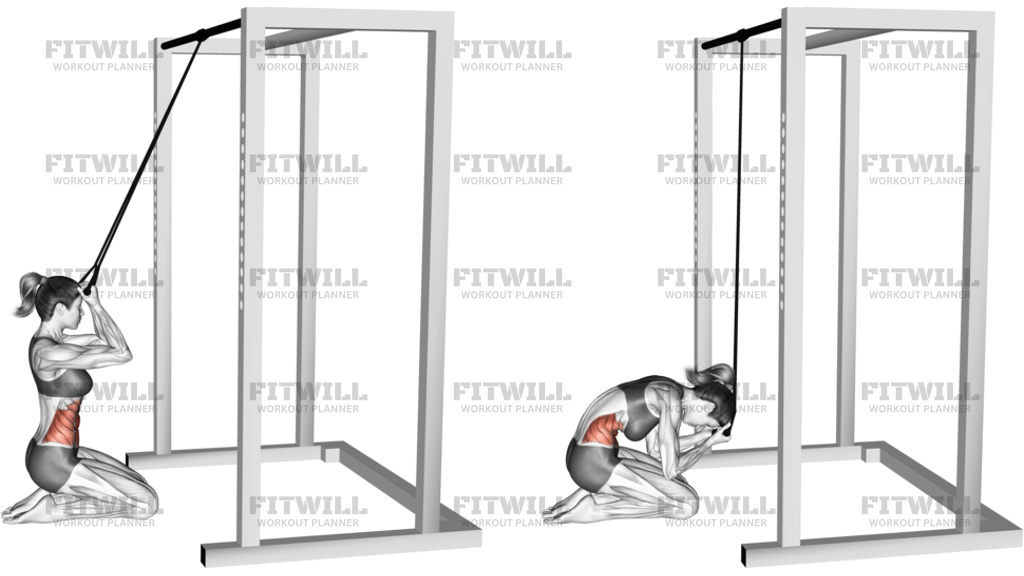
Band Kneeling Crunch Version 2 is a band-resisted kneeling abdominal crunch performed from a high anchor. It is designed to load trunk flexion in a controlled way, with the knees fixed on the floor and the upper body doing the moving. The exercise is most useful when you want direct abdominal work without relying on a machine stack, because the band lets you adjust tension by changing distance from the anchor and by controlling how far you crunch.
The image shows a tall-kneeling setup with the band traveling from a high point behind and above the head to the hands at the forehead. That setup matters. If you kneel too close to the anchor, the band goes slack at the top and the rep loses tension; if you kneel too far away, the band can pull you into the first rep before you are braced. The best position is the one where the abs are already working before the crunch begins and the shoulders can stay quiet while the ribcage moves.
Treat the rep as a spinal flexion drill, not a hip hinge. Keep the thighs, knees, and hips largely fixed while you curl the ribs down toward the pelvis. The elbows stay bent and the hands stay close to the temples or forehead so the arms do not become the driver. A clean rep finishes with the torso rounded, the abs shortened, and the neck still relaxed. On the way back up, resist the band smoothly instead of snapping upright.
Use this movement when you want focused core work in warm-ups, accessories, or lighter strength circuits. It fits best after the main lifts, when you can keep the torso controlled and the range honest. Beginners can use it if they can keep the pelvis stacked under the ribcage and avoid yanking with the arms. The main coaching priority is staying in control of the band, the knees, and the return phase so every rep looks the same from the first to the last.
[ Workout Log & Planner ]
Put your next workout in Fitwill
Keep your plan and training log ready when you are.


Instructions
- Set a high band anchor behind you and kneel on a pad several feet in front of it, facing away from the anchor.
- Hold the band or handles beside your temples with your elbows bent, and keep the band lightly tensioned before the first rep.
- Stack your ribs over your pelvis, keep your hips over your knees, and tuck your chin slightly so your neck stays long.
- Exhale and curl your ribs down toward your pelvis, letting your elbows travel toward your thighs without sitting back.
- Keep your hips and knees mostly still while your upper back rounds and your abs shorten against the band.
- Pause briefly at the bottom when your torso is fully flexed and the abs are tight.
- Inhale and slowly unwind back to a tall kneel, keeping tension on the band instead of letting it go slack.
- Reset your ribs over your pelvis before the next repetition and repeat for the planned set.
Tips & Tricks
- Kneel far enough from the anchor that the band is already loaded at the top, but not so far that it pulls you forward before you brace.
- Keep your hands near your temples or forehead; if your arms start pressing hard, the band load is too heavy or your setup is too far away.
- Think about shortening the distance between your ribs and pelvis instead of pulling your elbows down aggressively.
- Let your upper back round naturally, but do not collapse at the hips or shift your weight back toward your heels.
- Keep the chin slightly tucked so the neck does not extend when the band gets heavy at the top.
- Use a slower return than the crunch itself so the abs control the band on the way back up.
- Stop the set when you can no longer keep the ribcage stacked over the pelvis at the top position.
- A lighter band with a clean full crunch is usually better than a heavy band that turns the rep into an arm pull.
Frequently Asked Questions
What muscles does Band Kneeling Crunch Version 2 train most?
It mainly trains the rectus abdominis, with the obliques and deeper trunk muscles helping stabilize the torso.
Where should the band be anchored for this crunch?
Use a high anchor above head height so the band pulls from overhead as you kneel and crunch forward.
Should my hips move during the rep?
The hips should stay mostly stacked over the knees while the ribcage curls down toward the pelvis.
Why do I feel this in my arms more than my abs?
That usually means you are gripping too hard, kneeling too far from the anchor, or trying to pull the band with the arms instead of crunching the torso.
Can beginners use this exercise?
Yes, if they keep the setup light and can hold a tall kneel without arching the low back or yanking on the band.
What is the most common mistake with this movement?
The biggest error is turning it into a hip hinge or arm pull instead of a true rib-to-pelvis crunch.
How do I know if the band tension is right?
You should feel resistance at the top without being dragged out of position before the first crunch starts.
What is a good way to progress it?
Move farther from the anchor, use a stronger band, or slow the lowering phase while keeping the same clean kneeling position.