Ring Leg Curl
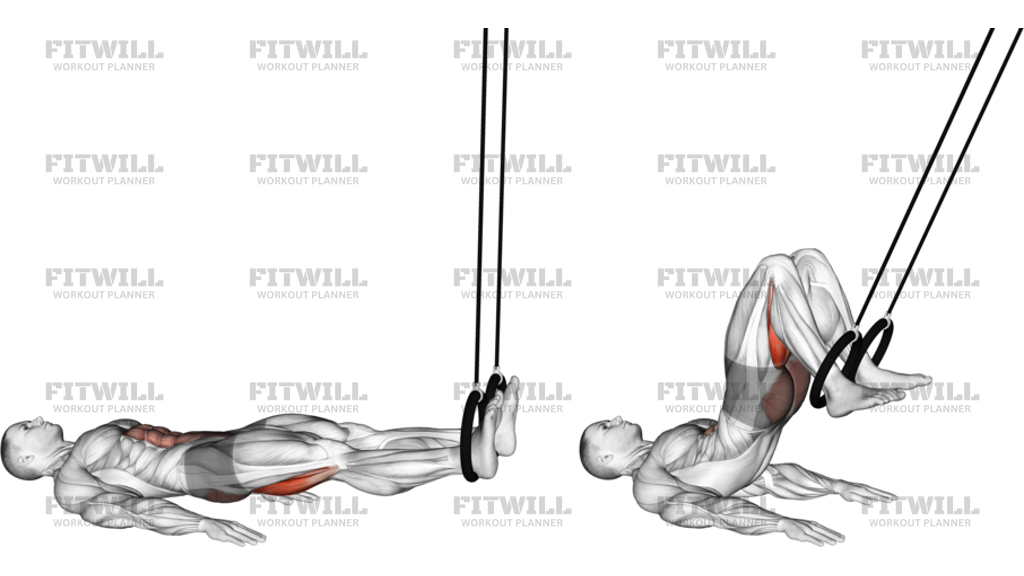
Ring Leg Curl is a bodyweight hamstring exercise performed with your heels or ankles supported in suspension rings while you lie face up on the floor. The movement combines knee flexion with a small hip lift, so it trains the hamstrings hard while also demanding enough core and pelvic control to keep the body from folding or twisting. The rings add an unstable element that makes the exercise feel much different from a machine curl, which is why the setup and body line matter so much.
This variation is useful when you want a hamstring-focused drill that also teaches control through the bridge position. The floor gives you feedback from your upper back and shoulders, while the rings challenge your feet to stay centered as you pull. That combination makes Ring Leg Curl a strong choice for accessory work, athletic conditioning, or home training when you do not have access to a leg curl machine.
The exercise works best when the straps are adjusted so your legs can start almost straight without the rings dragging on the floor. Lie down with your arms out for balance, press your upper back into the ground, and keep your ribs from flaring as you begin the curl. A clean rep should feel like the heels are sliding toward the glutes while the hips stay controlled, not like the lower back is arching to fake extra range.
At the top, the knees should bend deeply and the hamstrings should feel fully shortened, but the movement still needs to stay smooth. If the rings swing, the hips drop, or the feet slip forward, the load is too aggressive or the straps are set too high. Lowering the difficulty, shortening the range slightly, or slowing the eccentric phase usually makes the exercise much cleaner.
Use Ring Leg Curl when you want a direct hamstring stimulus with a balance challenge built in. It can be an effective beginner-friendly progression if the range is controlled and the rings are secure, but it also scales well for experienced lifters by adding a hip bridge, slower lowering, or longer pauses. The goal is not just to curl the legs in, but to keep the pelvis steady and the tension on the back of the thighs from the first rep to the last.
[ Workout Log & Planner ]
Put your next workout in Fitwill
Keep your plan and training log ready when you are.


Instructions
- Set the rings so they hang low enough for you to lie on your back with your heels or lower ankles cradled securely in the handles.
- Lie face up on the floor, extend your legs, and open your arms slightly out from your sides to steady your torso.
- Press your upper back and shoulders into the floor, keep your ribs down, and brace your midsection before the first rep.
- Lift your hips just enough to create a straight line from shoulders to knees without over-arching your lower back.
- Pull your heels toward your glutes by bending your knees and keeping the rings centered under your feet.
- Keep the hips lifted and the thighs steady as the knees bend, letting the hamstrings do the work instead of swinging the legs.
- Squeeze hard at the top when your heels are close to your hips, then pause briefly without losing tension.
- Slowly extend your knees back out until your legs are nearly straight again, controlling the rings all the way back.
- Lower your hips to the floor, reset the straps if needed, and repeat for the planned number of reps.
Tips & Tricks
- Keep the rings under your heels or lower ankles; if they drift toward your arches, the curl gets sloppy fast.
- Start with a small hip lift and only raise higher if your lower back stays quiet through the whole set.
- Pull your toes slightly toward your shins to help keep the straps from sliding and to keep tension in the hamstrings.
- If the rings swing side to side, narrow your arm position and reduce speed on the way down.
- Do not let your ribs pop up at the top; the pelvis should stay controlled instead of turning the rep into a back extension.
- A slower lowering phase usually makes this movement more effective than trying to yank the feet in quickly.
- Stop the set when you can no longer keep both heels level; asymmetrical reps usually mean one leg is taking over.
- If your hamstrings cramp, shorten the range slightly and keep the top hold brief instead of forcing extra height.
Frequently Asked Questions
What does Ring Leg Curl train most?
It primarily trains the hamstrings, with the glutes and core helping you hold the bridge position while the rings stay steady.
Where should my feet sit in the rings during Ring Leg Curl?
Your heels or lower ankles should stay centered in the handles so the straps do not slide toward the arches as you curl.
Why do my hips lift during Ring Leg Curl?
A small hip lift is normal, but the goal is to keep the torso and pelvis controlled instead of arching the lower back to fake more range.
Can beginners do Ring Leg Curl?
Yes, if the straps are set low and the range stays short at first. Beginners usually do best with slow reps and only a modest hip lift.
What is the most common mistake with Ring Leg Curl?
Letting the rings swing and the ribs flare. That usually means the hamstrings are not controlling the rep and the lower back is taking over.
How far should I bend my knees in Ring Leg Curl?
Bend them as far as you can while keeping the heels level and the hips controlled. If the pelvis drops or twists, shorten the range.
What can I use instead of Ring Leg Curl?
A stability-ball leg curl, slider leg curl, or machine leg curl can all serve as substitutes if you need a more stable option.
How do I make Ring Leg Curl harder?
Slow the lowering phase, add a longer pause at the top, or keep your hips lifted higher while still keeping the ribs down.