Dumbbell Lateral Lunge
Dumbbell Lateral Lunge is a side-to-side lower-body strength exercise that trains the thighs, hips, and trunk while the dumbbells hang at your sides. Instead of stepping forward or back, you shift your weight laterally, sit into one hip, and keep the opposite leg long. That change in direction makes the exercise especially useful for building frontal-plane strength, groin resilience, and better control when you need to move or absorb force to the side.
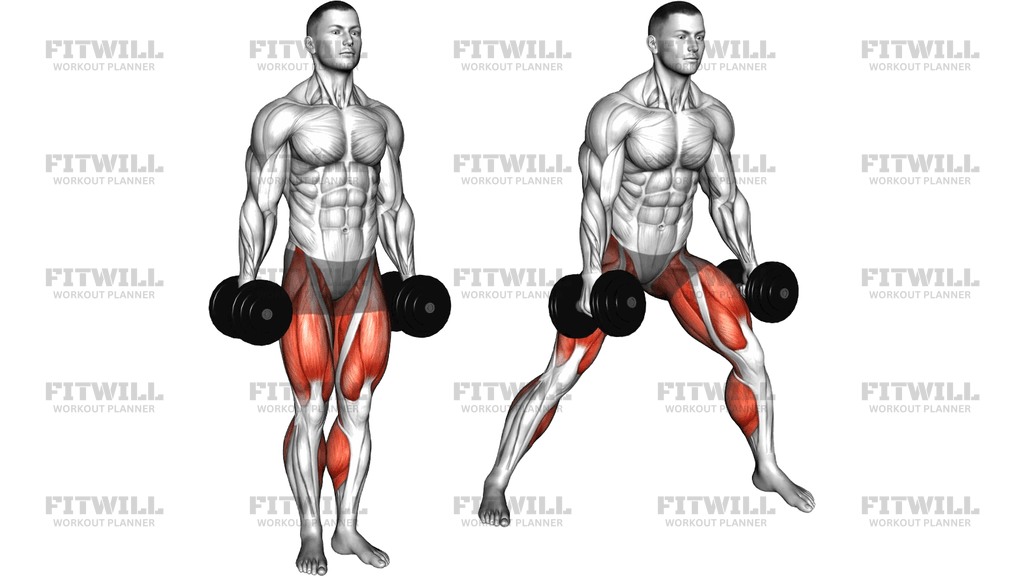
The image shows a clear working-side squat with the other leg extended, which is the key to the movement. The lunging leg bends and tracks over the foot while the straight leg stays more relaxed and stretched. The hips travel back and down, the chest stays lifted, and the dumbbells remain quiet near the outer thighs. That setup lets the legs do the work instead of turning the exercise into a forward bend or a rushed step.
This exercise is usually felt most in the inner thigh of the straight leg, the quadriceps and glute of the bent leg, and the stabilizers around the hips and core. A clean lateral lunge also asks the ankle and foot to stay organized, so the working foot should stay flat and planted as you descend and rise. If the knee collapses inward, the arch caves, or the torso falls too far forward, the load shifts away from the intended muscles and the rep becomes harder to control.
A good rep begins with a shoulder-width stance, dumbbells at your sides, and enough space to step out without losing balance. Step to one side, load the hip on that side, and keep the trailing leg straight with the foot still on the floor or lightly grounded. Then drive through the bent leg to return to center before repeating on the other side or for the programmed side only.
Use this movement when you want a controlled lower-body accessory that builds strength in a direction many squat and hinge exercises miss. It fits well in athletic warmups, leg sessions, and unilateral training blocks, especially when you want to challenge adductors, glutes, and thighs without needing machines or a lot of equipment. Beginners can learn it with light dumbbells or even body weight first, but the rep should always feel smooth, balanced, and pain-free.
Fitwill
Log Workouts, Track Progress & Build Strength.
Achieve more with Fitwill: explore over 9600 exercises with images and videos, access built-in and custom workouts, perfect for both gym and home sessions, and see real results.
Start your journey. Download today!




Instructions
- Stand tall with a dumbbell in each hand, feet about shoulder-width apart, toes pointing mostly forward, and your arms hanging straight by your sides.
- Take a controlled step out to one side so you have room to sit into that hip without the opposite foot sliding away from the floor.
- Keep the stepping foot flat and let the knee bend in line with the toes while the other leg stays longer and more relaxed.
- Send the hips back and down as you lower into the lunge, keeping the chest lifted and the dumbbells hanging quietly near the outside of the thighs.
- Lower until the working thigh is near parallel or until your hip, groin, and ankle mobility naturally stop the descent.
- Pause briefly in the bottom without bouncing, making sure the working foot stays planted and the trunk stays organized.
- Drive through the heel and midfoot of the lunging leg to stand back up and bring your body back to the start.
- Reset your stance, switch sides as needed, and keep your breathing steady: inhale on the step and descent, exhale as you push back to center.
Tips & Tricks
- Step far enough that the working hip can sit back; a tiny step usually turns this into a shallow side squat with little inner-thigh loading.
- Keep the non-working leg straighter, but do not lock it so hard that you lose balance or pull the pelvis out of position.
- Let the knee of the bent leg track over the middle toes instead of collapsing inward toward the big toe.
- Keep the whole working foot down, especially the heel and big-toe base, so the rep stays centered on the leg that is bending.
- Hold the dumbbells still beside your legs; swinging them forward often means you are losing tension and using momentum.
- Keep your chest proud rather than folding at the waist, because too much forward lean shifts the work away from the hips and thighs.
- Use a shorter range if the groin feels pinchy; the exercise should stretch the inner thigh without creating sharp discomfort.
- Choose a load that lets you reverse smoothly from the bottom, since the hardest part is usually coming back to center.
Frequently Asked Questions
What muscles does the Dumbbell Lateral Lunge work?
It primarily trains the thighs and hips, with a strong emphasis on the adductors, quadriceps, glutes, and the core muscles that keep you upright.
Is this the same as a regular lunge?
No. A lateral lunge moves side to side instead of forward and back, so it puts more demand on the inner thigh and side-to-side hip control.
How wide should my step be?
Wide enough to load the hip and bend the working knee comfortably, but not so wide that you lose balance or have to twist the torso.
Should the other leg bend too?
It should stay mostly straight with the foot still grounded or lightly connected to the floor, so the shift stays on the working side.
Where should I feel the stretch?
You should feel the deepest stretch in the inner thigh and hip of the straight leg, while the bent leg does most of the driving.
Can I do this with body weight first?
Yes. Body weight is a good way to learn the side step, hip shift, and knee tracking before adding dumbbells.
What if my knee caves inward?
Reduce the load and shorten the step until you can keep the knee lined up with the toes during both the descent and the drive back up.
Is this safe for beginners?
Yes, if you start light, move slowly, and only go as deep as you can while keeping the foot flat and the torso controlled.