Lying Criss Cross Legs
Lying Criss Cross Legs is a floor-based scissor-style exercise done on your back with the legs lifted and crossing through the midline. It is a low-equipment movement that challenges abdominal control, hip flexors, inner thighs, and pelvic stability while also asking the shoulders and arms to stay quiet for balance. The exercise looks simple, but the value comes from keeping the trunk still while the legs move with precision.
Because the movement happens with the torso pinned to the floor, setup matters. Lie flat, press the low back gently into the mat, and keep the ribs down so the pelvis does not tip forward as the legs cross and open. That position keeps the effort where it belongs: on the front of the hips and trunk instead of turning the drill into a lower-back compensation pattern. Small, crisp reps usually work better than large, swinging ones.
The crossing action trains coordination as much as strength. Each rep should create a controlled scissor pattern with the legs reaching long, meeting or crossing at center, then separating again without losing tension. If the legs drift too low or the lower back starts arching, the range is too aggressive. A slightly smaller arc with steady breathing is usually the better choice and gives cleaner work to the abs and hip stabilizers.
Use Lying Criss Cross Legs as a warmup drill, a core accessory, or a conditioning finisher when you want focused trunk control without loading the spine. It can work well for beginners if the range is reduced and the movement stays slow. The exercise becomes less effective when the legs are thrown around by momentum, so treat every rep like a controlled pattern, not a speed exercise.
[ Workout Log & Planner ]
Put your next workout in Fitwill
Keep your plan and training log ready when you are.


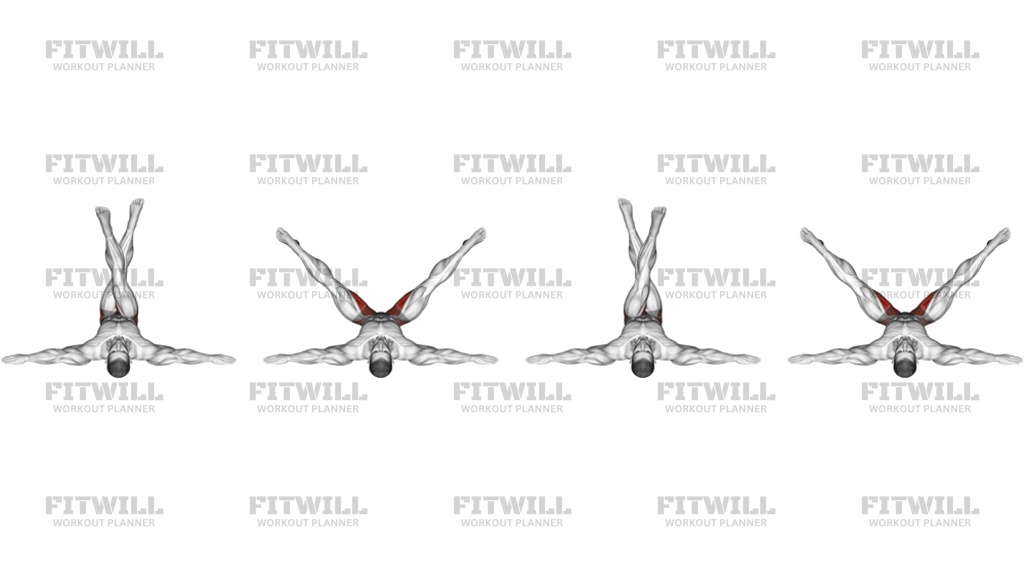
Instructions
- Lie on your back on a mat with your arms out to the sides for balance and your legs extended upward.
- Press your low back gently into the floor and keep your ribs down before the first rep.
- Hold the legs long and slightly lifted so the pelvis stays stacked instead of tipping forward.
- Open the legs in a controlled V, then cross one leg over the other through the center line.
- Uncross and return to the open position without letting the legs swing or drop suddenly.
- Keep the movement smooth and even so the hips stay quiet and the trunk stays braced.
- Breathe out as the legs cross and breathe in as they reopen or reset.
- Continue for the planned reps, then lower the legs with control and reset your low back.
Tips & Tricks
- Keep the legs high enough that your low back does not peel off the floor.
- Make the crossing motion small and precise if you feel your hips tugging or your lumbar spine arching.
- Press your palms lightly into the floor only for balance; do not use the arms to swing the legs.
- Pointing the toes can help you keep the legs long, but the knees should stay straight and controlled.
- If the hamstrings feel too tight, bend the knees slightly rather than forcing a bigger shape.
- Move one leg over the other through center instead of kicking both legs side to side together.
- Slow the lowering phase so the abs stay on and the motion does not turn into momentum.
- Stop the set when the pelvis starts rocking or the neck and shoulders begin to tense up.
Frequently Asked Questions
What muscles does Lying Criss Cross Legs work?
It mainly hits the lower abs, hip flexors, and inner thighs, with the deep trunk muscles helping keep the pelvis steady.
Can beginners perform this exercise?
Yes. Beginners should keep the legs higher, use a smaller crossing range, and slow the tempo down until the pelvis stays stable.
How low should my legs go during the scissor motion?
Only as low as you can keep your low back pressed into the floor. If the pelvis tilts or the back arches, raise the legs a little.
Should my arms stay on the floor the whole time?
Yes, the arms are there for balance. Keep them lightly anchored to the floor instead of using them to create momentum.
Why do my hip flexors feel this more than my abs?
That usually means the legs are too low or the movement is too fast. Bring the legs up slightly and slow the crossing pattern.
Can I bend my knees if my hamstrings are tight?
Yes. A small knee bend can make the exercise more controllable while you still keep the crossing pattern clean.
What is the biggest form mistake on this exercise?
The biggest mistake is letting the legs swing wildly while the lower back arches and the pelvis rocks off the floor.
How can I make Lying Criss Cross Legs harder?
Lower the legs a little, slow the tempo, pause briefly at the cross, or extend the set while keeping the same strict floor contact.