Bar Close-Grip Biceps Curl
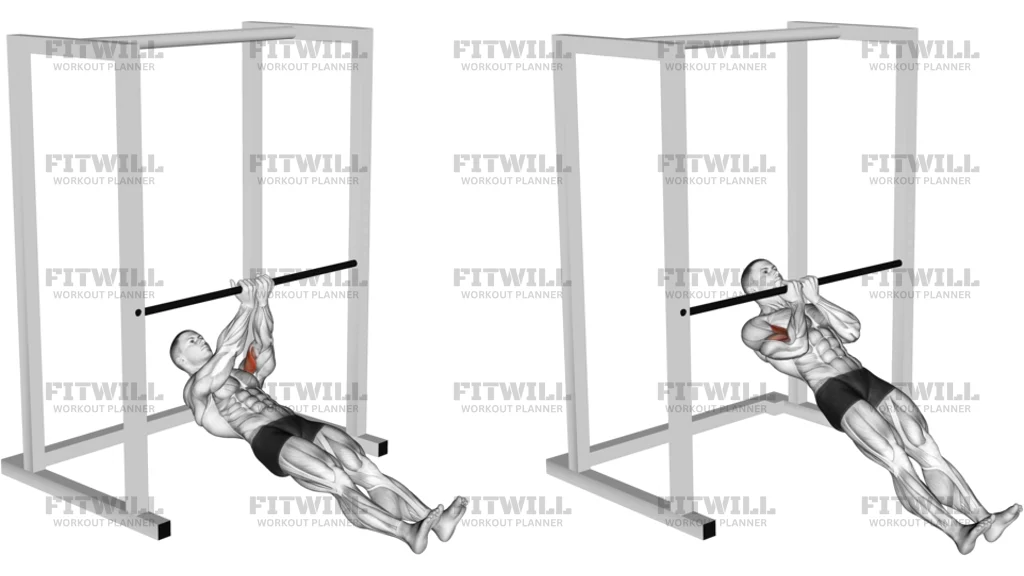
Bar Close-Grip Biceps Curl is a bodyweight pulling exercise performed under a fixed bar with a narrow hand position. In practice, it behaves like a close-grip inverted row that shifts more of the work toward elbow flexion, so the biceps, forearms, and upper-arm stabilizers have to stay organized while the torso moves as one rigid line.
The setup changes the difficulty more than most people expect. Bar height, foot placement, and body angle all change how much load you feel at the top and bottom of the rep. A higher bar or a more upright body makes the movement easier; a lower bar and a straighter body increase the lever demand and make the curl more challenging.
A good repetition starts with the hands close on the bar, heels grounded, and the body extended from shoulders to ankles. Brace before each rep, then drive the chest toward the bar by bending the elbows and keeping them close to the torso. At the top, squeeze without shrugging, then lower under control until the arms are long again and the shoulders stay set.
This exercise is useful as an accessory drill when you want a curl-biased pull without external loading. It fits well in strength, calisthenics, or arm-focused sessions, and it can be regressed by bending the knees or raising the bar. Stop the set if the hips drop, the shoulders roll forward, or the motion turns into a jerk instead of a controlled pull.
Fitwill
Log Workouts, Track Progress & Build Strength.
Achieve more with Fitwill: explore over 9600 exercises with images and videos, access built-in and custom workouts, perfect for both gym and home sessions, and see real results.
Start your journey. Download today!




Instructions
- Set a fixed bar at about waist to chest height in a rack or Smith setup.
- Lie underneath the bar and take a narrow grip, then set your shoulders down and away from your ears.
- Walk the feet out until your body is long and straight, with heels on the floor and the torso braced.
- Start with the arms fully extended and the chest slightly behind the bar.
- Pull the chest toward the bar by bending the elbows and keeping them close to the ribs.
- Keep the body rigid so the shoulders, hips, and heels rise together as one unit.
- Touch the upper chest or sternum close to the bar, pause briefly, and keep the neck neutral.
- Lower yourself slowly until the arms are fully extended again, then repeat for the planned reps.
Tips & Tricks
- A more horizontal body makes the curl much harder; bend the knees or raise the bar to regress it.
- Keep the elbows drifting back, not flaring wide, to keep tension on the biceps and upper arms.
- Do not let the hips sag; a broken body line turns the set into a lower-back endurance test.
- If the bar reaches your chin before the chest, adjust body angle instead of shortening the pull.
- Use a grip width that keeps the wrists stacked and forearms comfortable; too narrow can irritate the wrists.
- Pause at the top for a second to remove momentum and make the biceps work through the finish.
- Lower slowly so the last third of the descent stays controlled instead of dropping into the bottom.
- Stop the set when you start shrugging or rolling the shoulders forward to finish reps.
Frequently Asked Questions
What does Bar Close-Grip Biceps Curl work most?
It mainly targets the biceps and elbow flexors while the upper back and forearms stabilize the pull.
Is this the same as an inverted row?
It is a close-grip, curl-biased version of an inverted row pattern, with more emphasis on elbow flexion.
Can beginners do this movement?
Yes, if the bar is high enough and the body angle is easy enough to keep good alignment.
How close should my hands be?
Close enough to emphasize the curl path, but not so close that your wrists bend hard or your shoulders pinch.
Where should my feet stay during the rep?
Keep the heels planted or the feet anchored so the torso moves as a single line.
What is the most common mistake?
Letting the hips sag or turning the pull into a shrug instead of a controlled elbow-driven curl.
How can I make it easier?
Raise the bar, bend the knees, or stand more upright under the bar.
How can I make it harder?
Lower the bar, straighten the body more, or add a slower descent and a top pause.