Incline Push-Up
Incline Push-Up is a hands-elevated pressing exercise that uses body weight to train the chest, triceps, front shoulders, and trunk while reducing the loading of a floor push-up. By placing the hands on a bench, box, or other stable platform, the body angle becomes more upright and the movement is easier to control, which makes this a useful option for beginners, warm-ups, volume work, and technique practice.
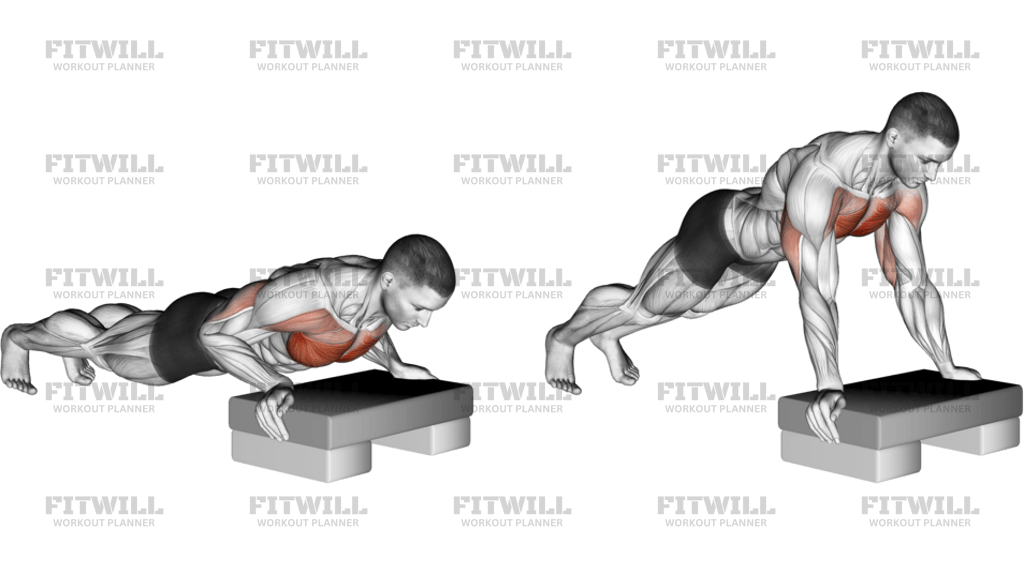
The image shows a rigid plank from head to heels with the hands on a raised surface and the chest lowering between the arms. That setup matters because the exercise works best when the torso stays braced and the shoulders, elbows, and wrists stay stacked over the support. When the body sags, the rep turns into a low-back exercise instead of a clean press. A stable incline lets you keep pressure through the palms and keep the line of force organized.
Mechanically, the main work goes to the Pectoralis major, with assistance from the Anterior deltoid, Triceps brachii, and Rectus abdominis. The incline changes the leverage so the chest and triceps can produce force through a full pressing path without demanding the same relative strength as a floor push-up. That makes it valuable for building pressing capacity, improving push-up mechanics, and adding controlled upper-body volume without needing external weight.
Quality reps start with the setup: hands shoulder-width or slightly wider, feet set back, and the body long and tight before the first descent. Lower under control until the chest approaches the bench or your chosen depth, then press the floor away and return to a straight-arm lockout without losing the plank. If the elbows flare hard, the hips drop, or the shoulders shrug toward the ears, the incline is probably too low or the set is too hard.
Use this exercise when you want horizontal pressing with a reduced load and clear movement feedback. It is especially useful for building confidence before standard push-ups, for high-rep chest work in a body-weight session, or for keeping pressing volume in a joint-friendly range. Keep the setup consistent from rep to rep, breathe steadily, and choose an incline height that lets you control both the lowering phase and the press back to the top.
[ Workout Log & Planner ]
Put your next workout in Fitwill
Keep your plan and training log ready when you are.


Instructions
- Place your hands on a stable bench, box, or platform slightly wider than shoulder width.
- Walk your feet back until your body forms a straight line from head to heels.
- Brace your abs and glutes so your hips do not sag before the first rep.
- Start with your elbows soft, wrists stacked under your shoulders, and your neck long.
- Lower your chest toward the edge of the bench by bending the elbows under control.
- Keep your torso rigid and let the chest travel between the hands as you descend.
- Stop when your chest is near the platform or when your shoulders begin to lose position.
- Press through your palms to return to full elbow extension without locking out harshly.
- Exhale as you press up and inhale as you lower for the next repetition.
- Reset your plank before each rep if your hips or shoulders drift out of line.
Tips & Tricks
- Raise the hands higher if you cannot keep the chest and thighs moving together through the whole rep.
- Keep the elbows about 30 to 45 degrees from the torso instead of flaring them straight out.
- Think about lowering your chest to the bench, not dropping your hips toward the floor.
- Screw the hands lightly into the surface to help the shoulders stay packed and stable.
- Choose an incline that lets you own the eccentric phase instead of bouncing off the bottom.
- Keep pressure through the big toe line and heels so the plank stays active from feet to shoulders.
- If your shoulders roll forward at lockout, shorten the range and press with better scapular control.
- Use a slower descent if you want more chest tension and cleaner body alignment.
Frequently Asked Questions
What muscle does Incline Push-Up target most?
The chest is the main target, especially the pectorals, with the triceps and front shoulders helping through the press.
Can beginners perform this exercise?
Yes. The elevated hand position makes it one of the easier push-up variations for building strength and control.
How high should the bench or box be?
Use a height that lets you keep a straight plank and controlled chest-to-support depth. A higher surface is easier; a lower one is harder.
Should my chest touch the bench on every rep?
Only lower as far as you can while keeping the ribs down, the hips level, and the shoulders in good position. Touching is fine if it does not break form.
Why do my hips sag during the rep?
The incline may still be too challenging, or your brace is fading. Set your feet farther back, tighten the glutes, or use a higher support.
What should my elbows do on the way down?
Let them bend naturally at a moderate angle instead of flaring straight out. That keeps stress on the chest and shoulders more organized.
Is this just a beginner version of a push-up?
It is a regression for beginners, but it is also useful for volume, warm-ups, tempo work, and controlled chest training.
How can I make Incline Push-Up harder?
Lower the hand support, slow the descent, add a pause near the bottom, or move toward a flat floor push-up.