Lying Prone W
Lying Prone W is a floor-based shoulder and upper-back drill done while lying face down with the arms bent into a W shape. It is commonly used to train scapular control, rear-shoulder engagement, and the ability to hold the shoulder blades back and down without shrugging or arching the low back. The movement is small on purpose: the point is not to heave the torso off the floor, but to create clean tension through the upper back and shoulders.
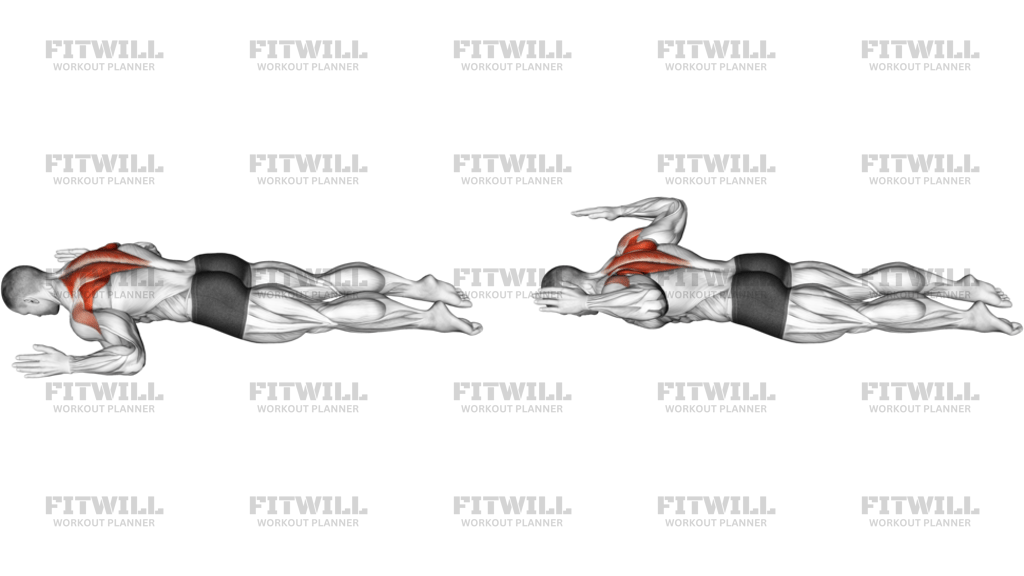
The image shows a classic prone W position, where the elbows stay bent and the upper arms angle away from the torso while the forearms and hands form the wide W shape. That setup matters because it puts the shoulders in an externally rotated, retracted position that asks the mid-back, lower traps, and posterior shoulder to work together. If the elbows drift too far forward or the ribcage pops up, the exercise stops being a controlled upper-back drill and turns into a back-extension cheat.
Use this exercise when you want better postural strength, better shoulder positioning, or a low-load accessory movement that teaches the upper back to stay organized. It fits well in warm-ups, activation work, or accessory blocks for pressing, pulling, overhead work, or shoulder health sessions. Because the resistance is body weight, the value comes from precision: a steady neck, quiet torso, and a deliberate squeeze between the shoulder blades.
Each rep should feel like a short, controlled lift and lower, not a swing. Start with the chest and pelvis anchored to the floor, then raise the arms only as far as you can without losing the W shape. Keep the neck long, keep the chin slightly tucked, and avoid dumping tension into the lower back. A brief pause at the top helps reinforce the position and makes the working muscles do the job instead of momentum.
This is a good exercise for beginners if the range stays small and the shoulders feel smooth. It is also useful for experienced lifters who need cleaner scapular mechanics or more endurance in the rear shoulder and mid-back. If you feel pinching in the front of the shoulder, shrugging in the upper traps, or excessive low-back compression, reduce the range and focus on the setup before adding more repetitions.
[ Workout Log & Planner ]
Put your next workout in Fitwill
Keep your plan and training log ready when you are.


Instructions
- Lie face down on the floor with your forehead hovering just above the ground, legs long, and your arms bent so your elbows point out from your sides in a W shape.
- Rest the fronts of your upper arms and hands lightly on the floor to start, with your chest, pelvis, and ribs staying down and your neck in a long neutral line.
- Pull your shoulder blades gently back and down before you lift, and keep your elbows bent roughly 90 degrees instead of letting them flare or slide forward.
- Exhale and lift your elbows, hands, and upper arms a few inches off the floor while keeping the W shape intact.
- Squeeze through the mid-back and rear shoulders at the top without shrugging or arching your lower back.
- Hold the top position briefly, then lower with control until the arms lightly touch down again.
- Keep the chest and hips pinned to the floor as you repeat each rep, and let the neck stay relaxed instead of craning forward.
- Finish the set by setting the arms back down softly and fully relaxing the shoulders before the next round.
Tips & Tricks
- Keep the elbows bent and the forearms angled into a true W; if the arms straighten too much, the movement turns into a different raise.
- Think about sliding the shoulder blades into your back pockets before you lift so the upper traps do not take over.
- Lift only a small distance off the floor; the rep is better when it is clean and low than when it is high and sloppy.
- Keep the ribs heavy against the floor so the low back does not arch to fake extra range.
- If your hands float up but your elbows stay glued down, you are losing the intended shoulder action, so match the lift through the whole arm position.
- Use a slow lower because the return phase is where many people lose the W shape and let the shoulders roll forward.
- Keep your chin slightly tucked and your forehead near the floor so neck tension does not creep into the set.
- Choose reps that leave the rear shoulders and mid-back working hard before fatigue starts changing the arm angle.
Frequently Asked Questions
What does the prone W mainly train?
It mainly trains the upper back and posterior shoulder muscles that help you hold the shoulders back and down.
Why are my arms bent into a W shape?
That elbow angle puts the shoulders in a position that emphasizes scapular control and external rotation instead of a straight-arm raise.
Should my chest come off the floor?
No. Keep the chest and pelvis anchored and let the arms do the work so you do not turn it into a low-back extension.
Where should I feel the exercise?
You should feel it between the shoulder blades, across the rear shoulders, and through the upper back rather than in the neck.
Can I do this if I have shoulder pain?
Only if the position feels smooth and pain-free. Reduce the range or skip it if the front of the shoulder feels pinched.
Is this a strength move or an activation drill?
It can be used as either. Most people use it as a light accessory, warm-up, or posture-focused drill.
How high should I lift my arms?
Only a few inches. If you need a big lift to feel it, the setup or tension is usually off.
What is the biggest mistake with prone W raises?
Shrugging, arching the lower back, and losing the W shape are the most common form breakdowns.