Rear Lunge From Deficit
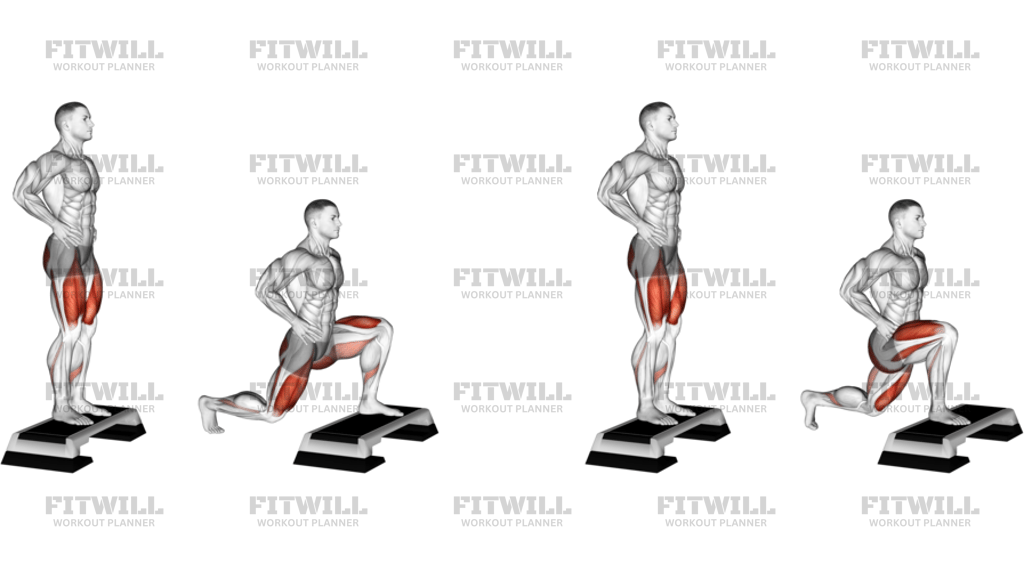
Rear Lunge From Deficit is a bodyweight lower-body exercise performed with the front foot on a low raised step so the back leg can travel farther behind the body. That added drop increases the range of motion at the front hip and knee, which makes the movement useful for building single-leg strength, balance, and control without needing external load. It is especially effective when you want a simple drill that still challenges the glutes and quads hard.
The main training emphasis is on the front leg. The gluteus maximus and quadriceps do most of the work as you descend and stand back up, while the hamstrings, adductors, calves, and trunk muscles help keep the pelvis level and the torso steady. Because the front foot stays elevated, the exercise also asks for good ankle mobility and clean knee tracking over the toes. If the platform is too high, the movement quickly turns into a balance problem instead of a strength drill.
Set the step low and stable, then stand tall with the whole front foot planted on top and the rear leg free to step back and down. Lower under control until the rear knee approaches the floor and the front thigh moves through a deeper range than it would on flat ground. Keep the front heel down, the chest tall, and the knee tracking in line with the second and third toes so the load stays where it belongs. On the way up, drive through the front foot and stand without bouncing off the back leg.
This is a good accessory exercise for glute-focused sessions, unilateral leg training, warm-ups that need a controlled hip opener, or conditioning blocks that still need good mechanics. It works well for beginners if the step is low and the rep speed stays deliberate. It becomes much more demanding when the deficit is high or when the body starts rotating, collapsing inward, or pushing off the rear foot to cheat the rep. Keep the range honest and the setup consistent from side to side.
[ Workout Log & Planner ]
Put your next workout in Fitwill
Keep your plan and training log ready when you are.


Instructions
- Place one foot on a low, stable step or platform and stand tall with the rear foot on the floor behind you.
- Set the front foot fully on the platform, keep the heel down, and square your hips before you move.
- Brace your torso and step the rear leg back and down until the back knee approaches the floor.
- Keep the front knee tracking over the second and third toes instead of collapsing inward.
- Let the front leg control the descent; do not push off the rear foot to get back up.
- Press through the front heel and midfoot to stand back to the start position.
- Inhale on the way down and exhale as you drive back up through the front leg.
- Finish the rep balanced on top of the step and reset before starting the next rep.
Tips & Tricks
- Start with a low step, because a big deficit makes the front knee and hip work much harder and can expose balance issues fast.
- Keep the entire front foot on the platform; letting the heel drift off the edge makes the rep unstable and shifts pressure into the toes.
- Lower straight down instead of reaching far back with the stepping leg, so the front leg still carries most of the load.
- Keep the chest proud but not arched; if your ribs flare up, the torso is doing the work instead of the front hip.
- Aim the rear knee toward the floor, not forward into the step, so the lunge stays long and controlled.
- Do not bounce off the back knee or the floor at the bottom; pause briefly if you need to own the position.
- If the front knee caves in, shorten the range or reduce the step height before adding more reps.
- Use slow descents and smooth stands, because this drill is about single-leg control more than speed.
Frequently Asked Questions
What muscles does Rear Lunge From Deficit work most?
The front leg does most of the work, so the glutes and quadriceps are the main targets. The hamstrings, adductors, calves, and core help with balance and control.
Can beginners perform this exercise?
Yes, if the step is low and the movement stays slow. Beginners should keep the range comfortable and avoid turning it into a balance drill.
How high should the deficit be?
Low is better. A small step is enough to increase range and challenge the front leg without forcing the pelvis to twist or the back knee to crash down.
Should my rear knee touch the floor?
It does not need to slam down. Let it approach the floor under control, and only make light contact if that still lets you keep the front foot planted and the torso steady.
Why is the front foot elevated?
The raised front foot increases the range of motion at the hip and knee, which makes the front leg work harder through the lowering and standing phases.
What is the biggest form mistake?
Letting the back leg push you out of the bottom. The front leg should control the rep, and the rear leg should only act as a light balance assist.
Where should I feel the exercise?
You should feel it mostly in the front glute, front quad, and upper hip as the body lowers and stands. The rear leg should not take over the set.
Can I add weights to this movement?
Yes, but only after you can keep the front foot flat, the hips square, and the descent smooth on body weight alone.