Roll Kneeling Upper Back Rotation
Roll Kneeling Upper Back Rotation is a kneeling thoracic mobility drill that opens the upper back while asking the shoulders and trunk to stay organized. One forearm rests on the roller while the other hand supports you on the floor, so the movement is guided instead of forced. That setup makes it useful for loosening stiff upper backs before pressing, overhead work, or any session where you want better rotation without adding much fatigue.
The exercise is aimed at clean upper-back rotation, not at cranking through the lower back. As the chest turns, the ribs and shoulder girdle should move together while the hips stay stacked over the knees. The roller gives the supporting arm a stable track and helps you feel where the rotation is coming from, which is especially helpful if your thoracic spine tends to feel rigid or your shoulders stay closed in the front.
The quality of the setup matters more than how far you twist. Start in a strong kneeling position, place the elbow and forearm comfortably on the roller, and keep the other hand planted under the shoulder for balance. From there, rotate slowly through the upper back, exhale as you open, and return under control so the rep stays smooth and repeatable. If the pelvis starts drifting or the low back starts doing the work, the range is too big.
This drill fits well in a warm-up, recovery block, or accessory circuit when you want a controlled rotation pattern for the upper back, shoulders, and core. It can help prepare the torso for bench pressing, rowing, throwing, or overhead positions by improving how the rib cage and shoulder blade move together. Because the load is light, the value comes from precision: the more exact the position, the more useful each rep becomes.
Treat Roll Kneeling Upper Back Rotation like a quality check for your torso. Keep the neck long, avoid shrugging into the floor hand, and let the roller support the motion instead of sliding around on it. A smaller, slower rotation that stays in the upper back is better than a larger twist that steals motion from the low back or lets the shoulders collapse forward.
Fitwill
Log Workouts, Track Progress & Build Strength.
Achieve more with Fitwill: explore over 9600 exercises with images and videos, access built-in and custom workouts, perfect for both gym and home sessions, and see real results.
Start your journey. Download today!




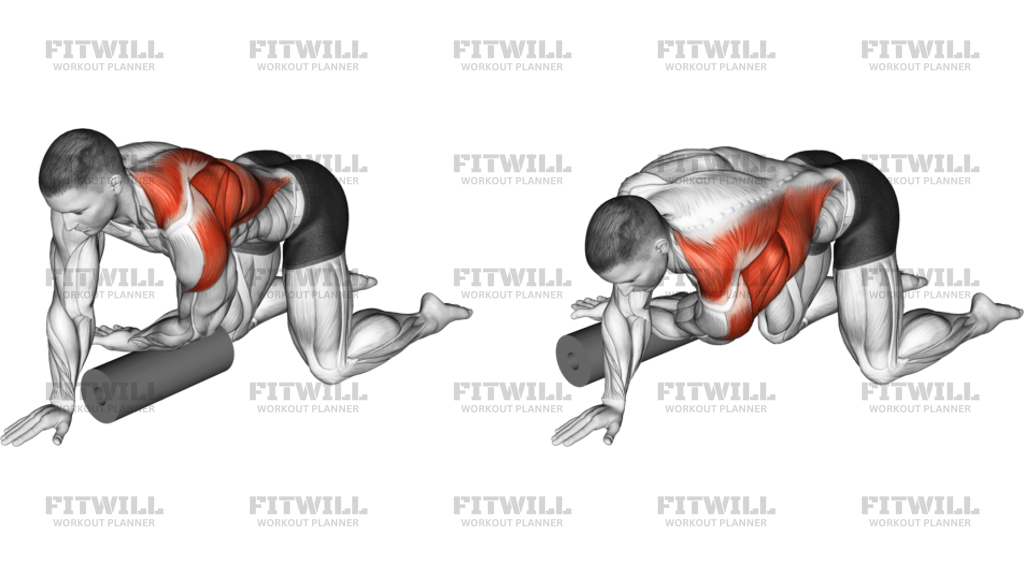
Instructions
- Kneel on the floor with one forearm resting on the roller and the opposite hand planted under the shoulder for support.
- Stack your hips over your knees, keep your shins on the floor, and set the chest long without arching the low back.
- Let the roller sit under the forearm and elbow so the supporting arm can guide the motion instead of collapsing inward.
- Brace lightly through the ribs, then begin the rotation by turning the upper back and chest as a single unit.
- Open as far as you can without shifting the hips or letting the pelvis twist away from the floor.
- Exhale as you rotate open, then inhale as you return the chest back toward the floor under control.
- Keep pressure light through both hands so the shoulders stay active and the neck remains long.
- Repeat for the planned reps, then reset and switch sides if your program calls for both directions.
Tips & Tricks
- Keep the hips directly over the knees; if they slide back, the stretch turns into a hip shift instead of an upper-back rotation.
- Rotate through the ribs and sternum, not by yanking the lower back sideways.
- A smaller opening is better if the shoulder on the roller side feels pinched or unstable.
- Press gently into the floor hand so the neck does not jut forward or shrug toward the ear.
- Use the roller as a support, not as a lever to throw your torso open.
- If the floor hand bothers your wrist, make a fist or use a handle while keeping the same shoulder position.
- Slow exhalations usually help the chest open without forcing the movement.
- Stop the set if the motion starts to look like a hurried twist instead of a controlled thoracic rotation.
Frequently Asked Questions
What does Roll Kneeling Upper Back Rotation work?
It mainly targets thoracic rotation in the upper back while the shoulders, obliques, and deep trunk muscles help keep you organized.
Is Roll Kneeling Upper Back Rotation a stretch or a strength exercise?
It is mostly a mobility drill, but the supporting arm and trunk still have to work to keep the position controlled.
What should I feel during Roll Kneeling Upper Back Rotation?
You should feel the upper back, side ribs, and rear shoulder opening, not a sharp twist in the lower back.
Why is one forearm on the roller?
The roller supports the arm and gives you a smooth surface to rotate against, which helps keep the movement deliberate and repeatable.
Should my hips move in Roll Kneeling Upper Back Rotation?
They should stay mostly stacked over the knees. A little shift is fine, but the rotation should come primarily from the rib cage and upper back.
Can beginners do this exercise?
Yes. Start with a small range and slow breathing so you can learn the position before trying to open farther.
What if the roller side of my shoulder feels pinched?
Reduce the rotation angle, keep a little more bend in the elbow, or use a thinner roller so the shoulder does not close down at the front.
What can I use instead of Roll Kneeling Upper Back Rotation?
Thread-the-needle, open books, or quadruped thoracic rotations are good substitutes if you want a similar upper-back rotation pattern.