Weighted Plate Overhead March
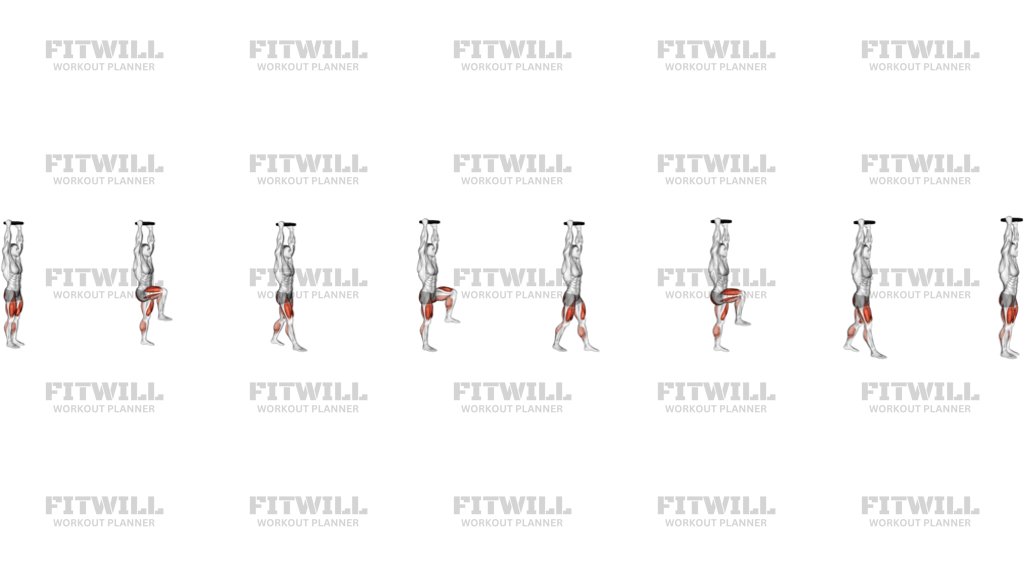
Weighted Plate Overhead March is a standing stability drill built around holding a load overhead while you alternate marching one knee at a time. It looks simple, but the exercise asks for a lot at once: steady shoulders, stacked ribs and pelvis, balanced foot pressure, and enough trunk control to keep the torso from tipping as each leg leaves the floor. That is why the setup matters as much as the march itself.
The movement trains glutes, hamstrings, core, and the muscles that keep the shoulders locked into a stable overhead position. In anatomy terms, the main work centers on the Gluteus maximus, with help from the Biceps femoris, Rectus abdominis, and Erector spinae. The overhead hold also challenges the shoulders and upper back to stay active so the plate does not drift forward or behind the head.
Start by standing tall with the feet about hip-width apart and the plate held directly above the crown of the head. The elbows should stay extended without letting the shoulders shrug toward the ears. From there, lift one knee only as high as you can without leaning back, twisting, or losing the ribs-down position. The supporting leg should stay rooted and quiet while the marching leg does the work.
The best reps are slow and even. Each lift should feel like a controlled balance transfer rather than a bounce or a hop. When one foot returns to the floor, reset the stance before switching sides. Breathing should stay smooth and deliberate, with a firm exhale as the knee rises so the torso does not flare open under the overhead load.
Weighted Plate Overhead March is useful in warm-ups, core circuits, athletic prep, and accessory work when you want to build better posture under load. It is also a practical way to expose weaknesses in shoulder stability or pelvic control without needing a heavy load. Keep the weight light enough that the plate stays centered overhead and the march stays crisp; if you have to arch, sway, or rush the steps, the load is too heavy.
Fitwill
Log Workouts, Track Progress & Build Strength.
Achieve more with Fitwill: explore over 9600 exercises with images and videos, access built-in and custom workouts, perfect for both gym and home sessions, and see real results.
Start your journey. Download today!




Instructions
- Stand tall with your feet about hip-width apart and hold the plate directly overhead with both arms straight.
- Set your ribs over your pelvis, keep your chin level, and press the plate slightly upward so the shoulders stay active.
- Fix your gaze straight ahead and keep most of your weight through the middle of each foot before you start marching.
- Lift one knee to about hip height without leaning back, twisting, or letting the standing hip collapse.
- Lower that foot quietly to the floor and re-center your stance before the next march.
- Alternate legs in a steady rhythm while keeping the plate stacked over the shoulders the entire time.
- Exhale as each knee rises and inhale as the foot returns to the floor.
- Finish the set by bringing the plate down under control once your posture starts to fade.
Tips & Tricks
- Choose a plate you can hold overhead without elbow bend or a shrugging upper trap.
- Keep the plate centered over the midfoot; if it drifts forward, the lower back will usually arch to save the rep.
- March slowly enough that each foot lands softly instead of slapping the floor.
- If the torso rocks side to side, shorten the knee lift before adding more load.
- Keep the stance leg active so the hip does not sink when the other knee rises.
- Think about lifting the knee from the hip, not swinging it from the foot.
- Stop the set when the overhead position starts to wobble or the ribs pop up.
- A light load with clean marching mechanics is more useful here than a heavier plate with sloppy posture.
Frequently Asked Questions
What muscle does Weighted Plate Overhead March target most?
The glutes and trunk do most of the stabilizing work, with the shoulders and upper back keeping the plate fixed overhead.
Can beginners perform this exercise?
Yes, beginners can use a very light plate or even an unloaded plate and focus on staying tall while they march.
How high should I lift my knees during the march?
Lift the knee only as high as you can without leaning back or losing the plate position overhead; hip height is usually enough.
Should my elbows stay locked out overhead?
They should stay long and active, but not painfully jammed; think reach up through the plate without shrugging.
What is the biggest form mistake with this exercise?
The most common error is arching the lower back or swaying the torso to help the knee come up.
Where should I feel the work during the march?
You should feel the stance glute, deep core, and overhead stabilizers working to keep the body stacked and steady.
What should I do if the plate drifts forward?
Lower the load, reset the ribs under the pelvis, and press the plate back over the middle of the head before continuing.
Can I use this as a warm-up?
Yes, it works well in a warm-up or core block because it teaches bracing, balance, and overhead control at the same time.