Lying Prone Y
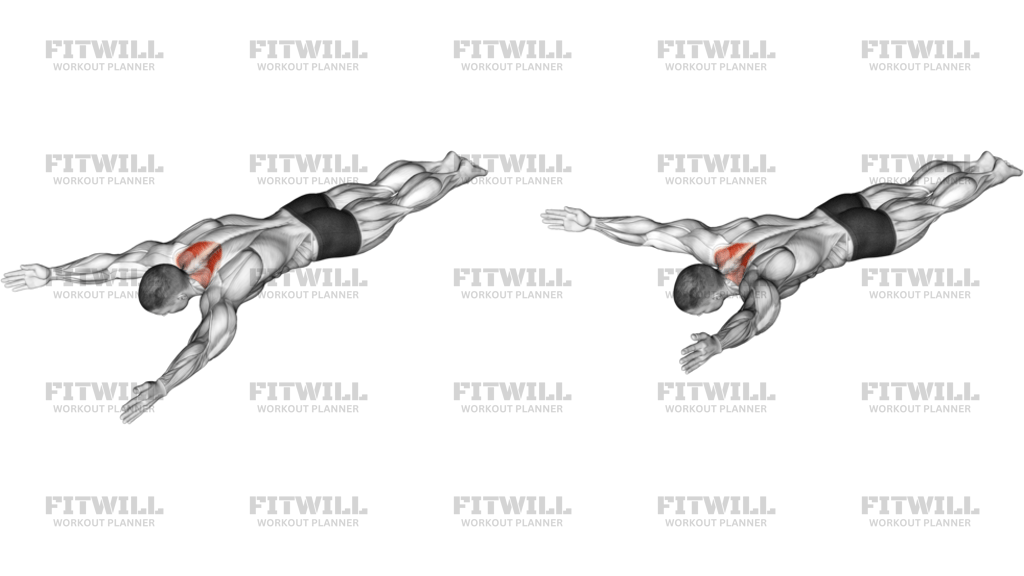
Lying Prone Y is a floor-based prone raise that trains the upper back and shoulder complex through a very specific arm path. You lie face down and lift the arms into a Y shape, which makes the exercise useful when you want better scapular control, cleaner overhead mechanics, or more tolerance in the lower traps and rear shoulder area without heavy loading.
The movement looks simple, but the setup decides whether the work stays where it should. In Lying Prone Y, the chest stays anchored to the floor, the neck stays long, and the arms travel in a wide Y instead of drifting into a shrug or a straight lateral raise. That position biases the muscles that help pull the shoulder blades down and upwardly rotate them with control.
Because the load is just body weight, the exercise is usually chosen for warm-ups, accessory work, rehab-style training, or as a finisher after pressing and pulling. It is especially useful for lifters who need better shoulder positioning on overhead work, benching, swimming, throwing, or any movement where the upper back has to stabilize the arm without the ribs flaring up.
A good repetition starts from a quiet torso. You press the hips and ribs into the floor, then lift the arms only as high as you can without arching the lower back or jamming the neck forward. The goal is a clean arc with the thumbs, elbows, and wrists staying organized so the shoulder blades can move smoothly instead of getting pinned or shrugged.
Lying Prone Y is not a max-strength lift, but it rewards precision. Use it when you want crisp repetitions, not speed, and stop the set when the shoulders start to creep toward the ears or the lower back takes over. Done well, it teaches the body how to lift the arms overhead from a stable trunk and a more disciplined shoulder blade position.
[ Workout Log & Planner ]
Put your next workout in Fitwill
Keep your plan and training log ready when you are.


Instructions
- Lie face down on the floor with your legs long behind you, forehead hovering just above the ground, and your arms reaching overhead in a wide Y.
- Turn your thumbs slightly up or forward and let your elbows stay straight without locking them hard.
- Press your hips, ribs, and lower abdomen gently into the floor so your low back stays quiet before you lift.
- Reach both arms away from the floor in a smooth arc, lifting from the shoulders instead of shrugging your neck.
- Raise until your hands are just off the floor or as high as you can without arching your back or losing the Y shape.
- Pause for a brief squeeze at the top and keep the shoulder blades moving down and around the rib cage.
- Lower the arms under control back to the floor, keeping tension through the upper back instead of dropping the hands.
- Exhale as you lift, inhale as you lower, and reset your forehead and ribs before the next repetition.
Tips & Tricks
- Keep the Y narrow enough that the arms stay slightly in front of the shoulders; if the shape turns into a T, the lower trap work usually drops off.
- If your neck tightens first, lower the arms less and think about sliding the shoulder blades down rather than lifting the hands higher.
- A small forehead towel or folded mat can help you keep the cervical spine neutral instead of craning to look forward.
- Do not let the ribs pop off the floor to fake extra range; the chest should stay grounded through the whole rep.
- Slow the lowering phase until the hands almost settle, then start the next rep without bouncing off the floor.
- Thumbs-up or slightly externally rotated hands usually feel better than palms-down for most shoulders.
- If the low back arches before the shoulders fatigue, shorten the range and keep the squeeze at the top smaller.
- Treat this as a precision drill and stop the set when the shoulder blades start shrugging toward the ears.
- For a tougher version, hold the top position for a second or two instead of adding speed or momentum.
Frequently Asked Questions
What muscles does Lying Prone Y train most?
It mainly hits the upper back and shoulder stabilizers, especially the lower traps and the muscles that control the shoulder blades during overhead arm movement.
Is Lying Prone Y a good beginner exercise?
Yes, because it uses body weight and teaches shoulder control without heavy loading. Beginners should keep the range small and focus on a smooth lift rather than height.
Should my chest stay on the floor during Lying Prone Y?
Yes. Keeping the chest and ribs grounded prevents the lower back from taking over and keeps the work in the upper back and shoulders.
Why do my shoulders shrug up during Lying Prone Y?
That usually means the range is too high or the neck is tense. Lower the arms only as far as you can while keeping the shoulder blades moving down and away from the ears.
Do I need weights for Lying Prone Y?
No. The floor version is meant to be a body-weight control drill, although very light hand weights or plates can be added later if the form stays clean.
What is the best hand position for Lying Prone Y?
A thumbs-up or slightly externally rotated position usually feels best and keeps the shoulders happier than forcing the palms flat down.
Where should I feel Lying Prone Y working?
You should feel it between and below the shoulder blades, with some work in the rear shoulders. If you feel it mostly in the lower back, the range is too big.
Can Lying Prone Y help with overhead pressing or posture?
Yes. It is commonly used to improve scapular control and upper-back endurance, which can support cleaner overhead pressing and better shoulder mechanics.