Prone Y Raise
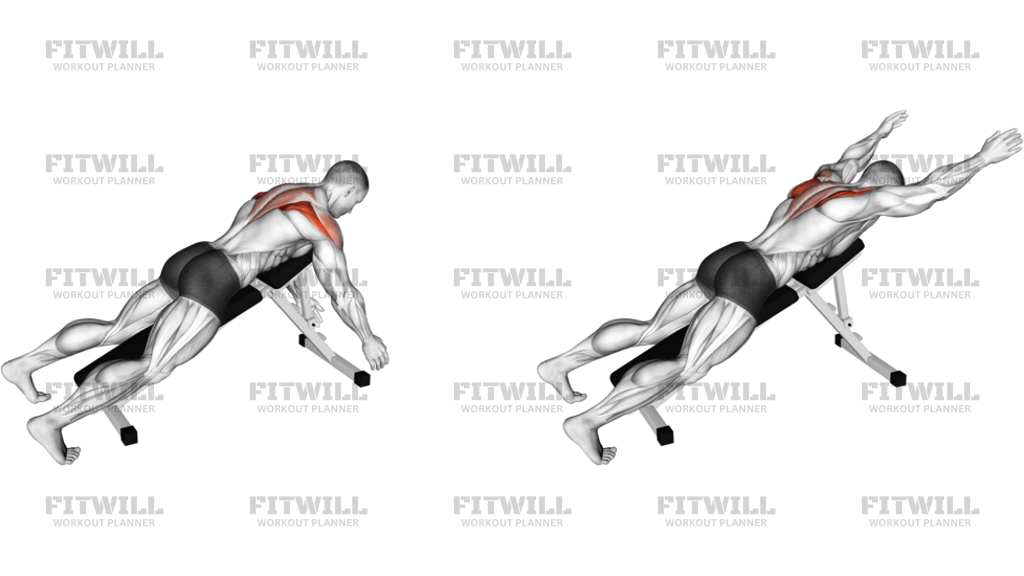
Prone Y Raise is a chest-supported upper-back and shoulder control exercise performed face down on an incline bench with the arms reaching overhead in a Y shape. It trains the lower traps, rear delts, rotator cuff, and the small stabilizers that keep the shoulder blades moving cleanly. Because the lever arm is long and the range is small, the movement depends more on position and control than on load.
The bench angle matters because it lets the rib cage stay supported while the shoulders do the work. With the chest anchored to the pad, you can raise the arms without turning the set into a lower-back extension or a momentum-driven swing. That makes the exercise useful for shoulder health, postural work, warm-ups before pressing or pulling, and accessory training when you want precise scapular control rather than heavy output.
A good repetition starts with the ribs staying down, the neck long, and the hands reaching away from the body before the shoulders lift. From there, the arms travel in a Y path overhead until they are roughly in line with the ears, or only as high as you can keep the shoulder blades stable. The goal is not to shrug hard at the top; it is to upwardly rotate and elevate the arms without losing the chest support or craning the neck.
Use slow, repeatable reps and treat the lowering phase as part of the exercise, not just the reset. This movement is often best with body weight only or very light resistance, because the limiting factor is usually shoulder position and scapular control. If the lower back arches, the traps take over aggressively, or the arms drift into a wide T shape, the set has usually become too heavy or too fast. Keep the motion crisp, pain-free, and symmetrical from side to side.
[ Workout Log & Planner ]
Put your next workout in Fitwill
Keep your plan and training log ready when you are.


Instructions
- Set an incline bench at a moderate angle and lie chest-down with your sternum supported near the top pad.
- Let your arms hang straight toward the floor, legs long behind you, and keep your neck in line with your spine.
- Turn your thumbs slightly up or keep your palms facing each other so the shoulders stay in a comfortable external rotation.
- Brace your abs and keep your ribs heavy against the bench before the first rep.
- Lift both arms in a wide Y path, leading with the hands and keeping the elbows almost straight.
- Raise until the arms are in line with your ears or until your shoulders start to shrug and lose position.
- Pause briefly at the top while keeping the chest on the pad and the neck relaxed.
- Lower the arms slowly back to the start under control without letting the shoulders dump forward.
- Repeat for the planned reps, keeping each rep symmetrical and smooth.
Tips & Tricks
- Use a very light load or no load at all; this movement gets sloppy fast once the shoulders start compensating.
- Keep the chest glued to the bench so the rep comes from the shoulders and upper back, not from a back arch.
- Think about reaching long through the fingertips instead of just lifting the hands higher.
- If the upper traps dominate, stop the set a little earlier and reduce the range before the shrug takes over.
- Keep the thumbs up or slightly turned out to give the shoulders room and avoid an internally rotated front-delt position.
- Move slowly enough that you can feel the shoulder blades glide rather than jerk.
- Exhale as the arms rise and inhale as they lower to keep the torso from bracing so hard that it pops off the pad.
- Use a smaller Y angle if your shoulders are tight; forcing the arms too far overhead usually changes the exercise into a shrug.
- Stop if you feel pinching at the front of the shoulder, especially near the top of the rep.
Frequently Asked Questions
What muscles does the prone Y raise work most?
It mainly targets the lower traps and rear delts, with the rotator cuff and other scapular stabilizers helping control the lift.
Can beginners perform this exercise?
Yes. Beginners usually do best with body weight only and a small range until they can keep the chest supported and the neck relaxed.
Should I keep my arms straight during the raise?
Keep the elbows almost straight, but not locked. A soft elbow helps you hold the Y shape without turning it into a row.
Why is the incline bench important here?
The chest support keeps the rib cage stable so the shoulders and upper back do the work instead of the lower back taking over.
How high should I lift the arms?
Lift until the arms line up with the ears or just before the shoulders shrug and the chest starts coming off the pad.
Is this more of a strength exercise or a shoulder health drill?
It can serve both purposes, but it is usually programmed as a low-load accessory or prehab-style movement rather than a heavy strength lift.
What is the most common mistake with the prone Y raise?
Shrugging hard, arching the lower back, or swinging the arms instead of keeping the torso anchored and the motion smooth.
Can I add weight to make it harder?
Yes, but only very lightly. If the added load changes the arm path or causes a shrug, it is too heavy for this exercise.