Dumbbell Banded Wall Sit
Dumbbell Banded Wall Sit is an isometric lower-body hold that builds quadriceps endurance, knee control, and trunk stiffness while the wall removes the need to balance the body. The dumbbells add external load at the sides, and the band above the knees gives you an immediate cue to keep the thighs active and the knees tracking in line with the toes. It is a simple exercise on paper, but the setup determines whether the load stays on the quads or leaks into the low back, hips, and feet.
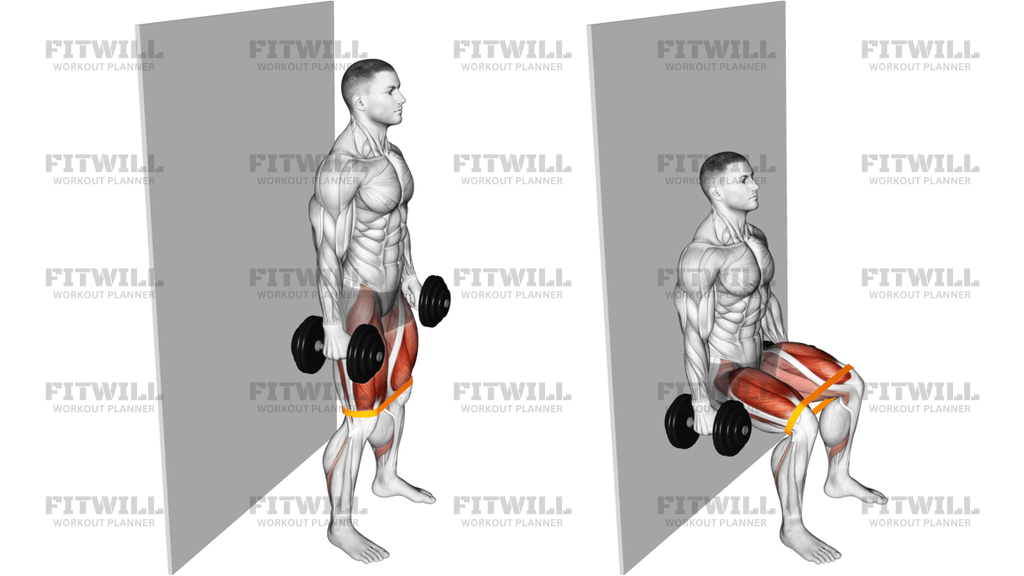
In the image, the athlete is backed into the wall with the feet stepped forward, knees bent to roughly a seated position, arms long at the sides, and the band resting above the knees. That setup matters because the torso should stay stacked and quiet while the legs do the work. If the feet are too close to the wall, the knees can drift too far forward and the hold feels cramped. If the feet are too far away, the wall sit turns into a shallow hinge and the quads lose tension. The goal is a stable, pain-free angle where the thighs stay loaded and the heels remain rooted.
The band does not create the wall sit by itself. Its job is to keep the knees from collapsing inward and to remind you to maintain gentle outward pressure through the thighs. The dumbbells should hang still with straight arms rather than being braced against the legs. Keep the low back in contact with the wall, ribs down, and chin neutral. A strong wall sit is quiet from the waist up: no shrugging, no bouncing, no shifting side to side, and no resting the hands on the thighs.
This exercise is useful as accessory work, conditioning, or a finisher when you want a direct quad burn without repeated joint impact. It can also be a useful regression or preparation tool for sport positions that demand knee and hip isometrics. Choose a hold time and load that let you preserve position for the full set. If the knees start to cave, the feet drift, or the pelvis tucks hard under the body, shorten the hold or reduce the load and keep the rep quality high.
For most lifters, the best version is the one that keeps the thighs working while the wall and the band provide structure, not compensation. Stay patient with the hold, breathe through the brace, and come out of the position under control when the set is finished.
[ Workout Log & Planner ]
Put your next workout in Fitwill
Keep your plan and training log ready when you are.


Instructions
- Stand with your upper back and shoulders against a wall, step your feet forward, and place the band just above your knees before picking up the dumbbells.
- Slide down the wall until your hips and knees are near a 90-degree bend, or stop higher if that depth is more comfortable for your knees.
- Plant both feet flat about hip-width apart, with the knees tracking over the second and third toes instead of collapsing inward.
- Let the dumbbells hang straight at your sides with your palms facing in and your shoulders relaxed away from your ears.
- Press your low back gently into the wall, brace your trunk, and keep your ribs stacked over your pelvis.
- Push your knees slightly out into the band so the thighs stay active without forcing a wide stance.
- Hold the position for the planned time while breathing steadily and keeping your heels down.
- When the set is finished, drive through your feet and slide back up the wall under control.
Tips & Tricks
- Place the band above the knees, not around the shins, so it cues the thighs without changing the foot position.
- If your heels lift, move your feet a little farther from the wall before starting the hold.
- Choose a wall-sit depth that lets you keep the low back touching the wall instead of over-arching.
- Keep the dumbbells quiet at your sides; if you are gripping hard or shrugging, the load is probably too heavy.
- Use a timer rather than counting breaths or reps, because this is an isometric hold, not a repetition exercise.
- Think about pushing the floor away through the whole foot, especially the heel and mid-foot, to keep pressure on the quads.
- Let the knees travel in line with the toes instead of forcing them excessively outward against the band.
- End the set as soon as the knees cave, the pelvis tucks hard, or the torso starts to slide off the wall.
Frequently Asked Questions
What muscles does Dumbbell Banded Wall Sit train most?
It mainly targets the quadriceps, with the glutes, adductors, calves, and core working to keep the hold stable.
How do I know if my wall-sit depth is right?
You should be low enough to feel the quads working hard, but high enough to keep your low back on the wall and your heels planted.
Where should the band sit during this exercise?
Place it just above the knees so it helps cue knee alignment without pulling on the shins or feet.
Do the dumbbells change the movement pattern?
They do not change the wall-sit pattern, but they add load and make the hold much more demanding on the thighs and trunk.
Is this exercise beginner-friendly?
Yes, as long as you start with a shallow hold, light dumbbells, or even bodyweight only until you can keep the knees and back in position.
Why do my knees want to cave inward?
Fatigue, too much load, or too much depth can cause that. Keep gentle outward pressure into the band and shorten the hold if needed.
Should I rest my hands on my thighs?
No. Let the dumbbells hang at your sides so the legs do the work and you do not turn the hold into a partial support position.
How can I progress this wall sit over time?
Increase the hold time first, then add load, then lower the sit angle only if you can keep the same knee and pelvis position.