Cable Kneeling Hip Abduction
Cable Kneeling Hip Abduction is a cable-based outer-hip exercise that trains the glute medius, glute minimus, and the smaller stabilizers that keep the pelvis from shifting when one leg moves away from the body. It is useful when you want cleaner hip control for squats, lunges, step-ups, running, or any work that asks one side of the pelvis to stay level while the other leg moves. The cable gives steady tension through the whole arc, so the exercise rewards control more than load.
The setup matters because the body is already working against rotation before the leg moves. In Cable Kneeling Hip Abduction, you support yourself on the floor with the hands and one knee while the working leg is attached to the low pulley through the handle attachment. That position lets the cable pull the leg inward, and your job is to keep the torso quiet while the hip drives the motion. If the hips open or the low back takes over, the outer hip stops doing its share.
Start with the support knee directly under the hip, hands under the shoulders, and the spine long rather than arched. Keep the working knee slightly bent if that matches the setup shown, then move the leg out to the side from the hip without hiking the pelvis or swinging the foot. The best repetitions are smooth enough that the cable never jerks and your shoulders stay stacked over the hands.
At the top, the outer hip should feel like it has finished the job, not like the body has had to twist to create more range. Lower the leg slowly and let the cable bring it back toward center under control. Light to moderate resistance is usually enough here; if the pelvis rocks, the elbows unlock, or the motion turns into a kick, the load is too heavy or the range is too large.
Cable Kneeling Hip Abduction works well as an accessory lift, activation drill, or lower-body control exercise at the end of a session. It is also a good option for people who want direct hip work without standing balance demands. Keep the movement honest and repeatable, and the exercise becomes a clean way to build outer-hip strength and better single-leg mechanics.
[ Workout Log & Planner ]
Put your next workout in Fitwill
Keep your plan and training log ready when you are.


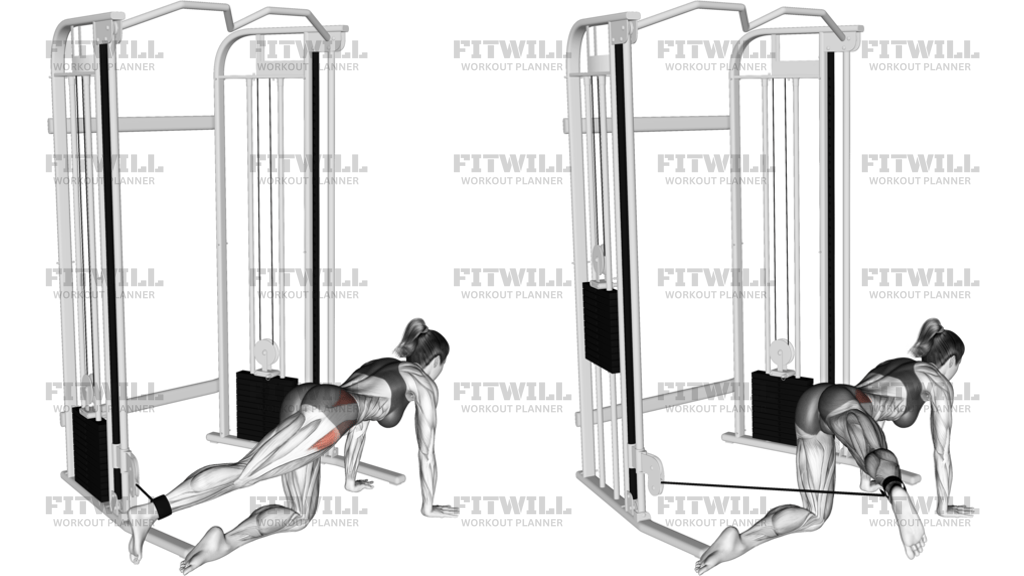
Instructions
- Set the low pulley beside the working leg and clip the handle attachment to the working ankle.
- Get on both hands and one knee, with the support knee under the hip and your hands under your shoulders.
- Square your hips to the floor and keep your spine long while the cable pulls the working leg toward the start position.
- Brace your midsection and keep your chest steady so the torso does not shift before the leg moves.
- Exhale as you drive the working leg out to the side from the hip, keeping the pelvis pointed down.
- Lift only until the outer hip stops moving cleanly or the low back wants to help.
- Pause briefly at the top, then lower the leg slowly and let the cable bring it back toward center.
- Reset your breath, repeat for the planned reps, and unclip the handle before standing up.
Tips & Tricks
- If the cable twists your pelvis before the leg leaves the floor, step a little farther from the stack or lower the load.
- Keep the support knee and both hands heavy on the floor so the torso does not drift toward the working side.
- A small bend in the working knee usually keeps Cable Kneeling Hip Abduction on the outer hip instead of turning it into a leg swing.
- Stop the lift when your hip starts to open; more height usually means more torso rotation, not more glute work.
- Lower for two to three seconds so the cable keeps tension on the side glute instead of snapping the leg back.
- If you feel the front of the hip or your low back more than the outer glute, shorten the range and keep the ribs down.
- Use light to moderate resistance here; Cable Kneeling Hip Abduction is more useful as a strict accessory than as a heavy strength lift.
- Keep the ankle attachment snug so the cable path stays clean and the handle does not wobble at the bottom of the rep.
Frequently Asked Questions
What muscles does Cable Kneeling Hip Abduction work?
It mainly trains the outer glutes and hip stabilizers, especially the glute medius and glute minimus. Your core and supporting shoulder on the floor also help keep the torso from twisting.
Is Cable Kneeling Hip Abduction good for beginners?
Yes, as long as the load stays light enough to keep your hips square and your torso still. The floor support makes it easier to learn than a standing cable abduction.
Where should I feel Cable Kneeling Hip Abduction?
You should feel it along the side of the glute and outer hip of the moving leg. If you feel it mostly in the low back or front of the hip, shorten the range and reduce the resistance.
Why does my pelvis twist during Cable Kneeling Hip Abduction?
That usually means the stack is too heavy or the leg is traveling too far. Back off the load and stop the rep before the hips start to open.
Should my working knee stay bent in Cable Kneeling Hip Abduction?
A slight bend is usually the cleanest setup because it keeps the movement focused on the hip instead of turning into a straight-leg kick. Use the bend that lets you keep the pelvis level.
How heavy should I go on Cable Kneeling Hip Abduction?
Light to moderate resistance is usually enough. If you cannot pause at the top and lower the leg slowly, the load is too high.
Can I use Cable Kneeling Hip Abduction before squats or running?
Yes. It works well as an activation or accessory drill when you want better hip stability before single-leg work, squats, or run training.
What is a good substitute if I do not have a cable machine?
A banded kneeling hip abduction or a side-lying hip abduction can train a similar outer-hip pattern. The feel will be different, but the control demand is close.