Dumbbell One Arm Front Raise
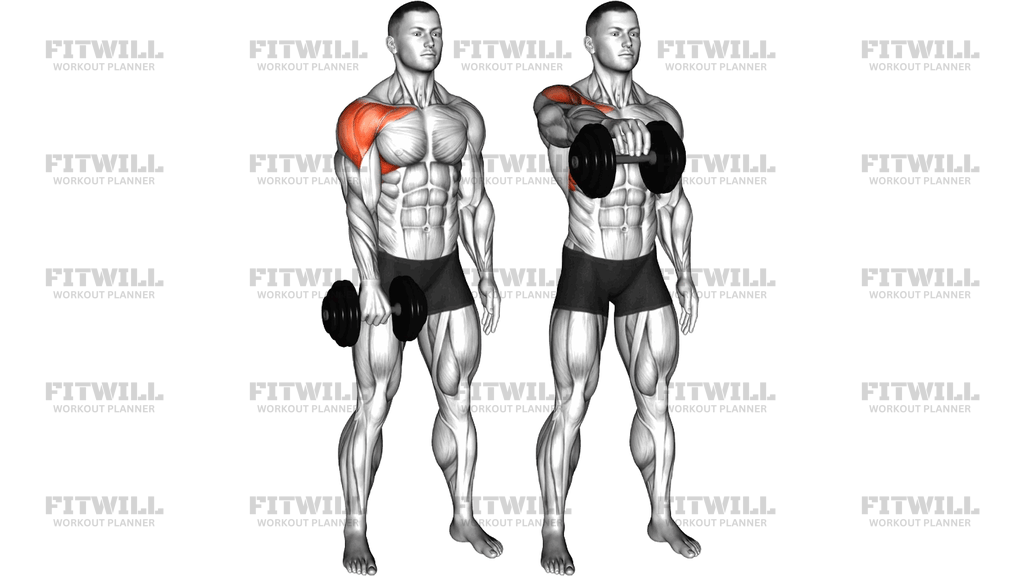
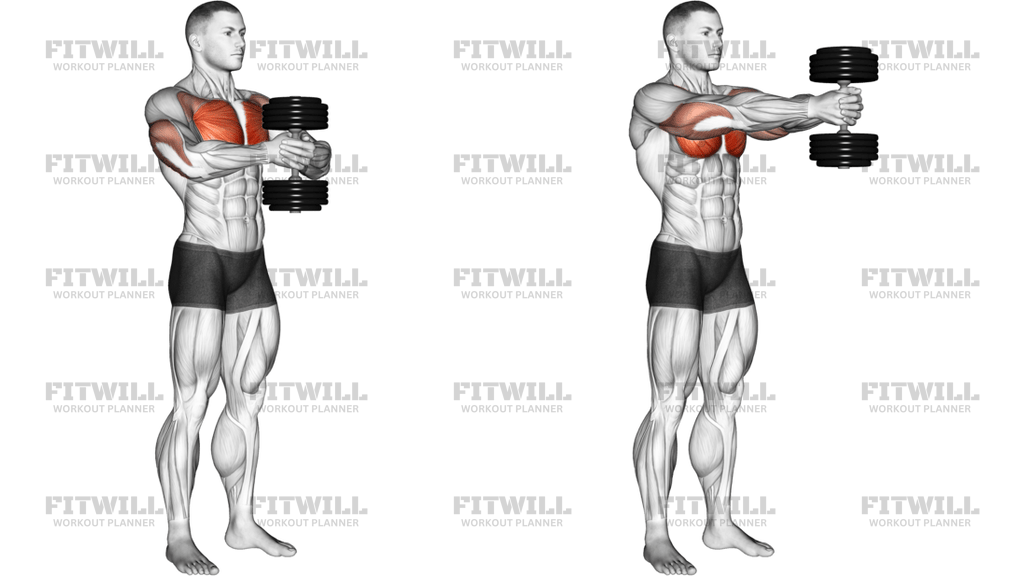
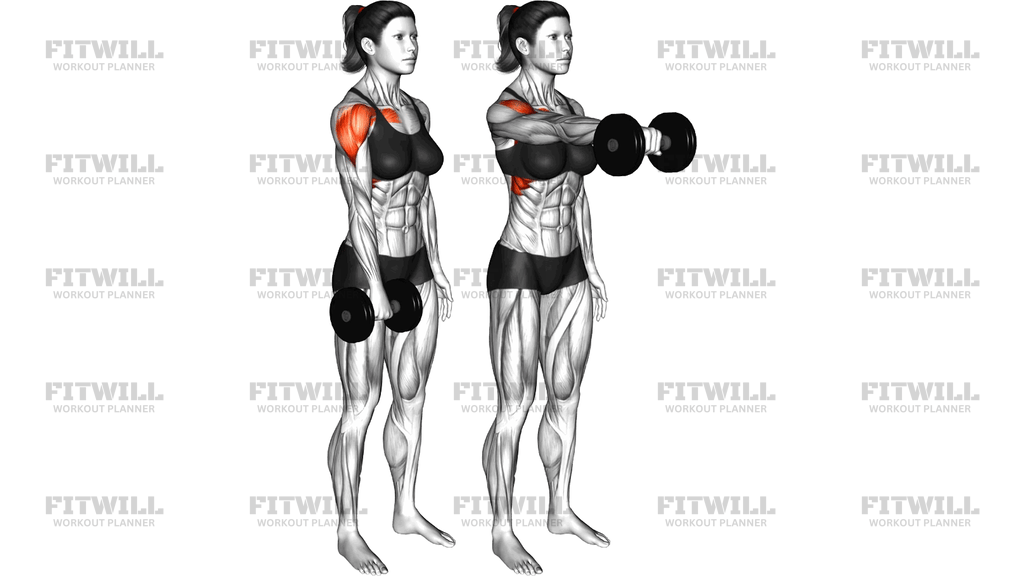
The Dumbbell One Arm Front Raise is a single-arm isolation movement performed standing, where you lift one dumbbell from your thigh straight out in front of your body to about shoulder height. Working one side at a time changes the exercise in a few useful ways: each shoulder has to do its own share of the work, your core has to resist the rotational pull of the off-center load, and you can concentrate fully on the feel of the working deltoid without one side masking weakness on the other.
The main muscle at work is the anterior deltoid, the front portion of the shoulder that lifts the arm forward. The clavicular head of the chest assists in the early portion of the lift, the upper traps help control the arm at the top, and the forearm and grip muscles hold the dumbbell steady throughout. Because this is a true isolation exercise, the weight used will be modest, and that is by design.
This movement suits lifters who want to bring up the front of their shoulders, people addressing a side-to-side imbalance from sports or one-sided carrying habits, and anyone building a shoulder session with raises from multiple angles. It also fits well late in a pressing workout, when the delts are pre-fatigued and a light, focused set of raises is more productive than another heavy press.
Setup matters more than it looks. Stand tall with feet about hip-width apart, hold the dumbbell in one hand at your side with a neutral grip, and keep the non-working arm relaxed at your side or braced lightly against your body for balance. Your torso position determines the quality of the lift: if you lean back or swing, the raise becomes a momentum exercise instead of a shoulder exercise. Brace the abs as if bracing for a light punch, and keep the ribs stacked over the pelvis before the arm ever moves.
Execution is simple but easy to rush. Raise the dumbbell forward and slightly upward in a smooth arc until your arm is roughly parallel to the floor, with the palm facing down or slightly inward. Pause briefly at the top, then lower the dumbbell under control back to your thigh rather than letting gravity take over. The lowering phase is where most of the shoulder's work actually happens, so give it the same attention as the lift.
Practically, keep the working arm nearly straight but not locked, since a soft elbow protects the joint without turning the raise into a lateral movement. Choose a weight you can lift for 10 to 15 strict reps per side, complete all reps on one side before switching, and stop each set when your torso starts rocking. If you feel the movement in your neck or lower back instead of the front of the shoulder, the weight is too heavy or the range is too high.
Fitwill
Log Workouts, Track Progress & Build Strength.
Achieve more with Fitwill: explore over 9600 exercises with images and videos, access built-in and custom workouts, perfect for both gym and home sessions, and see real results.
Start your journey. Download today!




Instructions
- Stand upright with feet hip-width apart and hold one dumbbell in your right hand at your side, palm facing your thigh.
- Let your left arm hang relaxed at your side, pull your shoulders back and down, and brace your abdominal muscles to keep your torso from leaning.
- Set a soft bend in the elbow of the working arm and keep your wrist straight so the dumbbell sits in line with your forearm.
- Exhale and raise the dumbbell straight out in front of your body in a smooth arc, keeping the arm in the same vertical plane as your shoulder.
- Lift until your arm is roughly parallel to the floor at shoulder height, with the palm turned down or slightly inward, and pause for a beat.
- Avoid shrugging: keep the shoulder blade quiet so the front delt does the lifting rather than the upper traps.
- Inhale and lower the dumbbell slowly along the same path back to your thigh, taking about twice as long on the way down as on the way up.
- Complete all planned reps on the right arm, then switch the dumbbell to your left hand and repeat.
- Rest briefly between sides and reset your stance and brace before the next set so you never start a rep leaning back.
Tips & Tricks
- The most common mistake with this raise is using body English — a small backward lean of the torso that turns the lift into a swing. Stand close to a wall with your head and hips just off it if you need feedback that your torso is staying vertical.
- Keep the raise in front of your shoulder, not out to the side. If the dumbbell drifts outward, the exercise turns into a lateral raise and the front delt loses its line of work.
- Stop at shoulder height. Lifting the dumbbell higher than parallel rarely adds front delt benefit and mostly shifts effort to the upper traps and lower back.
- Match your breathing to the rep: exhale on the way up, inhale on the way down. Holding your breath while braced against an off-center load is a quick route to dizziness.
- If your grip fails before your shoulder does, use a dumbbell with a slimmer handle or chalk your hands — the working delt should be the limiting factor.
- Do the weaker or less coordinated arm first and match its rep count with the stronger side to keep any imbalance from growing.
- A slight fixed bend in the elbow is fine, but do not let the elbow bend and straighten during the rep; that turns a shoulder raise into a half front-press.
- Because each set works only one side, these sets feel short — resist the urge to rush reps. A two-second lift and a three-second lower is a good tempo.
- If one shoulder consistently feels it lower or shakes more than the other, drop the weight rather than compensating with a lean, and build back up symmetrically.
Frequently Asked Questions
Which muscles does the Dumbbell One Arm Front Raise target?
The primary muscle is the anterior deltoid, the front head of the shoulder. The upper chest assists during the first half of the lift, and the upper traps, grip, and core muscles work to stabilize the arm and torso.
Why raise one arm at a time instead of both arms together?
The single-arm version lets you focus on each shoulder separately, exposes and corrects side-to-side strength differences, and adds a small anti-rotation demand on your core because the load sits off-center.
How high should I lift the dumbbell in the Dumbbell One Arm Front Raise?
Raise until your arm is about parallel to the floor at shoulder height. Going higher generally shifts work to the traps and encourages torso lean without adding much for the front delt.
Should my arm be completely straight during the raise?
Keep a small, fixed bend in the elbow. A locked arm is harsh on the joint, and a bending elbow turns the movement into a partial press, which defeats the isolation purpose.
Can beginners do the Dumbbell One Arm Front Raise?
Yes, and it is a good way to learn front delt control with light feedback on form. Start with a very light dumbbell for 10 to 12 strict reps per side and prioritize a still torso over added weight.
What can I use if I don't have a dumbbell?
A kettlebell held by the handle, a small plate held at its edge, or a light barbell loaded on one end all work. The key is a single implement you can lift with a neutral, wrist-neutral grip in front of one shoulder.
I feel this in my neck and traps instead of my shoulders. What should I change?
You are likely shrugging the shoulder up as you lift or raising past shoulder height. Keep the shoulder blade pulled gently down, stop at parallel, and reduce the weight so the front delt can do the lifting.
Is it safe for the shoulder joint?
Performed with a light to moderate weight, a controlled tempo, and a range ending at shoulder height, it is generally well tolerated. If you have a history of shoulder impingement, use a slightly lower range or a thumbs-up grip and stay in a pain-free zone.
Where does this fit in a workout?
Use it after your main pressing or overhead work, in the 10 to 15 rep range per side, when a lighter isolation set is more valuable than another heavy compound lift. It pairs naturally with lateral raises to cover the front and side of the shoulder.
How do I know when to increase the weight?
Add load only when you can complete all reps on both sides with a vertical torso, no shrug, and a slow lowering phase. If the dumbbell forces you to lean or swing, the raise is no longer a shoulder exercise.