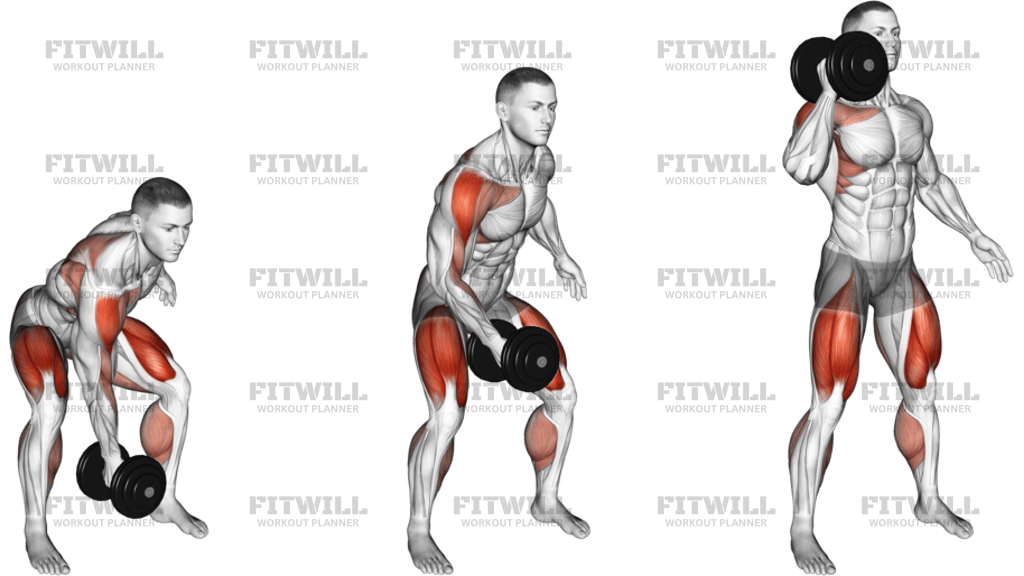
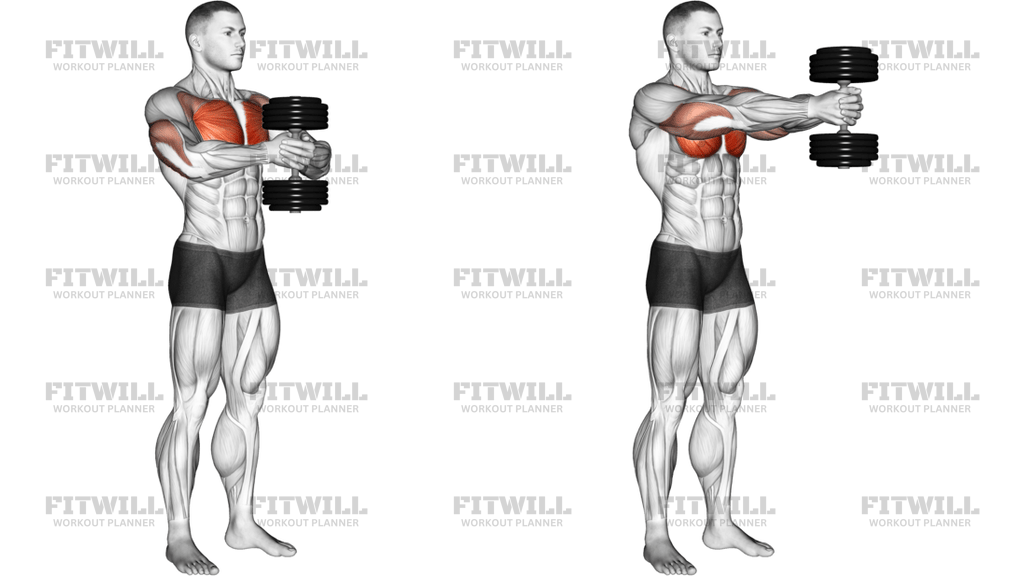
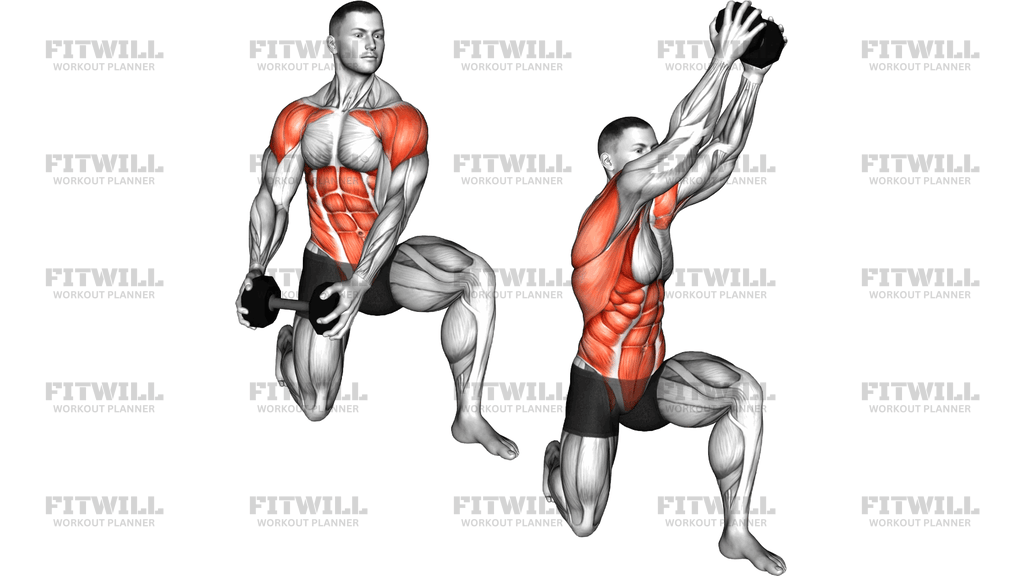
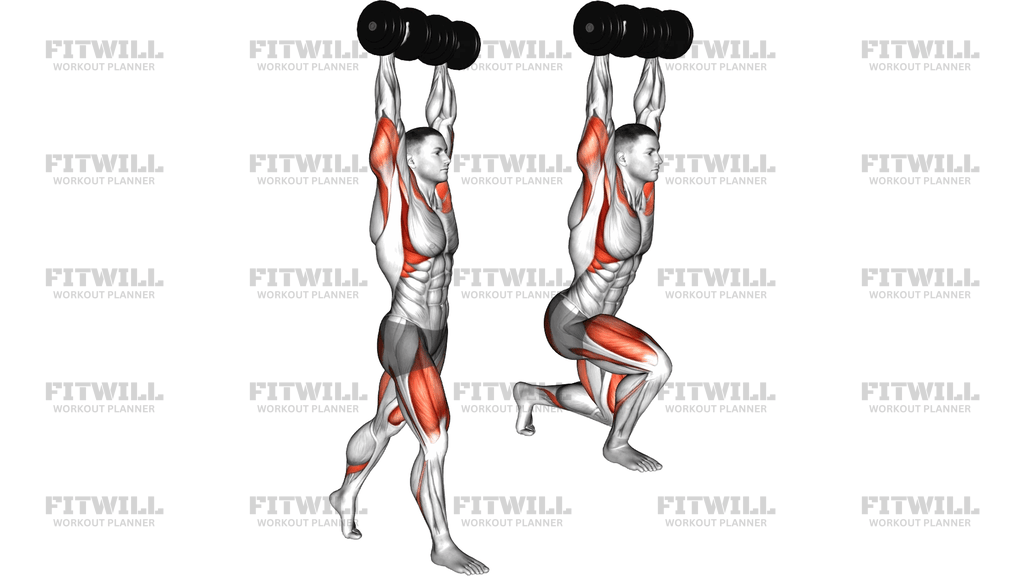
Dumbbell Split Stance Sigle Arm Overhead Press
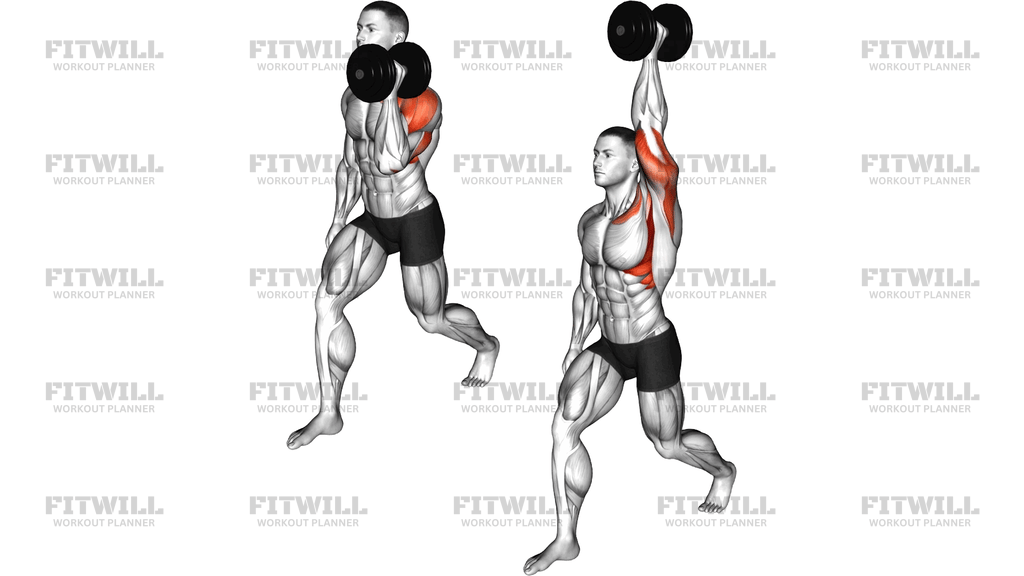
The Dumbbell Split Stance Single Arm Overhead Press is a standing one-arm press performed with your feet staggered front to back. You hold one dumbbell at shoulder height and press it straight overhead while your lower body holds a shortened, stable stance. Because you are pressing with only one arm and standing rather than sitting, the movement asks your shoulders and triceps to move the weight while your trunk and hips work to keep you from twisting or drifting.
This press is a good fit for lifters who want more than a seated machine press can offer. The split stance shortens your base compared to a normal standing position, which challenges balance and forces the muscles around your hips and spine to stay engaged for the whole set. At the same time, pressing one arm at a time gives each shoulder its own workload, so a weaker side cannot hide behind the stronger one. That makes it useful for correcting left-right differences in overhead strength.
The primary muscles at work are the front and side portions of the shoulder, with the triceps finishing the lockout overhead. The upper chest assists as the elbow drives up from shoulder height, and the upper traps help control the shoulder blade as the arm reaches full extension. Your core, especially the obliques on the side opposite the pressing arm, works continuously to resist rotation, and the legs hold the split position isometrically from start to finish.
The setup matters more here than in a seated press. With a narrow, staggered base and weight on one side of your body, any slack in your torso shows up immediately as leaning, twisting, or the dumbbell drifting forward. Before you press, set your ribs down over your pelvis, squeeze the glute of your back leg, and brace your trunk. This gives the shoulder a stable platform to press from and keeps the path of the dumbbell close to vertical over your ear.
To perform the movement well, think of pressing up and slightly back so the dumbbell finishes over the top of the same-side shoulder, not out in front of you. Lower it under control back to the collarbone area, keeping tension in the shoulder rather than dropping the elbow abruptly. Complete all reps on one side before switching, or alternate arms rep by rep if you prefer, but keep the stance and torso position identical on both sides.
You will see this press used in general strength training, in conditioning circuits where a moderate weight can be cycled for higher reps, and in programs aimed at building overhead stability. Start lighter than you would on a two-arm press, since the single-arm format plus the narrow stance exposes weaknesses quickly. If your lower back arches or your hips twist as the weight goes up, reduce the load and rebuild the position before adding weight again.
[ Workout Log & Planner ]
Put your next workout in Fitwill
Keep your plan and training log ready when you are.


Instructions
- Pick up one dumbbell and clean it to shoulder height so it rests near your collarbone, with your elbow tucked slightly in front of your ribs and your palm facing inward toward your body.
- Take a split stance: step one foot forward and the other foot back, feet staggered roughly hip-width apart side to side, with your weight spread evenly through the front foot and the ball of the back foot.
- Let your non-working arm hang relaxed at your side and set your posture: ribs down, chest tall, eyes forward, and the glute of your back leg squeezed.
- Brace your trunk as if bracing for a light push, and keep your hips squared forward so they do not rotate toward the pressing arm.
- Press the dumbbell overhead in a slight arc, letting your wrist rotate naturally so your palm faces forward at the top, finishing with the weight balanced over the same-side shoulder and your bicep near your ear.
- Pause briefly at full extension with your arm straight, making sure your lower back has not arched and your front knee has not drifted inward.
- Lower the dumbbell under control along the same path back to your shoulder, resisting the pull of gravity instead of letting it drop.
- Breathe in as you lower the weight, exhale steadily as you press up, and keep your breathing rhythm consistent across all reps.
- Finish all reps on one arm, re-brace, then switch the dumbbell to the other hand and repeat with the opposite leg forward if you want to balance the stance as well.
Tips & Tricks
- If your torso twists toward the ceiling as you press, the weight is usually too heavy or your brace is loose; drop the load a notch and think about driving the opposite-side foot into the floor.
- Keep the dumbbell path close to your face on the way up. Letting it swing out in front of you turns the press into a front raise and puts extra strain on the front of the shoulder.
- Do not let the back knee and hip collapse toward the floor. Actively squeezing the back-leg glute keeps the split stance honest and stops the pelvis from tilting as you press.
- A common mistake is pressing with the palm facing forward from the start. Start with your palm turned toward your head and let it rotate during the press, which is easier on the shoulder joint.
- Check your ribs at the top of each rep. If your lower back arches to finish the lockout, exhale fully and pull your ribs down before starting the next rep.
- Rest the dumbbell against the front of your shoulder between reps instead of hovering it. This gives your grip and traps a brief break and makes each rep start from the same spot.
- Alternate which leg is forward between sets. Pressing right arm with left leg forward and then repeating the mirrored combination keeps the movement symmetric over time.
- If your wrist bends backward at the top, grip the handle deep in your palm and keep your knuckles stacked over your forearm rather than letting the weight pull the hand into extension.
Frequently Asked Questions
Which muscles does the Dumbbell Split Stance Single Arm Overhead Press work the most?
The front and side shoulders do most of the pressing, with the triceps extending the arm at the top. The upper chest assists early in the press, while the obliques, glutes, and legs work to hold the split stance and prevent rotation.
Why use a split stance instead of a normal standing position for this press?
The staggered, narrower base reduces your stability, so your trunk and hip muscles have to work harder to keep you balanced and squared. It adds a stability demand without needing any extra equipment.
Is the Dumbbell Split Stance Single Arm Overhead Press suitable for beginners?
Yes, provided you start with a light dumbbell and focus on keeping the torso still. Beginners often benefit from mastering a regular two-hand standing press first, then moving to the single-arm split stance version once the overhead position feels comfortable.
Should I press with the same-side leg forward or the opposite leg?
Either works, and both are worth using. Same-side pairing feels more direct, while the opposite-side pairing creates a cross-body demand that slightly increases the challenge to your obliques. Whichever you choose, match it on the other side.
My hips twist toward the pressing arm on every rep. How do I fix that?
Squeeze the glute of your back leg, square both hip bones forward, and slightly reduce the weight. Bracing before the first rep rather than mid-set also makes a noticeable difference.
What can I substitute if I do not have a dumbbell?
A kettlebell held in the rack position at the shoulder is the closest alternative and actually favors the palm-in start position. A single handle on a cable stack set at shoulder height also works if you keep the same split stance.
How heavy should I go on the Dumbbell Split Stance Single Arm Overhead Press?
Start with roughly what you could press for ten or more reps with both arms combined, then adjust from there. Because one arm works alone and your base is narrow, the appropriate weight is usually well below your two-arm standing press.
Is it safe for my lower back?
When performed with a braced trunk and no excessive arching, it is a controlled standing press and generally well tolerated. If you feel your lower back taking over, the load is likely too heavy or your ribs are flaring up as you press, so reduce the weight and reset your posture.
Should I do all reps on one arm or alternate arms each rep?
Completing all reps on one arm before switching is simpler to track and keeps fatigue honest between sides. Alternating rep by rep adds a small balance challenge but makes it harder to notice strength differences between your left and right shoulders.
How many sets and reps should I use?
For strength, work in the range of four to six reps per arm with a heavier dumbbell; for muscle and endurance, eight to twelve reps per arm with a moderate weight fits well. Two to four sets per side is a practical starting point.