Forward Sideward Hop
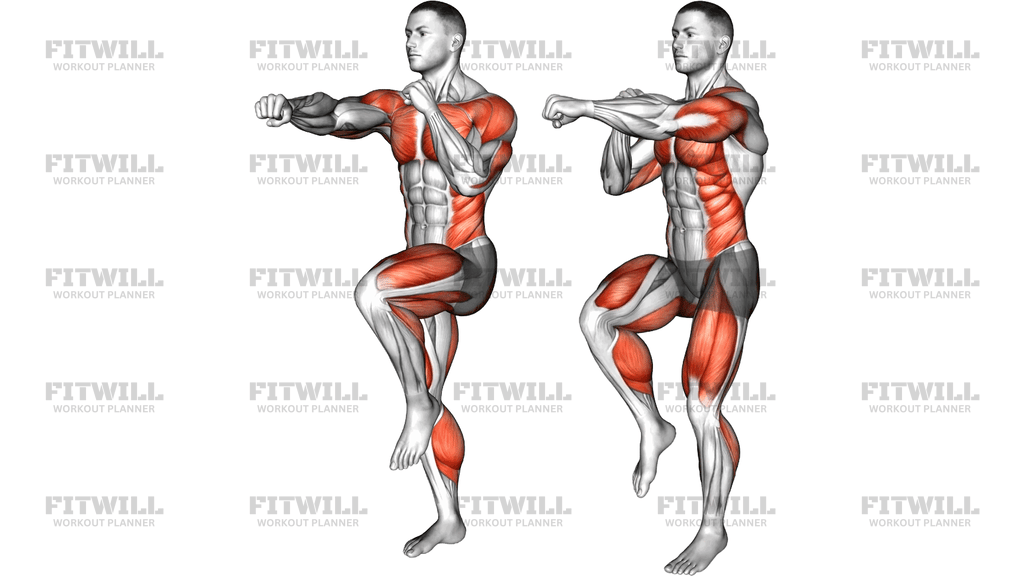
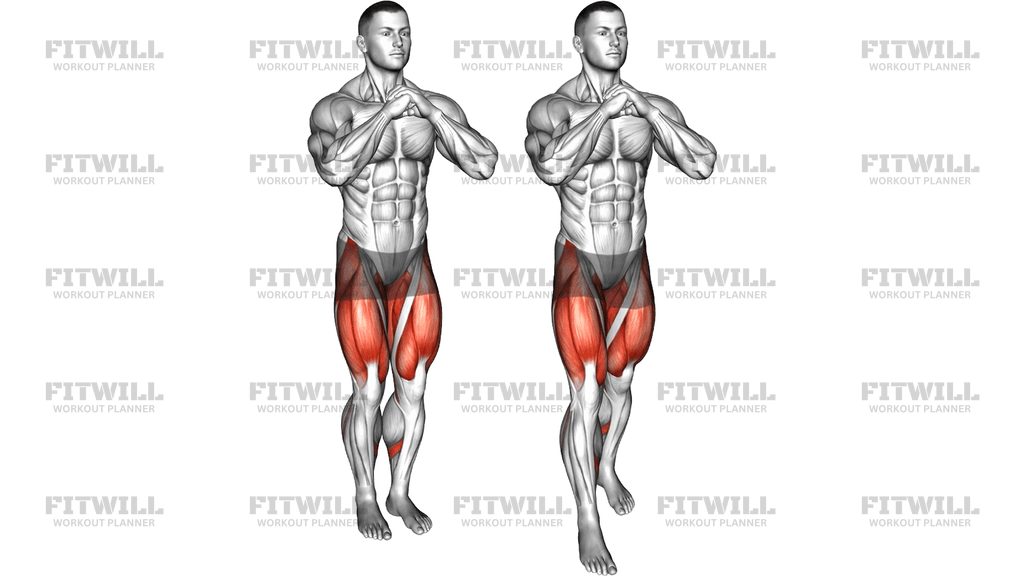
The Forward Sideward Hop is a bodyweight plyometric drill where you travel forward by hopping and alternating between a forward reach and a sideward cross of the legs on each landing. You stand tall, clasp your hands in front of your chest, and hop from foot to foot in a rhythm that shifts direction with every contact — one landing travels straight ahead, the next swings the leg across the body to the side. This constant change of direction is what separates it from a plain forward hop and makes it a genuine agility tool.
The exercise loads the quadriceps and calves through repeated takeoffs and landings, while the adductors and glute stabilizers on the outside of the hip work hard to control the crossed-leg positions. Because every landing happens on a slightly different foot position, your ankle stabilizers get far more targeted work than they would on a simple two-footed jump. That single-leg balance demand is exactly why this drill shows up in warm-ups and rehab-style conditioning for sports like soccer, basketball, tennis, and anything that involves cutting and changing direction.
Setup matters more than it looks. You need a flat, non-slippery surface and a clear runway of a few meters, because the drill moves you forward as you repeat it. Keep the hands clasped at chest height to dampen arm swing — the goal here is clean footwork, not jump height. If your feet land wide, stiff-kneed, or you let your knees cave inward on the cross-body hops, you lose the training effect and add stress to the knees and ankles.
Execution comes down to rhythm and control. Push off the ball of the foot, keep each hop short and quick rather than long and high, and land softly with the knee tracking over the toes. On the sideward phase, the moving leg crosses in front of the standing leg, you accept the landing through the whole foot while staying on the balls of the feet, and you immediately rebound into the next hop in the opposite direction. Think of it as skating on the spot while drifting forward.
Use the Forward Sideward Hop as a low-amplitude plyometric in warm-ups, as footwork conditioning between sets of heavier leg work, or as a standalone agility block of 2-4 sets covering a set distance. Beginners should start with slow, deliberate hops and prioritize quiet landings; once the crossing pattern feels automatic, the pace and distance can increase without changing the technique.
[ Workout Log & Planner ]
Put your next workout in Fitwill
Keep your plan and training log ready when you are.


Instructions
- Stand tall on a flat, clear surface with enough open space ahead of you to travel several meters.
- Clasp your hands together in front of your chest and keep them there throughout the drill to minimize arm swing.
- Shift your weight onto the balls of your feet with a slight bend in the knees and brace your core.
- Hop forward off one foot and land on the opposite foot, keeping the hop short and the landing soft.
- On the next hop, swing the free leg sideways and cross it in front of the standing leg as you land, shifting your body toward that side.
- Rebound immediately into the next hop, returning to a forward-facing position, so the pattern alternates forward and sideward crossings as you drift ahead.
- Land on the ball of the foot with the knee bent and tracking in the same direction as the toes, absorbing each contact quietly.
- Keep your chest up and eyes forward rather than looking down at your feet.
- Exhale on each takeoff and inhale during the brief landing phase, breathing steadily rather than holding your breath.
- Continue for the chosen distance or rep count, then stop, reset your stance, and rest before the next set.
Tips & Tricks
- Keep every hop low. High, long jumps turn this into a distance drill and make the sideward crossing sloppy — quick, small contacts are the point.
- If your knees dip inward when the leg crosses in front, widen your base slightly before starting and consciously push the landing knee out over the little toe.
- Land quietly. A loud, heavy foot strike means you are stiff-legged; aim for a soft contact with the heel barely kissing the ground.
- Master the pattern at walking speed first. Practice the forward-cross-forward rhythm without leaving the ground, then add the hop once the footwork is automatic.
- Do not let your torso rotate on the sideward hops. The hands stay clasped at the chest and the shoulders face forward even as the legs travel sideways.
- Use a smooth floor surface with grippy shoes. Wet or loose ground is a real slip risk on the crossing landings.
- If you feel the drill only in your calves and not your thighs, sit slightly deeper into each landing so the quads share the braking work.
- Progress by distance, not height — extend your runway from three meters to five, or add a set, before making the hops any bigger.
- Stop the set as soon as your balance breaks down. Fatigue shows up first as wobbly crossed-leg landings, and that is where ankle rolls happen.
Frequently Asked Questions
Which muscles does the Forward Sideward Hop work the most?
The quadriceps and calves drive the repeated takeoffs and landings, while the adductors, glutes, and ankle stabilizers control the crossed-leg and single-foot positions. It is primarily a thigh and lower-leg plyometric with a strong balance component.
Is the Forward Sideward Hop suitable for beginners?
Yes, as long as beginners reduce the pace and keep the hops small. Practicing the forward-and-cross footwork at low intensity first builds the coordination and ankle control needed before speed is added.
How far should I travel when performing the Forward Sideward Hop?
A runway of about three to five meters works well for one set. Cover the distance with continuous alternating hops, rest, and repeat for 2-4 sets.
Why should my hands stay clasped in front of my chest during this drill?
Clasping the hands limits arm swing, which forces the legs and core to control the direction changes instead of compensating with momentum from the upper body. It also keeps the torso from rotating on the sideward hops.
What is the most common mistake in the Forward Sideward Hop?
Letting the landing knee collapse inward during the crossed-leg hops. Fix it by landing with the knee tracking over the toes and keeping the hops low enough that you can control every contact.
Can I do the Forward Sideward Hop if I have knee problems?
The crossing landings place rotational demands on the knee, so anyone with a current knee issue should clear the drill with a professional first. If cleared, keep the hops very low and stop at the first sign of discomfort.
What can I use instead of the Forward Sideward Hop?
Lateral skater hops, single-leg forward hops, or side-to-side line hops all train similar qualities. The Forward Sideward Hop is unique in combining forward travel with cross-body footwork, so skater hops are the closest substitute.
Should each hop go forward or sideways?
The pattern alternates: one hop travels straight ahead, and the next crosses the leg sideways in front of the standing leg so your path drifts to that side. Alternating this way is what builds the agility and balance benefits.
How do I know when to progress the Forward Sideward Hop?
When you can complete all sets with quiet, controlled landings and no knee wobble, increase the distance, add a set, or speed up the rhythm. Do not increase hop height first — control matters more than amplitude.
Does the Forward Sideward Hop help with sports performance?
It trains the exact qualities many field and court sports demand: single-leg deceleration, cross-body cutting mechanics, and ankle stiffness under quick contact. It fits well as a warm-up drill or a low-load plyometric block.