Sit Up To Mountain Hop
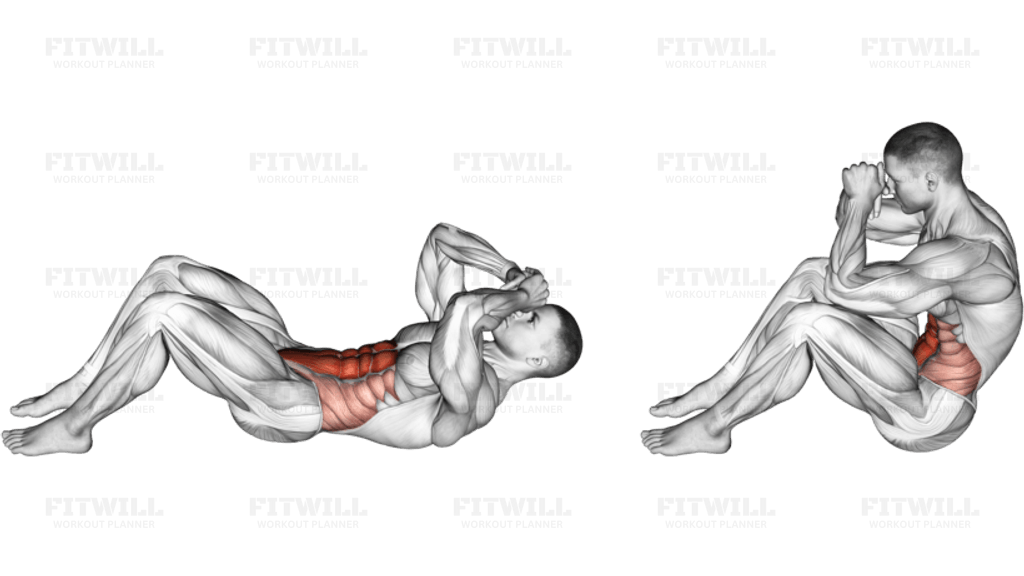
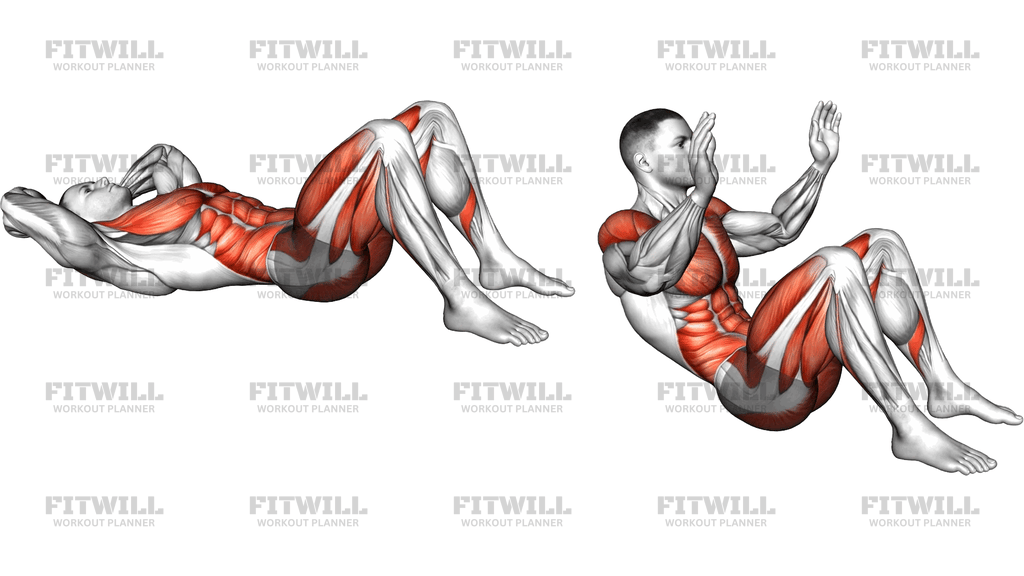
Sit Up To Mountain Hop combines two demanding bodyweight patterns into one flowing rep: a full sit-up from your back, followed by an explosive hop out of the seated position. You start flat on the floor with your knees bent and hands by your head, curl your torso up until you're sitting tall, then immediately drive forward into a short hop before resetting. It's a hybrid movement that trains trunk flexion and lower-body power in the same breath.
The abdominal work is obvious — the sit-up portion loads the rectus abdominis through a long range and challenges the hip flexors as your torso travels from the floor to vertical. What makes this variation different from a standard sit-up is the transition. Rather than lowering straight back down, you push through the floor, extend the hips and knees, and hop, which recruits the quads, glutes, and calves in a quick, coordinated effort. That transition demands real core control, because your trunk has to stay rigid while your legs produce force.
This exercise suits people who already own the basic sit-up and want something more athletic and more conditioning-heavy. It shows up in circuit training, martial arts and combat sport conditioning, and general fitness programs where the goal is to link core strength with explosiveness. Because you're moving from the ground to a hop repeatedly, your heart rate climbs quickly, so it also works well as a conditioning finisher in short, dense sets.
Setup matters here more than most people expect. Lie on a mat with your knees bent to roughly 90 degrees and your feet flat on the floor, about hip-width apart. If your feet are too close to your hips, you won't have room to hop forward; if they're too far away, your lower back tends to arch during the sit-up. Lightly place your hands beside or behind your head without pulling on your neck, and keep your eyes on a fixed spot forward so your head travels with your spine rather than jutting ahead of it.
Execution should feel like one continuous wave: exhale as you curl up from the floor, finish the sit-up tall, then let that momentum carry you forward into the hop, landing softly on both feet with bent knees. From the landing, sit your hips back down, roll your spine back to the mat one segment at a time, and set up for the next rep. The hop doesn't need to be dramatic — a controlled few inches of air with a quiet landing is plenty.
A few safety points are worth respecting. Keep your hands supporting your head rather than yanking it forward, especially when you're fatigued. If your lower back lifts off the mat during the descent, slow down and control that portion rather than dropping. And if you have sensitive knees, ankles, or a history of lower back discomfort, master a plain sit-up and a separate small hop before chaining them together, or start with a version where you stand up instead of hopping.
[ Workout Log & Planner ]
Put your next workout in Fitwill
Keep your plan and training log ready when you are.


Instructions
- Lie flat on your back on an exercise mat with your knees bent to about 90 degrees and your feet flat on the floor, hip-width apart, positioned far enough forward that you have room to hop.
- Place your hands lightly beside or behind your head with your elbows open, and brace your core so your lower back stays in contact with the mat.
- Exhale and curl your torso up off the floor, leading with your chest and keeping your neck neutral as you rise into a full sit-up with your torso tall over your hips.
- At the top of the sit-up, swing your arms forward or overhead and drive your feet into the floor to push your hips up and forward into a short, explosive hop.
- Land on both feet with soft knees and hips, absorbing the landing quietly rather than stomping down.
- From the landing, sit your hips back down toward the mat under control, keeping your torso engaged as you lower.
- Roll your spine back down one section at a time until your head and shoulders rest on the mat, returning to the exact starting setup.
- Inhale at the bottom as you reset your brace, then repeat for the desired number of reps.
- Stop the set when your hop height drops noticeably or you start pulling on your head to finish the sit-up.
Tips & Tricks
- If you find yourself yanking your head forward to start the sit-up, switch your hands to a crossed position on your chest for a few reps to relearn driving the movement from your abs.
- Aim for a quiet landing on the hop — a loud, stiff-legged landing means your quads and calves are absorbing the force instead of your hips and knees.
- Do not let your feet slide or lift during the sit-up portion; pressing them into the floor gives you the base you need to transition into the hop.
- Think of the rep as one fluid motion: curl, sit tall, hop, sit back down. Pausing too long at the top kills the momentum that makes the hop efficient.
- Keep your hop short and forward-focused. Jumping straight up from a seated position usually rounds the lower back and wastes energy.
- If your feet are planted too close to your hips, you'll feel cramped at the top and struggle to hop — slide them a few inches farther out and reset.
- Control the descent as much as the ascent. Slamming back down to the mat between reps turns this into a momentum exercise and robs your abs of work.
- On a hard floor, use a mat and keep the hop modest; the goal is coordinated power, not maximum jump height.
Frequently Asked Questions
Which muscles does Sit Up To Mountain Hop work?
The sit-up portion primarily targets the abs, especially the rectus abdominis, with strong assistance from the hip flexors. The hop then brings in the quads, glutes, and calves as you drive off the floor.
Is Sit Up To Mountain Hop suitable for beginners?
It's better suited to people who can already perform controlled sit-ups with clean form. Beginners should build up with standard sit-ups and basic bodyweight hops separately before linking the two.
How far should I hop forward during Sit Up To Mountain Hop?
Just a short, controlled hop is enough — a few inches of height with a forward drift. The point is to practice transitioning from the floor to an explosive lower-body drive, not to cover distance.
Why do my hip flexors fatigue before my abs in this exercise?
The sit-up from a flat back with bent knees loads the hip flexors heavily as they help raise your torso. If they burn out first, slow the tempo, reduce the range slightly at the start, or strengthen them with dedicated hip flexor work.
Should my hands be behind my head or in the air during Sit Up To Mountain Hop?
Keep your hands lightly supporting the sides of your head during the sit-up, then swing them forward or overhead to help power the hop. Never pull on your neck to lift your torso.
What can I substitute if the hop bothers my knees or ankles?
Replace the hop with a stand-up: rise from the seated position to a full stand and then sit back down. You keep the floor-to-standing transition without the impact of landing.
How many reps of Sit Up To Mountain Hop should I do?
Sets of 6 to 12 reps work well for strength and power, while longer sets of 15 to 20 push it into conditioning territory. Cut the set short once your hop height or sit-up speed drops.
Is it a problem if my lower back lifts off the mat as I lower down?
Some pelvic movement is normal, but if your lower back arches sharply or feels strained, your core is fatiguing or your feet are planted too close. Slow the descent, slide your feet slightly farther from your hips, and re-brace before each rep.
Can I do Sit Up To Mountain Hop on a hard floor without a mat?
You can, but a mat makes the movement far more comfortable and gives your spine and sit bones a little cushioning during the descent and reset. It's a small investment that improves every floor-based core exercise.