Kettlebell Figure 8 Swing
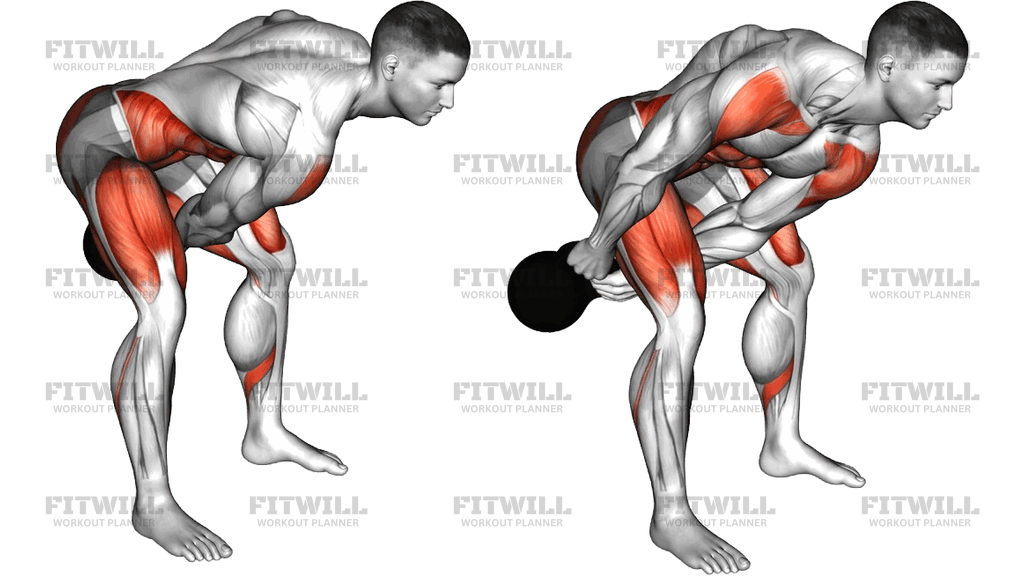
The Kettlebell Figure 8 Swing is a hip-hinged kettlebell drill where you pass the bell from one hand to the other through your legs in a figure-8 pattern. Unlike a standard swing, the bell never travels up in front of your chest. Instead, you hold an athletic hinge position and feed the kettlebell around the outside of one leg, through the middle, and catch it with the opposite hand behind the other leg, repeating that loop for reps. The image shows the exact position: a flat-back forward hinge with soft knees, the bell swinging low between the ankles as the hands trade off.
This movement earns its place in a program because it combines an isometric hinge hold with continuous hand-to-hand transfers. Your hamstrings and glutes hold the hinge while your obliques and deep core control the rotational pull of the bell changing sides every rep. Your forearms and grip work constantly because the bell is being caught, not just held, and your shoulders stay engaged steering the handle on each pass.
Setup matters more here than in most kettlebell drills because your feet sit directly in the bell's path. A stance slightly wider than shoulder width, knees bent enough to clear the swinging bell, and a genuinely neutral spine are what let you move fast without risk. If your hinge collapses into a rounded back or your knees drift inward, the pass gets cramped and the bell can clip your shins.
To execute it well, think of your lower body as a fixed frame and your arms as the only moving parts. The bell travels a diagonal loop: outside one leg, across the middle, outside the other leg, back across. Each hand releases the handle shortly after the pass and prepares to receive it on the next loop. Keep the arc low and controlled rather than muscling the bell through with your arms.
The Kettlebell Figure 8 Swing fits well as a warm-up primer before hinging work, a core finisher after lower body sessions, or a conditioning tool when performed continuously for time. It is also popular in combat sport training because the hand switch under load mimics the rotational demands of throwing and changing direction. Because it is self-paced, it scales from slow, deliberate reps for beginners learning the hinge to brisk continuous loops for conditioning.
The main safety point is respecting the path of the bell. Start light, keep the loop close to your body, and stop the set when your hinge position starts to sag. Fatigue in this drill shows up first as a rounding lower back, not as missed reps, so treat posture loss as your cue to end the set.
Fitwill
Log Workouts, Track Progress & Build Strength.
Achieve more with Fitwill: explore over 9600 exercises with images and videos, access built-in and custom workouts, perfect for both gym and home sessions, and see real results.
Start your journey. Download today!




Instructions
- Stand with your feet slightly wider than shoulder width and place a kettlebell on the floor between your feet.
- Push your hips back into a hinge with a flat back, bend your knees enough to keep your shins clear, and pick up the kettlebell with your right hand using a firm overhand grip.
- Keep your weight on your mid-foot, spine neutral, and brace your core as if preparing to absorb a light push to your side.
- Swing the kettlebell in a low arc around the outside of your right leg, then pass it through the middle behind your legs to your left hand.
- Receive the bell with your left hand, guide it around the outside of your left leg, and pass it back through the middle to your right hand to complete one figure 8.
- Keep the bell's path low, roughly at ankle height, and let each hand release the handle soon after the transfer rather than gripping through the whole loop.
- Exhale on each hand-off and inhale as the bell circles the outside of a leg, keeping the breathing rhythm tied to the loop.
- Maintain the hinge position throughout; your hips should not rise or squat down as the bell changes sides.
- After your final rep, steer the bell to a stop in front of you, set it on the floor inside your stance, and stand up by driving your hips forward.
Tips & Tricks
- The most common fault is rounding the lower back to reach the pass. If your back rounds, hinge less deep and bend the knees a little more so your hands can reach the middle without losing your spine position.
- Do not let the bell drift wide on the outside loops. A wide arc pulls your shoulders forward and strains your grip; guide the handle so the bell stays within a few inches of your calves.
- If the bell keeps clipping your ankles, your stance is too narrow or your knees are caving in. Widen your feet and actively push your knees out over your little toes.
- Your shoulders will try to do all the work at first. Let the bell's own momentum carry each arc and only steer the handle; this keeps the drill smooth and saves your forearms.
- Start with a lighter bell than you would swing. The hand-to-hand catch is a different skill from a two-arm swing, and a heavy bell punishes a late catch.
- Keep your head in line with your spine and look at a spot on the floor about a meter in front of you rather than tracking the bell with your eyes and neck.
- Speed up only when the transfers are clean. A common mistake is rushing the hand-off before the receiving hand has a secure grip on the handle.
- If your hamstrings cannot hold the hinge for the whole set, break it into shorter bouts of 15 to 20 seconds of continuous loops rather than pushing through a fading position.
Frequently Asked Questions
What muscles does the Kettlebell Figure 8 Swing work?
The obliques and core work to control the side-to-side pull of the bell, while the glutes and hamstrings hold the hinge position isometrically. The forearms, grip, and shoulders handle the continuous catching and steering of the handle.
Is the Kettlebell Figure 8 Swing suitable for beginners?
Yes, provided you can already hold a hip hinge with a neutral spine. Beginners should use a light bell, move slowly, and master the hand-to-hand transfer before adding speed.
How is the Kettlebell Figure 8 Swing different from a regular kettlebell swing?
The regular swing uses a hip snap to drive the bell up to chest or eye level, while the Figure 8 keeps you in a static hinge and moves the bell in a low looping path around and between your legs. The Figure 8 emphasizes grip, hand coordination, and rotational core control instead of hip power.
Why does the kettlebell keep hitting my ankles during the Figure 8?
This usually means your stance is too narrow, your knees are drifting inward, or you are passing the bell too far behind your body. Widen your feet, push your knees slightly out, and keep each arc hugging the outside of the working leg.
How heavy should the kettlebell be for this exercise?
Start roughly one size lighter than your normal swing weight, since the one-handed catch demands more grip control. Progress only when every transfer feels secure and your hinge does not break down.
Can I replace the kettlebell with a dumbbell in the Kettlebell Figure 8 Swing?
A single dumbbell can work in a pinch, but holding it by the head rather than the handle is awkward and the shape makes the through-the-legs pass riskier. A kettlebell's handle and compact center of mass make it the better tool here.
Should my hips stay still or move during the Figure 8 Swing?
Your hips stay in the hinge and should not rise, drop into a squat, or rock side to side as the bell changes hands. Treat the lower body as a stable frame while the arms and shoulders do the moving.
How many reps should I do?
Count each full figure-8 loop as one rep, or work in timed sets of 20 to 40 seconds. For strength and core control, 2 to 4 sets of 10 to 15 loops per side is a solid starting range.
Is the Kettlebell Figure 8 Swing safe for the lower back?
It is safe when the hinge stays neutral and the load is matched to your grip and hinge endurance. Stop the set as soon as your lower back starts to round, since that posture loss under a moving load is the main risk of this drill.