Medicine Ball Roll Plank
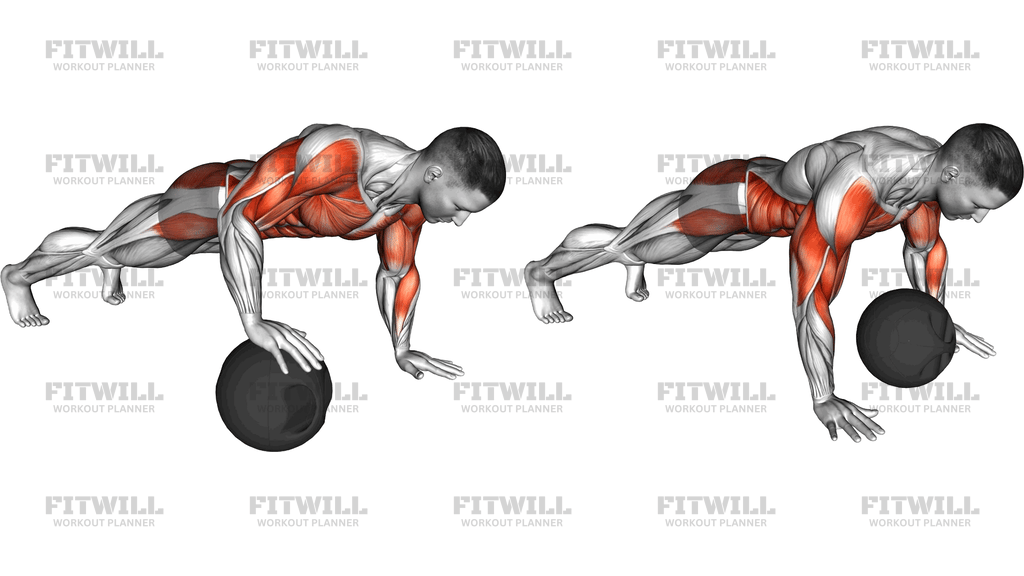
The Medicine Ball Roll Plank is an anti-rotation and stability exercise performed from a high plank position with one hand resting on a medicine ball. Instead of holding a static hold, you roll the ball across the floor from one hand to the other, lifting and replacing each hand as the ball travels. Every roll shifts your base of support, which forces your trunk to resist twisting while your shoulders work to control an unstable, moving surface.
This movement is useful for anyone who wants more out of a standard plank. Because the ball moves and only one hand is ever firmly planted on it at a time, your deep core, obliques, and shoulder stabilizers have to react continuously rather than settle into a hold. It fits well into core circuits, warm-ups for pressing days, and conditioning work for athletes who need trunk control under changing loads.
The main work comes from the abdominals and deep core muscles holding your ribs and pelvis level while the arms trade positions. Your shoulders, chest, and triceps support and steer the ball, and the forearm and wrist muscles handle the rolling contact. The legs and glutes stay active too, since a soft lower body makes the roll wobble your whole frame.
Setup matters more here than in most planks. The ball should sit under one shoulder, not out in front of you, and your feet should be wide enough to give you a stable base without letting your hips sway. If the ball starts too far away, you will reach and rotate through the spine, which turns an anti-rotation drill into a sloppy twisting motion.
To execute it well, think about keeping your hips square to the floor the entire time. Roll the ball with a flat hand and a controlled push rather than flicking it across, catch it under the opposite shoulder, and pause briefly before rolling it back. Slow, deliberate rolls with a level pelvis beat fast, jerky ones every time.
A few practical points keep this safe. Use a medicine ball with some grip and a small amount of give, avoid hard slick surfaces, and stop the set as soon as your hips start to sag or rotate. If the full version is too challenging, start with a smaller roll distance or place your knees on a mat until your plank position is solid.
[ Workout Log & Planner ]
Put your next workout in Fitwill
Keep your plan and training log ready when you are.


Instructions
- Place a medicine ball on the floor and set up in a high plank with your right hand on top of the ball and your left hand flat on the floor, both directly under your shoulders.
- Set your feet slightly wider than hip width so the wider base helps counter the shifting load of the ball.
- Form a straight line from head to heels, squeeze your glutes, and brace your abs as if bracing for a light punch before you move anything.
- Press your hand firmly into the top of the ball so your palm and fingers control it rather than just resting on it.
- Push the ball smoothly across the floor toward your left hand, keeping your hips and shoulders square to the ground as it travels.
- As the ball arrives, lift your right hand and place it flat on the floor while your left hand takes over on top of the ball, ending under the left shoulder.
- Pause for one or two seconds in this position, re-brace, and check that your hips have not twisted or sagged.
- Roll the ball back to the right side in the same controlled manner, trading hand positions again to complete one repetition.
- Exhale steadily as each roll travels across, and breathe shallowly but continuously while holding the plank between rolls.
- Finish the set by lowering your knees to the floor before releasing the ball, then reset your plank line before the next set.
Tips & Tricks
- If your hips rotate every time the ball crosses the midline, widen your feet another few inches. The wider stance gives your obliques a chance to resist the twist instead of losing to it.
- Keep the ball travel short at first. Rolling it just past the midline lets you learn the hand exchange before you add the instability of a longer roll.
- A common mistake is letting the ball sit ahead of the shoulders, which turns the exercise into a shoulder reach. Recheck that the hand on the ball stays stacked under its shoulder throughout.
- Spread your fingers and grip slightly into the surface of the ball. A flat, passive palm is what causes the ball to squirt out sideways mid-roll.
- If your lower back arches as the set goes on, that is usually fatigue in the abs, not tightness. Cut the set off a few rolls earlier rather than pushing through with a sagging pelvis.
- Avoid bouncing the ball off the floor to hand it over. A rolling transfer keeps tension in the core, while a bounce turns it into a catch drill with no trunk control.
- On a hard floor, use a ball with texture or rubber coating. A smooth, slick ball slides unpredictably and forces your shoulders to chase it.
- Pair this with a static plank in the same session. Doing the roll version first while you are fresh gives you the most stability benefit.
- Slow down the hand exchange, not just the roll. Most hip rotation happens in the moment one hand lifts off, so place each hand deliberately.
Frequently Asked Questions
Which muscles does the Medicine Ball Roll Plank work?
The primary work comes from the abs and deep core, especially the obliques, which fight the rotation created by the moving ball. The shoulders, chest, and triceps support and steer the ball, while the forearms and wrists handle the rolling contact.
Is the Medicine Ball Roll Plank suitable for beginners?
Yes, if you can already hold a solid high plank for 30 seconds or more. Beginners should use a light ball, keep the roll distance short, and widen the feet for extra stability.
How is the Medicine Ball Roll Plank different from a regular plank?
A regular plank has a fixed base, so your core can settle into one hold. Rolling the ball from hand to hand continuously changes your support points, so your trunk has to resist rotation and shifting weight the whole time.
What size medicine ball should I use for the Medicine Ball Roll Plank?
A ball roughly the size of a basketball with a slightly soft, grippy surface works best. Weight matters less than size and grip, since the goal is stability work rather than load.
Why do my hips rotate when I roll the medicine ball?
Hip rotation usually means the roll is too fast, the ball is starting too far in front of the shoulder, or your feet are too narrow. Slow the transfer, start the roll directly under the shoulder, and widen your stance.
What can I use instead of a medicine ball for this exercise?
A small stability ball or a folded towel that slides slightly works as a substitute. You can also do plank shoulder taps with no equipment, which trains the same anti-rotation demand with a simpler hand transfer.
Should I perform the Medicine Ball Roll Plank on my knees if I am struggling?
Yes. Dropping to the knees shortens the lever and removes much of the lower body wobble, letting you practice the hand exchange and hip control before progressing to the full version.
How many reps and sets of the Medicine Ball Roll Plank should I do?
Two to three sets of 8 to 12 total rolls works well, treating each hand-to-hand transfer as one rep. Stop the set when your hips sag or rotate, since quality of position matters more than rep count.
Is it safe to do the Medicine Ball Roll Plank on a hard floor?
It is fine as long as the ball has a non-slip surface and does not shoot out from under your hand. On tile or hardwood, choose a textured rubber ball and keep the roll speed slow so you never have to lunge after it.