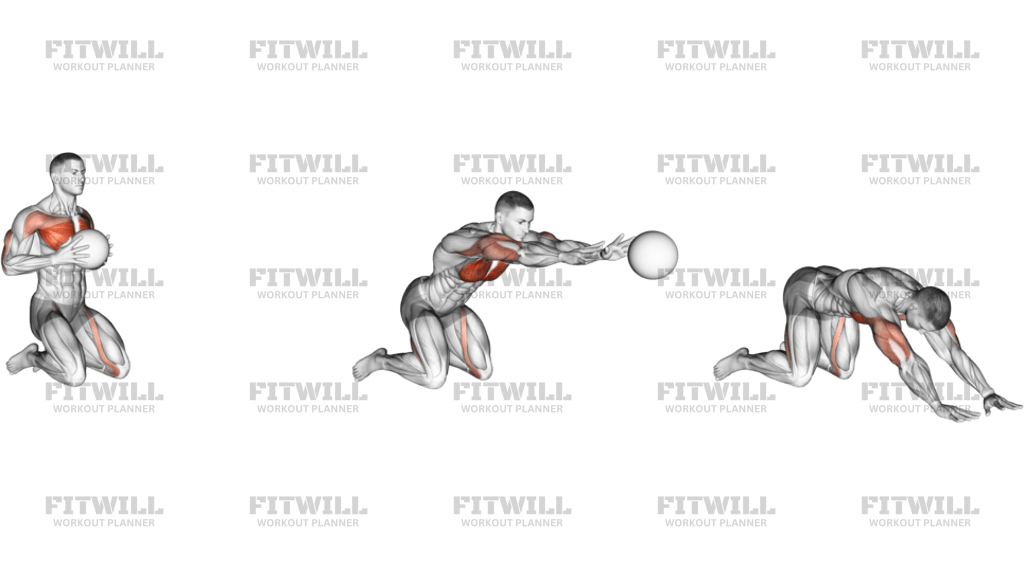
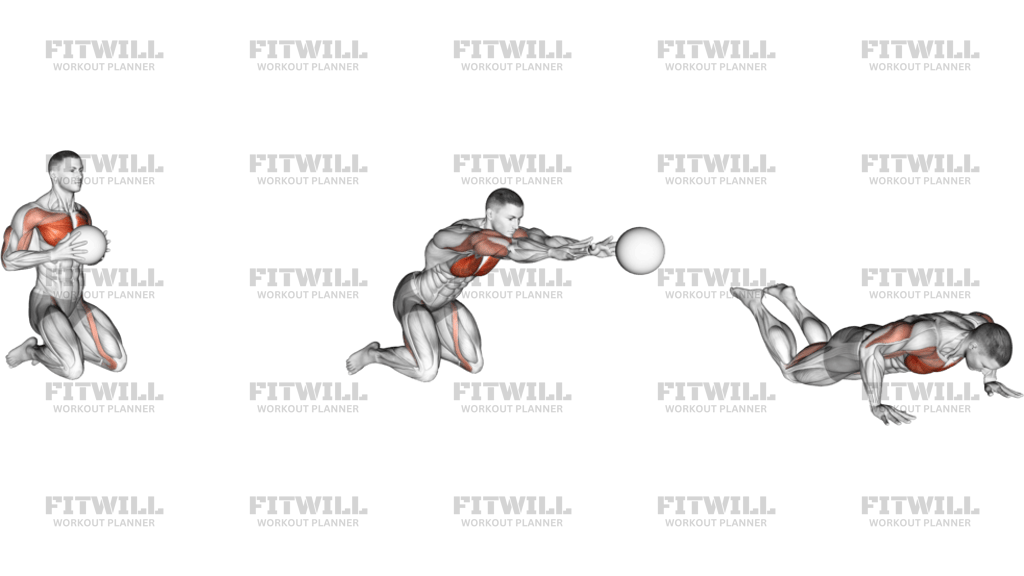
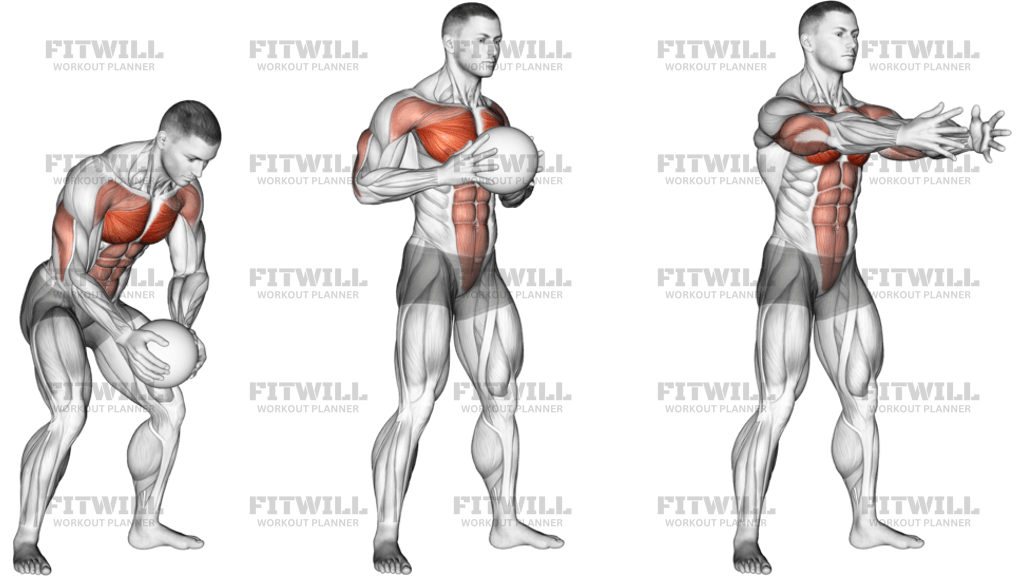
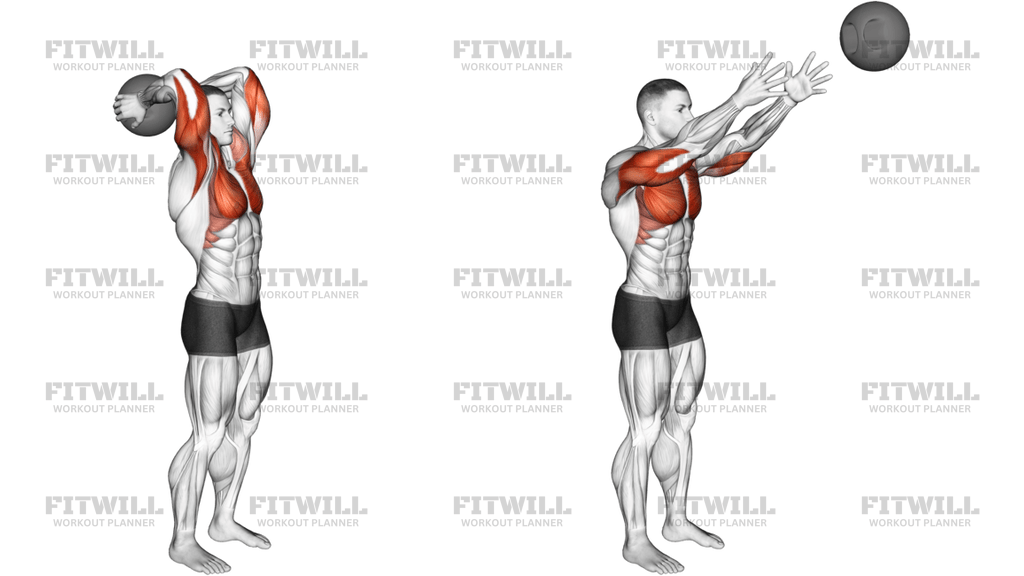
Medicine Ball Plyo Push Up
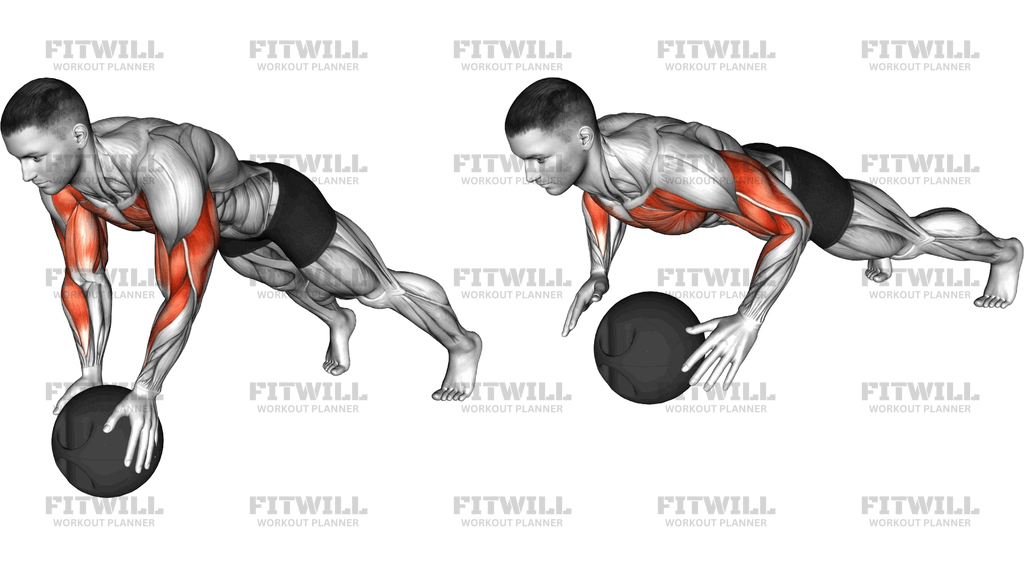
The Medicine Ball Plyo Push Up is an explosive upper-body exercise that uses a medicine ball as both an unstable surface and a target for your hands. You move through two hand positions in one continuous cycle: lowering with your hands gripping the sides of the ball, then driving off it explosively enough that your hands land on the floor just outside the ball. From there you press again and snap your hands back onto the ball. This back-and-forth switching is what separates it from a standard medicine ball push up, where the hands simply stay planted on the ball.
This movement is built for developing pressing power, not just pressing strength. Because each rep forces you to generate enough force to unweight your hands, it trains the chest, triceps, and front shoulders to produce force quickly. The ball itself adds a stability demand, so your core, rotator cuff, and the small stabilizers around each shoulder joint work overtime to keep you from wobbling or rolling the ball out from under you.
Athletes in punching, throwing, blocking, or sprint-contact sports get the most direct carryover, since the exercise closely mimics rapid force absorption and re-application through the arms. It also fits well into upper-body power blocks for general lifters who already own solid push up mechanics. If you cannot yet perform thirty or more clean regular push ups, spend time there first, because landing on and around a firm ball punishes sloppy positions.
Setup matters more here than in most push up variations. Place the medicine ball on a non-slip surface and grip its sides with your hands roughly under your chest, not out in front of your shoulders. Your body should form one straight line from head to heels, with feet set about hip width for balance. If the ball sits too far forward or your hands slide toward the top of it, your wrists take the brunt of every landing, which is the most common source of discomfort in this drill.
Execution is about rhythm and intent. Lower under control until your chest approaches the ball, then push down through the ball hard and fast so your hands lift off and spread to the floor on either side. Let the elbows bend as you land to absorb force, then immediately press again and drive the hands back to the ball in one explosive motion. Breathe in on the way down, exhale sharply on each explosive press, and reset your plank position between reps rather than rushing through a fatigued, sagging-hip version of the movement.
Use this exercise early in a session, when you are fresh, in sets of three to six reps. It pairs well as a contrast with heavy bench or dumbbell pressing work, and it needs far less equipment than many power drills, which makes it a practical choice for garage gyms and team warm-ups alike.
[ Workout Log & Planner ]
Put your next workout in Fitwill
Keep your plan and training log ready when you are.


Instructions
- Place a firm medicine ball on the floor and kneel behind it, then walk your hands out so each hand grips the sides of the ball at roughly chest height, fingers spread around the curve.
- Extend your legs back into a high plank with your feet about hip width apart, forming a straight line from head through hips to heels.
- Brace your abs and squeeze your glutes so your hips neither sag nor pike, and position your shoulders directly over your hands.
- Bend your elbows to lower your chest toward the ball, keeping your elbows tracking back at about 45 degrees rather than flaring straight out to the sides.
- Explosively press down through the ball, driving hard enough that both hands leave its surface and land on the floor just outside it, slightly wider than shoulder width.
- Bend your elbows immediately on landing to absorb the impact, letting your chest travel toward the floor between your hands.
- Without pausing, press explosively again and pull your hands inward so they return to their starting grip on the sides of the ball, elbows soft as they land.
- Exhale sharply on each press, inhale during the controlled lowering phases.
- Complete the rep cycle, then re-set your plank, check that the ball has not drifted, and begin the next repetition.
- Perform 3 to 6 quality reps per set, stepping off the ball rather than collapsing when you finish.
Tips & Tricks
- If the ball rolls away from you on landing, your hands are drifting forward of the ball's midline; re-center your grip on the sides before each set.
- Keep your landings quiet. A loud slap of hands on the floor or ball usually means you are letting your elbows lock out straight instead of absorbing force with a soft bend.
- Start with a larger, firm ball rather than a small soft one; bigger balls give your hands more surface to land on and are more forgiving while you learn the timing.
- If your hips sag as you fatigue, drop to your knees for the remainder of the set or end it. A broken plank position turns this into a lower-back exercise and robs the chest of power output.
- Do not rush the transition. Two crisp, deliberate presses beat five sloppy ones, because the plyometric benefit comes from maximal intent, not rep speed.
- Keep your weight slightly biased over the ball during the lowering phase; leaning back toward your feet makes the return of the hands to the ball much harder and less accurate.
- Warm up your wrists with circles and a few slow medicine ball push ups before attempting the plyo version, since the ball compresses the wrist into slight extension under load.
- Train this on grass, rubber flooring, or a mat-free grippy surface only. A ball on slick tile can slide out from under your hands on the first explosive press.
- If you consistently miss the return landing, narrow the floor landing position slightly and focus on pulling the hands down and in, not just pushing up.
Frequently Asked Questions
What muscles does the Medicine Ball Plyo Push Up work?
The chest is the primary mover, with strong contributions from the triceps and front shoulders during each explosive press. Your core and shoulder stabilizers also work hard to control the unstable ball and keep your body in a straight line.
How is the Medicine Ball Plyo Push Up different from a regular medicine ball push up?
In a regular medicine ball push up your hands stay on the ball for the whole set. In the plyo version you push hard enough that your hands leave the ball, land on the floor beside it, and then press again to return, adding an explosive element.
Can beginners do the Medicine Ball Plyo Push Up?
It is not a good first push up variation, because landing accurately on and around a firm ball requires solid push up strength and control. Build up to at least 20 to 30 clean regular push ups, and practice slow medicine ball push ups before adding the plyo element.
What size or weight medicine ball should I use?
Choose a firm ball, typically 6 to 10 pounds or larger in diameter, that gives your hands plenty of surface to grip and land on. A soft or undersized ball rolls and deforms under your hands, making the movement unpredictable.
Why do my wrists hurt when my hands land on the ball?
This usually means your grip has drifted toward the top of the ball or your hands are sliding during the landing. Grip the widest part of the ball's sides, keep your fingers spread, and warm your wrists up with a few slow reps first.
How many reps and sets should I do?
Treat it as a power exercise: 3 to 5 sets of 3 to 6 crisp reps, done early in your workout while you are fresh. Stop the set as soon as your landings get slow or sloppy.
What can I substitute if I do not have a medicine ball?
A low, stable plyo box push up or a standard clap push up trains similar explosive pressing. If you have a ball but lack the explosiveness yet, alternating one hand on the ball and one on the floor is a good stepping stone.
Should my elbows flare out to the sides during the Medicine Ball Plyo Push Up?
Keep your elbows tracking back at roughly 45 degrees from your torso rather than flaring straight out. This positions your chest to drive the press and reduces strain on the shoulder joints during landings.
Is it safe to do this exercise on a hard floor?
Yes, as long as the ball cannot slide and you land with soft elbows. Avoid slick or dusty surfaces, since the ball shifting under your hands mid-press is the main hazard of this movement.
How do I progress the Medicine Ball Plyo Push Up once it feels easy?
Increase intent by minimizing ground contact time between presses, move to a smaller ball for a narrower target, or add a light clap during the floor-hand phase. Progress one variable at a time and keep your body line intact.