Turn Knee Drive
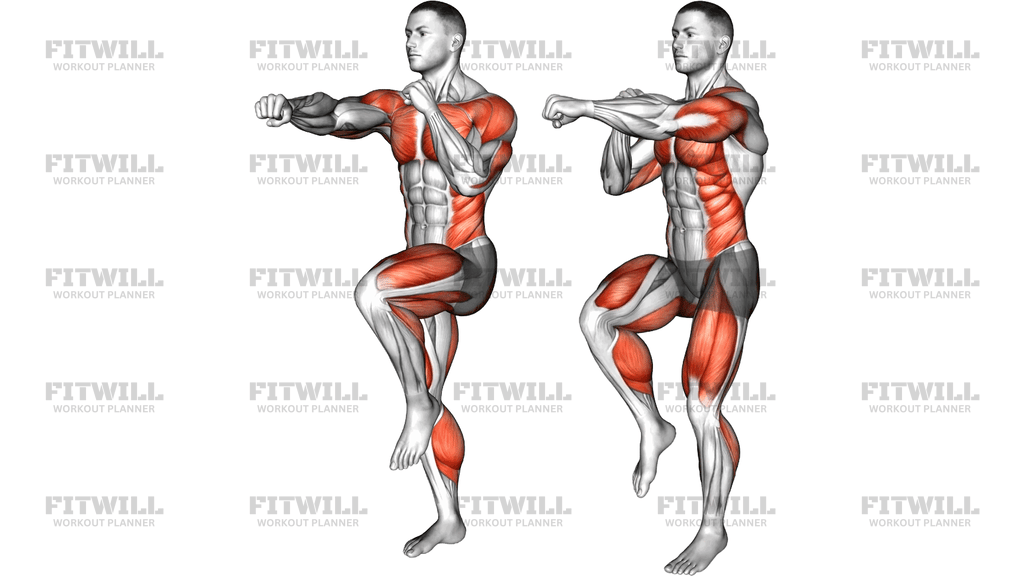
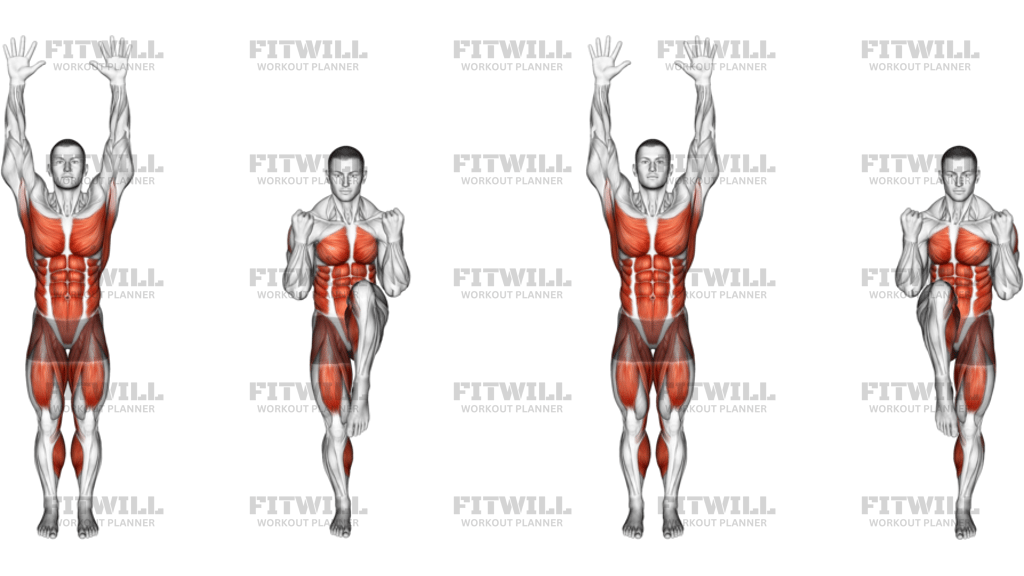
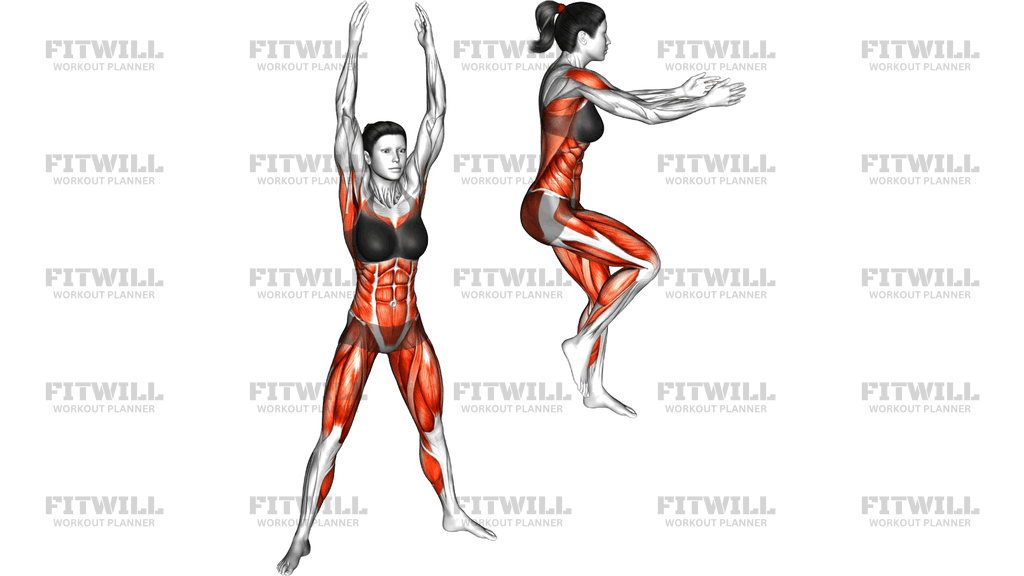
The Turn Knee Drive is an explosive bodyweight movement that combines a powerful vertical jump with an aggressive single-knee drive. From a tall standing position with the arms reaching overhead, you drop into a quick quarter squat, swing the arms down and forward, and simultaneously drive one knee up toward hip height while pushing off the standing leg. The result is a short, controlled hop in which the working knee finishes high, the arms reach forward for balance, and the trailing leg extends behind you before you land and reset.
This exercise belongs firmly in the plyometric category. It trains rate of force production rather than maximum strength, meaning your muscles learn to switch on hard and fast. The jumping leg works through the quads, glutes, and calves to produce the drive, while the hip flexors snap the free knee upward. Because the movement happens on one leg at a time, the ankle, knee, and hip stabilizers on the stance side get far more work than they would in a standard two-footed jump, and the core has to brace hard to keep your torso from twisting as the arms and opposite leg swing.
The Turn Knee Drive is especially useful for athletes who sprint, cut, or jump, since it closely mirrors the mechanics of acceleration and single-leg takeoff. Runners benefit from the hip flexor power and ankle stiffness, field and court athletes benefit from the landing control, and general trainees get a demanding conditioning effect that raises the heart rate quickly without any equipment. It also fits well into warm-up sequences before lower-body lifting, where a few crisp reps prime the nervous system for heavier work.
Setup matters more than it looks. A stance that is roughly hip-width to slightly wider gives you a stable base, and starting with the arms overhead loads the swing that actually powers the knee drive. If you skip the arm action, the movement becomes a weak hip-hike instead of a true jump. The quarter-squat depth before each rep should be shallow and quick; sinking slowly into a deep squat turns a plyometric drill into a slow strength exercise and defeats the purpose.
Execution quality comes down to three things: a hard, deliberate knee drive rather than a lazy lift; a tall chest and braced trunk so the torso does not collapse forward; and quiet, soft landings on the ball of the foot with the knee tracking over the toes. Quality over quantity applies strongly here. Stop the set when your jump height drops or your landings get loud and heavy, because sloppy reps at speed are where ankles and knees get irritated.
A simple way to program it is two to four sets of six to ten drives per leg, resting enough between sets to keep each rep sharp. Beginners can start with the same knee drive without leaving the ground, then add the hop once the arm swing and landing feel natural.
[ Workout Log & Planner ]
Put your next workout in Fitwill
Keep your plan and training log ready when you are.


Instructions
- Stand tall with your feet about hip-width apart, weight spread evenly across both feet, and both arms extended straight overhead with the palms facing forward.
- Brace your abdominal muscles and pull your shoulder blades down slightly so your ribs stay stacked over your hips before you start the movement.
- Drop into a quick quarter squat by bending the hips and knees together, letting your arms swing down and back behind you as you descend.
- Explosively extend the standing leg and push through the ball of the foot to hop upward, while simultaneously driving the opposite knee up toward hip height.
- Swing both arms forward to roughly chest height as the knee rises, keeping them relaxed rather than rigid, and let the driven leg's foot stay dorsiflexed with the trailing leg extended behind you.
- At the top of the hop, hold the knee-drive position for a split second: torso tall, knee high, arms forward, supporting foot under your hips.
- Land softly on the ball of the standing foot with the knee slightly bent, absorbing the impact instead of snapping down onto a straight leg.
- Exhale sharply as you jump and drive the knee, then inhale as you land and lower into the next quarter squat.
- Complete all reps on one side or alternate legs, resetting your stance and overhead arm position between reps if your balance drifts.
- Stop the set as soon as your jump height drops or your landings become heavy and noisy.
Tips & Tricks
- The power comes from the arm swing, not just the legs. If you skip the overhead start and keep your hands at your sides, the knee drive loses most of its momentum.
- A common mistake is hiking the hip to fake a high knee. Think about pulling the bottom of the kneecap toward your chest so the hip flexors do the lifting.
- Keep the pre-jump squat shallow and fast. Sinking into a deep squat before each rep slows the stretch reflex and turns this into a slow strength drill.
- If your torso pitches forward as the knee rises, you are likely rounding through the lower back instead of bracing. Tighten the abdominals and imagine growing taller as you jump.
- Land like you would from a small box: ball of the foot first, knees soft, knees tracking in line with the toes. Loud, flat-footed landings are a sign the set is done.
- Keep the foot of the driven leg flexed with the toes up. A loose, pointed foot usually means the knee drive is passive rather than active.
- Balance drift is normal on the landing side. Fix your eyes on a fixed point ahead of you and reset to a full stand with arms overhead between reps if you wobble.
- Do this drill early in a session, while you are fresh, if the goal is speed and power. Using it at the end of a tiring workout changes it into a conditioning exercise with messier mechanics.
- If landing bothers your knees or ankles, start with the non-jumping version: same knee drive and arm swing, but the stance foot stays planted.
Frequently Asked Questions
What muscles does the Turn Knee Drive work?
The jumping leg drives through the quads, glutes, and calves, while the hip flexors power the raised knee. Your core, especially the obliques, works to keep the torso from rotating as the arms and legs swing, and the shoulders contribute through the arm action.
Is the Turn Knee Drive suitable for beginners?
Yes, with one modification. Start by performing the knee drive and arm swing without leaving the ground, and add the hop only once you can balance on one leg and land quietly.
How high should I drive my knee during the Turn Knee Drive?
Aim to bring the thigh roughly parallel to the floor. Height matters less than speed and control, so a slightly lower knee driven explosively beats a higher knee lifted slowly.
Should I alternate legs or complete all reps on one side?
Both work. Doing all reps on one side makes it easier to feel and correct side-to-side differences, while alternating keeps the rhythm continuous and adds a conditioning effect.
Why do my arms start overhead in this exercise?
Starting overhead pre-loads the downward and forward arm swing, which contributes a large share of the jump's momentum. Without that swing, the movement becomes a weak hip lift rather than a true knee drive.
What is the most common mistake with the Turn Knee Drive?
Landing heavily with straight knees and flat feet. This usually happens when the set runs too long and fatigue sets in, so cut the set as soon as your landings stop being quiet and controlled.
How many reps and sets should I do?
Two to four sets of six to ten drives per leg works well for power, with full rest between sets. If you are using it for conditioning, shorten the rest but keep the reps on the lower end so form holds up.
Can I substitute the Turn Knee Drive if I cannot jump?
Yes. Perform the same knee drive and arm swing with the stance foot staying planted, or step the knee up onto a low step platform to get a similar hip flexor and balance challenge without impact.
Is the Turn Knee Drive safe for the knees?
When performed with soft landings, knees tracking over the toes, and a shallow pre-squat, it is generally well tolerated. If you have a current knee or ankle issue, use the non-jumping version and progress gradually.
When is the best time to include the Turn Knee Drive in a workout?
Early in the session, after your warm-up and before heavy lower-body lifting, when your nervous system is fresh and every rep can be explosive. A couple of low-volume sets also make a good primer before sprint or jump training.