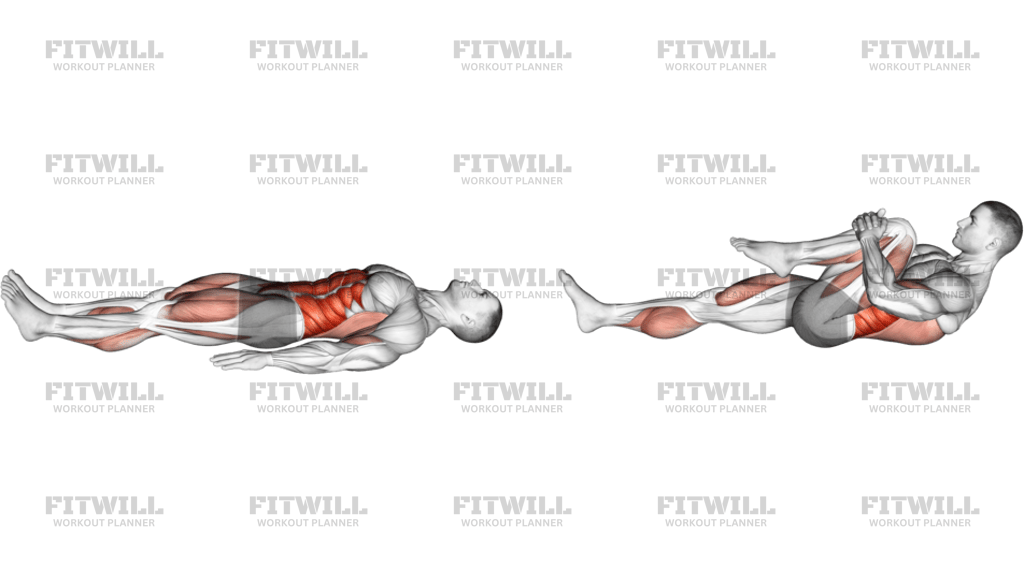
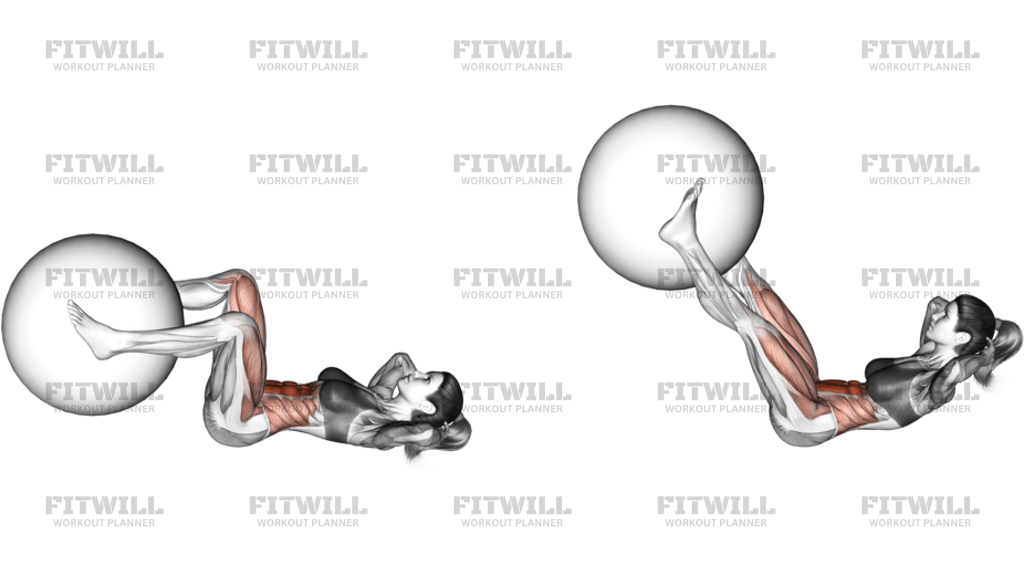
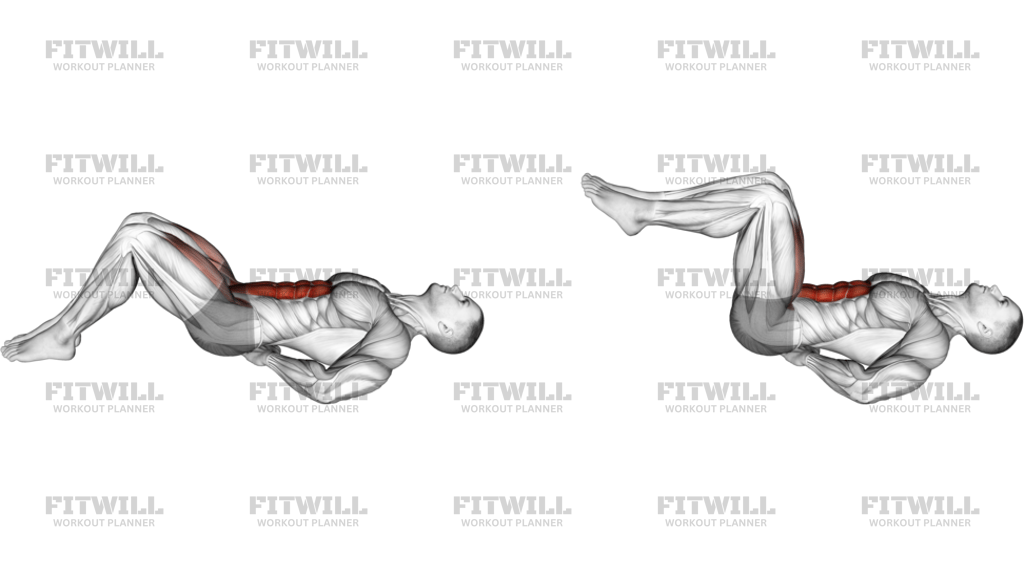
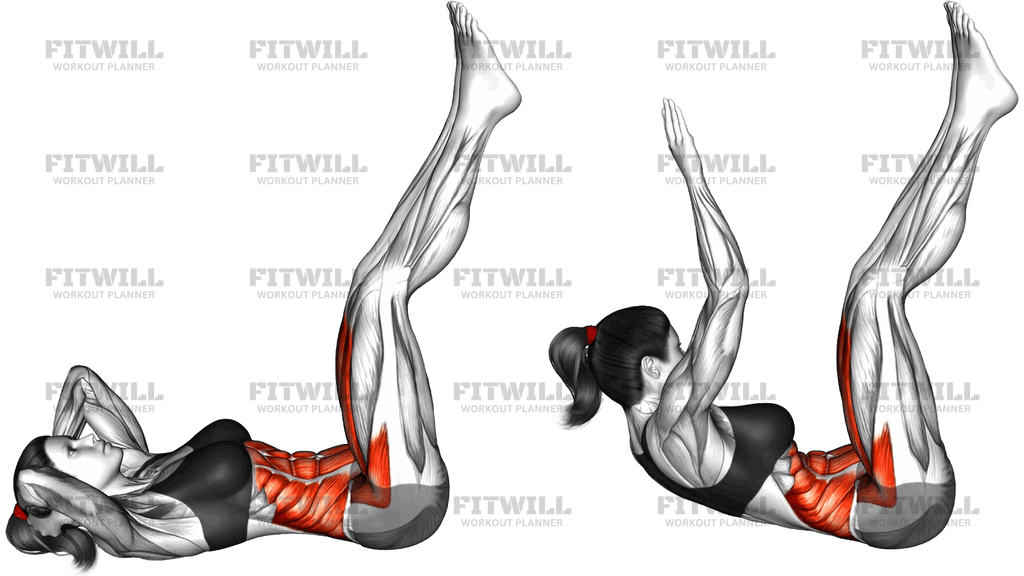
Bike Crunch And Feet Tap
The Bike Crunch And Feet Tap is a floor-based abdominal exercise that combines the rotational pulling action of a bicycle crunch with a controlled foot tap between repetitions. You lie on your back with your hands lightly supporting your head, knees bent, and alternate bringing one elbow toward the opposite knee while the other leg extends. Between each rotation, the bent leg's foot lowers to lightly tap the mat before you switch sides. This extra tap forces the lower abs to work eccentrically every single rep instead of letting the legs hover passively.
This movement suits anyone who has mastered the basic crunch and wants more challenge for the deep core and obliques without adding equipment. Because you control the pace entirely, it scales well: beginners can keep the tap slow and shallow, while more advanced trainees can extend the non-working leg closer to the floor to lengthen the lever and increase the load on the abdominal wall. It is a popular choice in core circuits, home workouts, and warm-up blocks because it needs nothing more than a mat and a few feet of floor space.
The main muscles at work are the rectus abdominis, which flexes the spine as you crunch, and the internal and external obliques, which rotate the torso to bring the elbow toward the opposite knee. The hip flexors assist as the legs drive the pedaling motion, and the transverse abdominis works continuously to keep your ribcage and pelvis stable as your limbs move. The lower abs in particular get extra demand during the tap phase, when they must control the leg's descent against gravity.
Setup matters more than speed here. Your lower back should stay pressed toward the mat for most of the rep, and the crunch should come from curling the ribs toward the pelvis rather than yanking the head forward. The elbows stay wide and relaxed; they are there to cradle the head, not to pull it. If you feel strain in your neck or your lower back arching off the floor, that is a signal to reduce the range or slow the tempo, not to push through.
A good rep rhythm looks like this: rotate and crunch, feel the side of your waist shorten, lower the foot for a light tap, then rotate to the other side without letting your shoulders drop all the way back down. Keeping constant tension on the abs from side to side is what separates productive reps from ones where momentum does the work. Aim for smooth, deliberate reps and stop the set when your form starts to unravel rather than counting to a target at any cost.
The most common use case is as a mid-rep or finisher core movement in a strength session, but it also works well as a stand-alone ab block of two to three sets. Because it trains flexion, rotation, and anti-extension control in one pattern, it pairs nicely with planks or dead bugs to cover the rest of the core's jobs in the same session.
[ Workout Log & Planner ]
Put your next workout in Fitwill
Keep your plan and training log ready when you are.


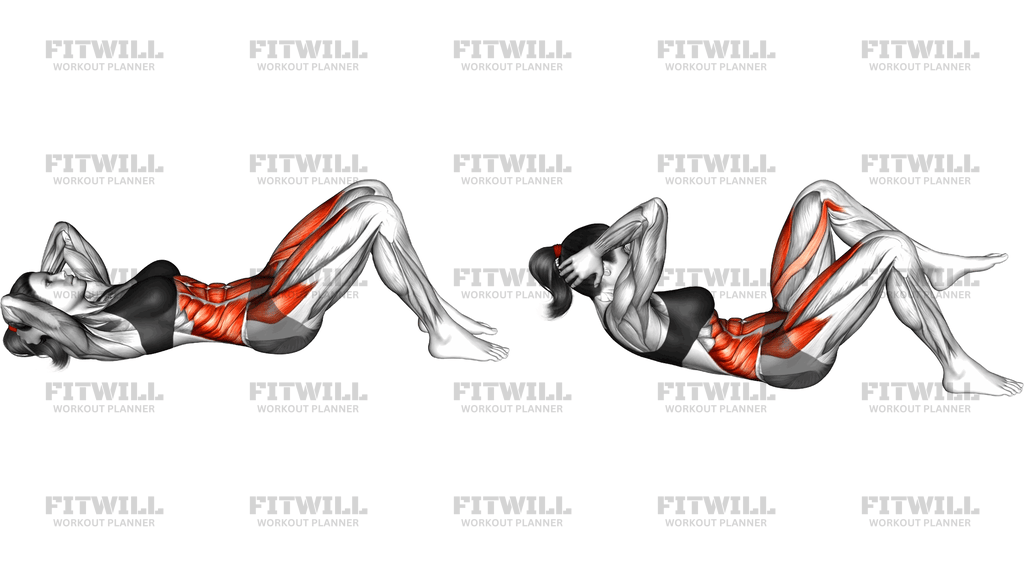
Instructions
- Lie on your back on an exercise mat with your knees bent and feet flat on the floor, hip-width apart.
- Place your fingertips lightly behind your ears with elbows flared wide, and let your shoulders relax away from your ears.
- Exhale and brace your abdomen, drawing your belly button gently toward your spine so your lower back settles toward the mat.
- Curl your head and shoulder blades off the mat and rotate your torso, bringing your right elbow toward your left knee as that knee draws in.
- Extend the opposite leg out low over the floor at the same time, keeping the knee soft and the toes reaching away.
- Lower the bent leg's foot until it lightly taps the mat, keeping tension in your abdomen as the leg descends.
- Rotate across to the other side, bringing your left elbow toward your right knee, and repeat the tap with the opposite foot.
- Keep your shoulder blades hovering above the mat for the whole set so the abs stay under tension between sides.
- Exhale as you crunch and rotate, inhale as you lower the foot to tap and transition across.
- When you finish the set, lower your shoulders and hips back to the mat together, release your hands from behind your head, and rest before the next set.
Tips & Tricks
- If your neck tires before your abs, rest one hand behind your head and place the other palm on the mat beside your hip for a few reps, then re-set both hands.
- The most common fault is pulling the elbow across the body instead of rotating the ribcage; think about steering the shoulder toward the knee, not the elbow toward it.
- During the foot tap, lower the foot under control rather than dropping it. If your lower back pops off the mat as the leg descends, do not extend the leg as far.
- Keep the extended leg just high enough that you can keep your back flat. A lower leg is harder only if you can still control it.
- Do not let both knees collapse toward your chest on each rep; the pattern is one knee in, one leg out, like pedaling a bike while tapping a toe down.
- Slow the transition between sides. Most people lose tension at the crossover point where the shoulders dip toward the mat.
- Grip the back of your head loosely, as if your fingers are just resting there. Squeezing the neck forward is a sign the crunch is too hard or you are fatiguing.
- Breathe out sharply on each rotation to help the ribs drop and the abs shorten; holding your breath usually causes the chest to lift and the low back to arch.
- If tapping both feet at the bottom of each rep feels too demanding, tap only every second rep and build up gradually.
Frequently Asked Questions
What muscles does the Bike Crunch And Feet Tap work?
The rectus abdominis drives the crunch, the internal and external obliques handle the rotation, and the hip flexors assist as the legs pedal and tap. The deep core stabilizes the pelvis throughout.
Is the Bike Crunch And Feet Tap good for beginners?
Yes, if the range is adjusted. Beginners can keep the extended leg higher, make the tap shallow, and move slowly until they can keep the lower back flat for a full set.
Why does my neck hurt when I do the Bike Crunch And Feet Tap?
Usually the hands are pulling the head forward instead of the abs curling the ribcage. Support the head lightly with fingertips, keep the elbows wide, and focus on lifting from the chest and ribs.
How close to the floor should the extended leg be?
Only as low as you can keep your lower back pressed toward the mat. If your back arches or lifts during the tap, raise the leg slightly on the next rep.
Should my shoulder blades touch the mat between reps?
No. Keeping them hovering a few centimeters off the mat maintains tension on the abs; letting them drop fully turns every transition into a rest.
Can I do the Bike Crunch And Feet Tap without a mat?
A mat is recommended because it cushions the pelvis and spine on a hard floor, but any firm, non-slip surface works in a pinch.
How is this different from a regular bicycle crunch?
The added foot tap makes the lower abs control each leg's descent to the floor between rotations, which removes the floating-leg rest phase and increases the control demand on the pelvis.
How many reps should I do?
Start with 8 to 12 controlled rotations per side, or about 20 to 30 seconds, and stop when your back arches or your neck takes over. Two to three sets is a solid starting volume.
What can I substitute if the Bike Crunch And Feet Tap is too hard?
A dead bug or a basic bicycle crunch with the feet resting on the floor trains similar muscles with less lower-ab load, letting you build up to the full tap.
Is it safe for my lower back?
For most people, yes, when the lower back stays supported by the mat and the range stays controlled. If you feel pinching or discomfort in the lumbar area, shorten the leg extension and reduce the set length.