Half Plyo Squat Core Shift
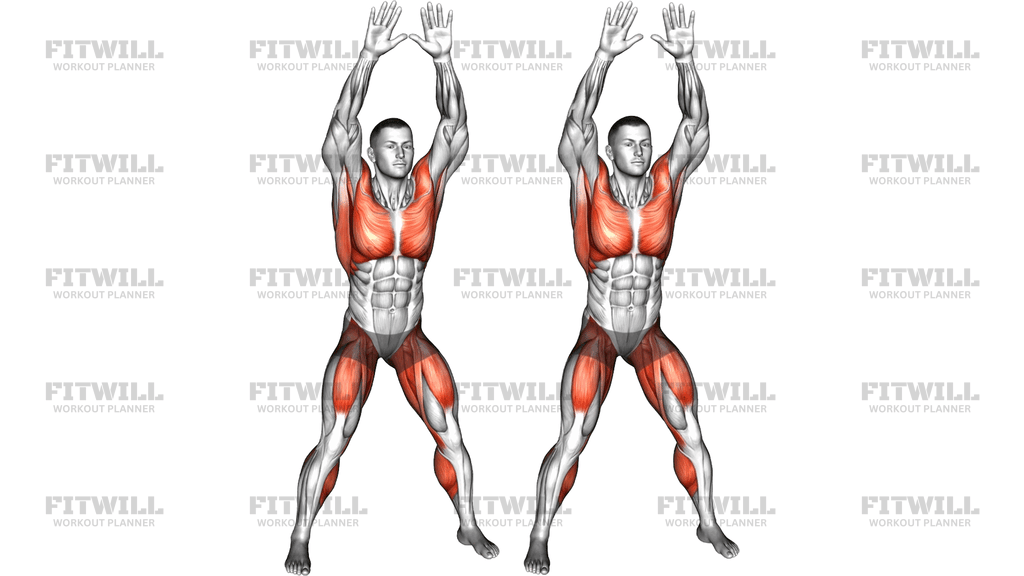
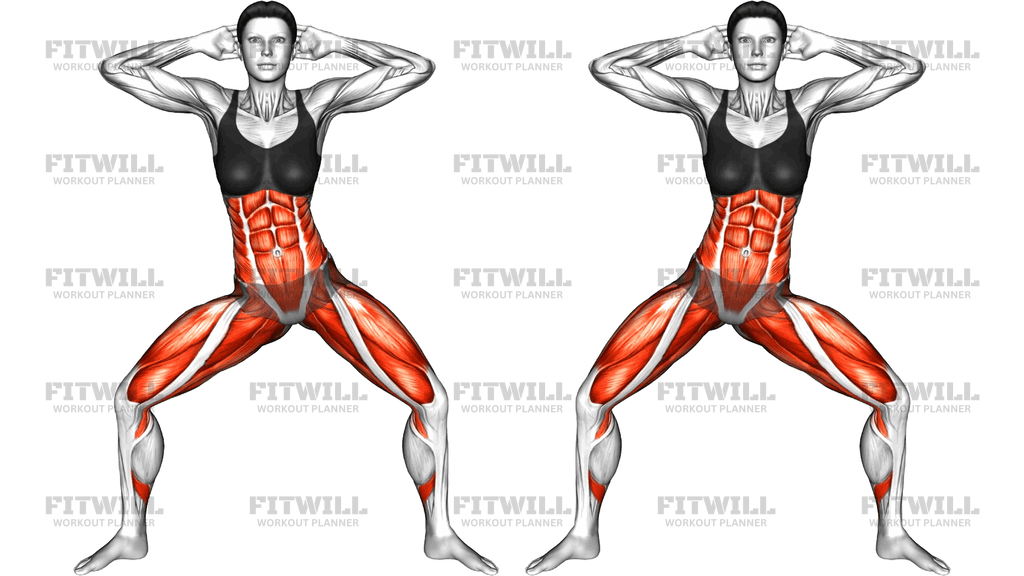
The Half Plyo Squat Core Shift is a bodyweight movement that combines a wide-stance half squat with an explosive lateral shift of the hips and torso from side to side. You hold a half-squat depth with hands behind your head, then repeatedly drive your pelvis and ribcage from one side to the other in a quick, springy rhythm. Each shift loads one leg harder while the opposite side of the core works to control and redirect your torso.
This movement earns its place in a warm-up, a conditioning circuit, or a standalone core-and-legs finisher. Because you stay in a partial squat the entire time, your quads and glutes work isometrically to hold depth while the obliques and deep core handle the rapid side-to-side transfers. The plyo quality of the shift teaches your body to produce and absorb force quickly in the frontal plane, which is something slow squats and planks simply do not train.
The setup matters more than most people expect. A wide stance with toes turned slightly out gives you the base to shift without your knees caving in, and placing your hands behind your head keeps your arms out of the movement so the work stays in your legs and trunk. If your stance is too narrow, the shift turns into a wobbly lean; if it is too wide, your knees and groin take strain you do not need.
To execute it well, drop into a comfortable half squat where your thighs are roughly parallel to a quarter-to-half depth, chest tall, weight spread across both feet. From there, shift your hips sharply to the left, letting the left knee bend a little more while the right leg lengthens, then immediately spring the shift to the right. The movement should feel like a controlled pendulum driven from the hips, not a sway of the shoulders. Keep your head and chest facing forward throughout so the rotation happens at the hips and trunk, not the neck.
Common use cases include athletic warm-ups for sports that involve cutting and change of direction, fat-loss circuits where you want continuous leg and core work without equipment, and rehab-style conditioning for hips that need frontal-plane loading in a low-skill pattern. Because there is no jump impact, it sits at the gentler end of plyometric work, making it approachable if you are new to explosive training.
For safety, keep the shift brisk but never sloppy. If your knees dive inward, your lower back rounds, or you lose the half-squat depth and start standing tall between shifts, slow the tempo down. Stop the set when the rhythm degrades rather than pushing through fatigue with poor mechanics.
[ Workout Log & Planner ]
Put your next workout in Fitwill
Keep your plan and training log ready when you are.


Instructions
- Stand with your feet roughly one and a half to two shoulder-widths apart, toes turned out about 15 to 30 degrees.
- Clasp your hands lightly behind your head with elbows flared wide, and brace your abs as if bracing for a light push.
- Sink into a half squat until your thighs reach a partial depth, keeping your chest tall, shins near-vertical, and weight spread evenly across both feet.
- Hold this squat depth for the entire set — do not stand up between repetitions.
- Shift your hips explosively to the left so your left knee bends deeper and your right leg lengthens, letting your torso tilt slightly toward the left.
- Immediately spring the shift back through center and over to the right, loading the right leg as the left leg straightens.
- Keep the head and chest facing forward the whole time; the shift comes from the hips and trunk, not the shoulders.
- Exhale sharply on each shift and inhale briefly through the transitions, keeping the breath rhythmic with the movement.
- Continue shifting side to side at a quick, springy tempo for the target time or reps.
- To finish, stop shifting at center, rise out of the half squat under control, and shake out your legs before the next set.
Tips & Tricks
- If your knees collapse inward as you shift, widen your focus to pushing the working knee out over the pinky toe on every rep.
- The most common fault is swaying the shoulders instead of driving the hips — imagine a rope pulling your belt buckle from side to side while your upper body stays quiet.
- Do not let the half squat creep upward as you fatigue; a quick check is that your thighs should feel a constant low burn by the middle of the set.
- Keep your hands behind your head rather than pulling on your neck — the elbows only flare, the fingers rest, and your trunk does the work.
- Softer is not always safer here; a crisp, snappy shift with a firm landing foot is easier on the knees than a slow, mushy drift.
- If your inner thighs cramp, shorten the shift range slightly for the first few sets and let the adductors adapt before going full range.
- Keep your heels glued to the floor. If you rock onto the outer edges of your feet during the shift, shorten the stance a touch and rebuild.
- Treat each side-to-side cycle as one rep and count time under tension instead — 20 to 40 seconds per set keeps the tempo honest.
- Place this exercise early in a session when your hips are fresh, or use light 15-second bouts as a dynamic warm-up before squats or lunges.
Frequently Asked Questions
What muscles does the Half Plyo Squat Core Shift work?
The quads and glutes hold the half squat and absorb each shift, while the obliques and deep core control the side-to-side transfer. The adductors and calves contribute as stabilizers throughout.
Is the Half Plyo Squat Core Shift suitable for beginners?
Yes, because there is no jump and no impact. Beginners should simply use a smaller shift range and a slightly higher squat depth until the rhythm feels natural.
How deep should the squat be during the Half Plyo Squat Core Shift?
Aim for a partial depth — roughly a quarter to half of a full squat — and hold it for the entire set. The key is that depth stays constant; if you keep standing up between shifts, reduce the tempo or range.
Why are the hands held behind the head in this exercise?
The hands-behind-head position takes the arms out of the movement so the shift has to come from the hips and trunk. It also makes it obvious if you start cheating by swinging your shoulders.
Should I feel the Half Plyo Squat Core Shift in my legs or my waist?
Both, and that is the point. Your thighs should feel a steady burn from holding the half squat, while the sides of your waist work on every redirect. If you feel nothing in one area, your range or tempo is probably too small.
What is the most common mistake in the Half Plyo Squat Core Shift?
Turning it into an upper-body sway. The hips should drive the shift while the head and chest stay facing forward — if your shoulders are doing the traveling, slow down and re-anchor from the pelvis.
Can I substitute the Half Plyo Squat Core Shift if it bothers my knees?
Try a slower standing hip shift with a shallower squat depth, or a lateral lunge pattern that lets one leg rest between reps. If knee discomfort persists at shallow loads, get it assessed before continuing.
How does the Half Plyo Squat Core Shift differ from a jumping squat?
The explosive part here is lateral and stays below standing height — you redirect force side to side instead of jumping vertically. That makes it lower-impact while still training quick force changes.
Where should this exercise fit into my workout?
It works well as a dynamic warm-up for leg day, a mid-circuit conditioner in fat-loss training, or a finisher paired with planks and lunges. Keep the sets short — 20 to 40 seconds — so the shifts stay crisp.