Hopping Knee Drive
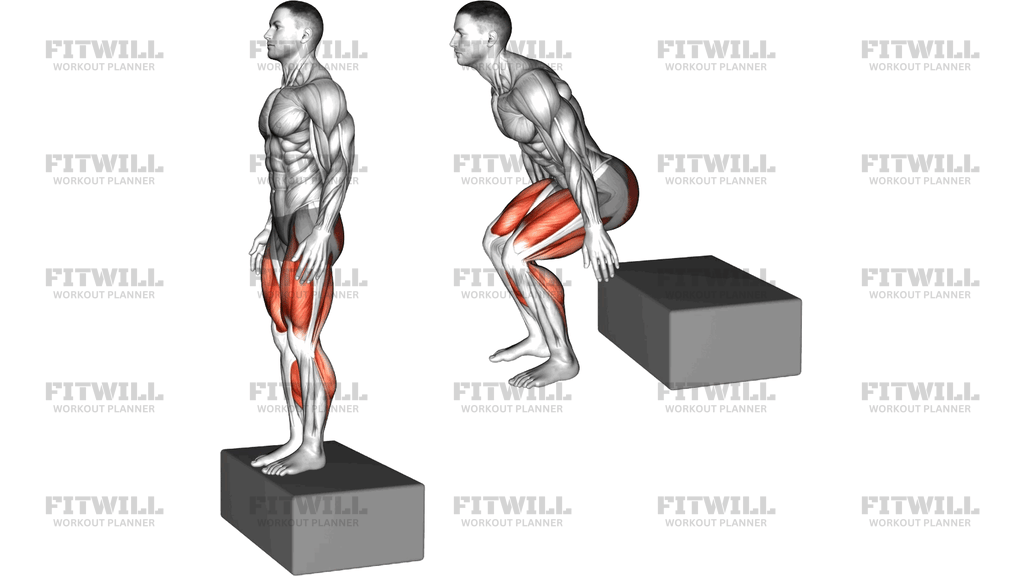
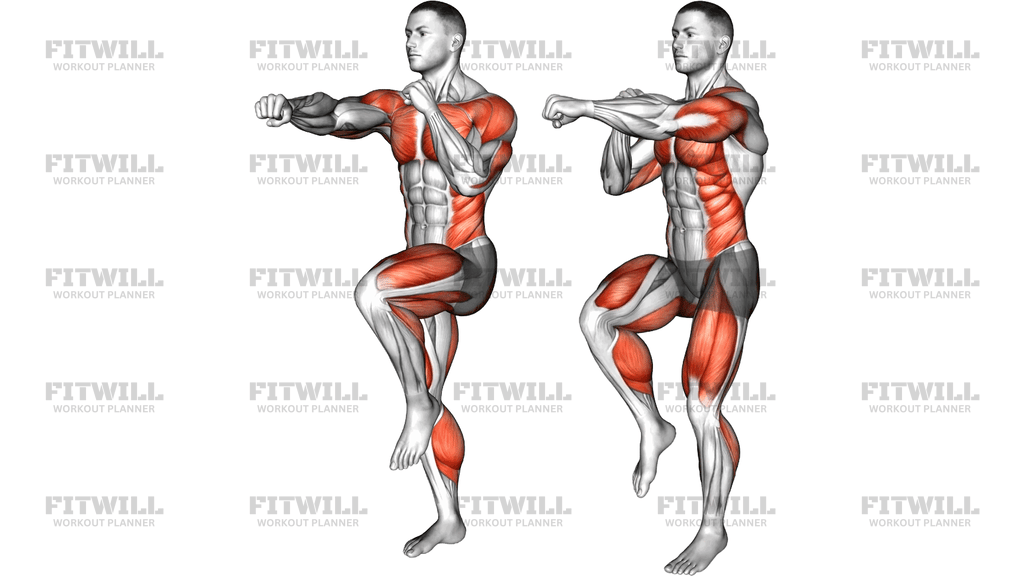
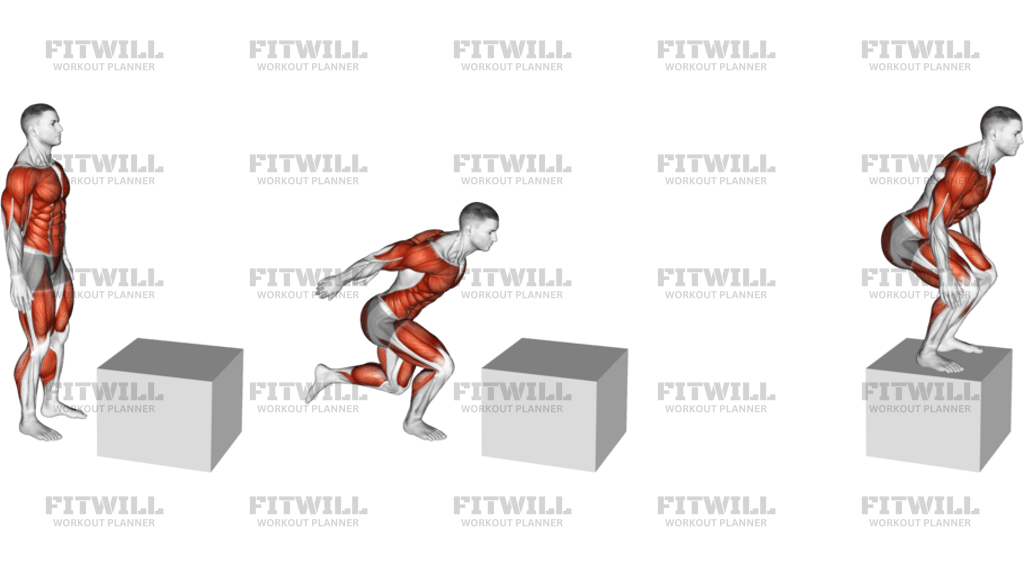
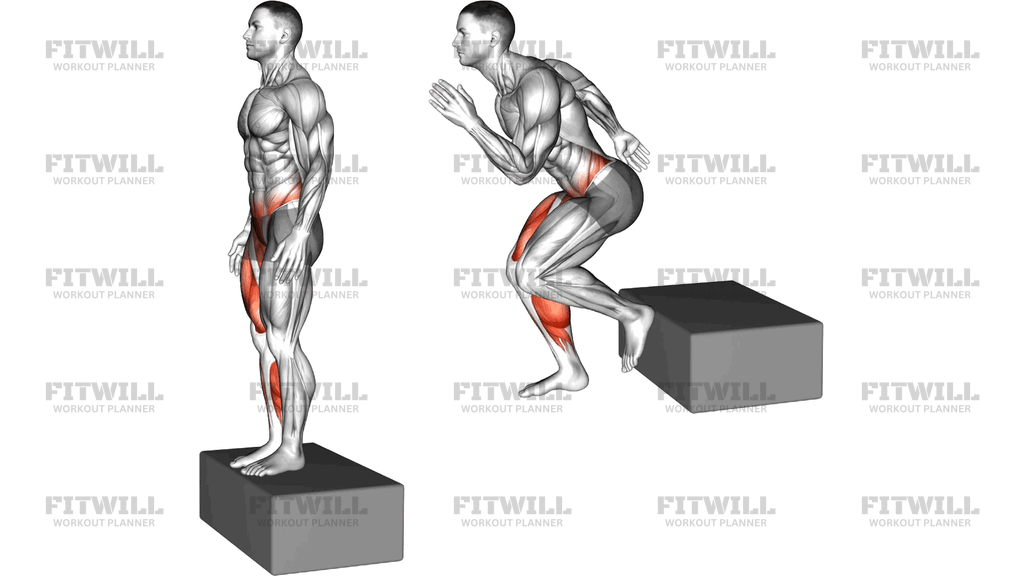
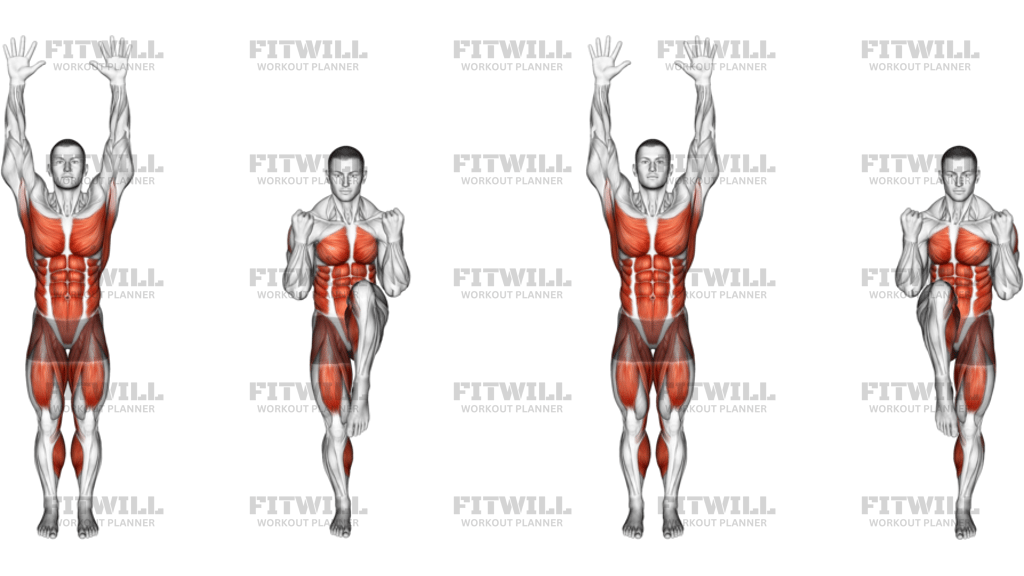
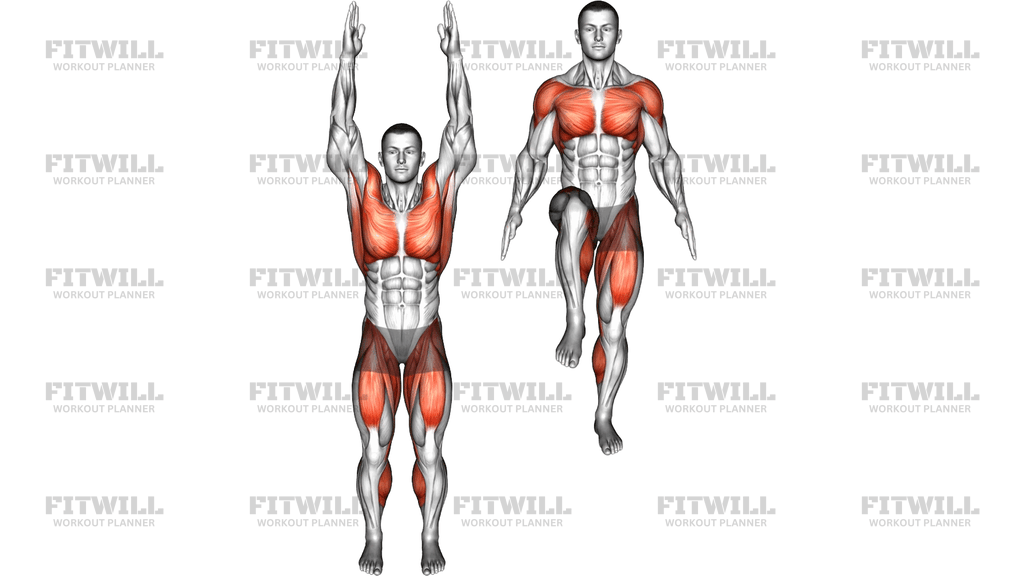
The Hopping Knee Drive is a plyometric bodyweight drill that combines a vertical hop with an explosive single-leg knee drive. You start standing tall with both arms reaching overhead, then dip slightly, hop off both feet, and as you rise you snap one knee up toward your chest while your arms swing down and back to power the movement. You land softly on the standing leg, reset, and repeat, alternating sides or working one side at a time depending on your goal.
This exercise earns its place in athletic training because it teaches the hip flexors and quadriceps to fire fast while the calves and ankle stabilizers absorb and redirect force on landing. Sprinters, jumpers, and field-sport athletes use knee-drive patterns constantly, so training that pattern with a hop builds a direct carryover to acceleration, first-step quickness, and vertical power. The arm swing is not decoration either — driving the arms down hard as the knee rises is what separates a crisp, high knee drive from a lazy leg lift.
Because it demands coordination between the upper and lower body, the Hopping Knee Drive also doubles as a conditioning tool. Strung together in continuous reps, it raises your heart rate quickly and challenges your core to keep your torso upright while one leg cycles high and the other handles the landing. The highlighted muscles in the movement — the quads, hip flexors, glutes, and calves — do most of the work, while the abs brace to stop you from folding forward at the waist.
Setup and landing mechanics matter more than height here. You need a flat, non-slippery surface and enough ceiling clearance to reach overhead with both arms. A tall, braced starting posture keeps your ribs stacked over your pelvis, which lets the knee drive come from the hip rather than from a lean or a slump. If you start each rep sloppy, you will land sloppy, and that is where knees and ankles get grumpy.
To execute it well, think of the hop and the knee drive as one burst, not two separate actions. Dip to about a quarter squat, explode up, and pull the knee to at least hip height while your arms slash down beside your ribs. Land on the ball of the standing foot with a soft knee bend, hold your balance for a beat, then reset your arms overhead before the next rep. Beginners can do the drill slowly, stepping instead of hopping, until the knee-drive pattern feels natural.
You will see this drill in warm-ups, plyometric blocks, and conditioning circuits. It needs no equipment and very little space, which makes it easy to program anywhere from a gym turf strip to a hotel room. Keep the reps quality-focused — stop the set when your knee height drops or your landings get loud, because that is your signal that power has left the building.
[ Workout Log & Planner ]
Put your next workout in Fitwill
Keep your plan and training log ready when you are.


Instructions
- Stand on a flat, non-slip surface with your feet hip-width apart and both arms extended straight overhead, palms facing each other.
- Brace your core lightly and pull your ribs down so your torso is tall and stacked over your hips.
- Push your hips back and bend your knees into a shallow quarter squat, letting your arms stay long overhead or begin to load behind you.
- Explode vertically off both feet, and as you rise, drive one knee up toward your chest to at least hip height.
- Swing both arms down forcefully past your hips in sync with the knee drive to add power to the lift.
- Keep your torso upright — resist the urge to lean your chest back or hunch forward as the knee comes up.
- Land softly on the ball of the standing leg with a bent knee, letting the other foot hang just off the floor, and hold your balance for a moment.
- Exhale sharply on the hop and knee drive, then inhale as you land and stabilize.
- Return the driven foot to the floor, raise your arms back overhead, and reset your stance before the next repetition.
- Alternate legs each rep for balanced coordination, or complete all reps on one side before switching.
Tips & Tricks
- If your knee drive tops out below hip height, the problem is usually a lazy arm swing — snap the hands down past your hips and the knee will follow.
- Loud, slapping landings mean you are stiff-legged. Push your hips back and let the ankle, knee, and hip bend together to absorb the landing quietly.
- Do not let your lower back arch as the arms reach overhead; if your ribs flare, brace your abs and reach slightly wider instead of higher.
- Rushing reps back to back turns this into a sloppy cardio move. Take one full breath and rebalance between hops when you are learning the pattern.
- Watch for the standing knee caving inward on landing. Think of spreading the floor with your foot and keeping the knee tracking over the toes.
- If you keep losing balance after each hop, shorten the hop height before you shorten the knee drive — control first, then amplitude.
- Alternate legs every rep if you want coordination and conditioning; block one side at a time if you want to fix a weaker or stiffer hip flexor.
- Do this drill early in a workout, while you are fresh, when the goal is power. Save high-rep sets for conditioning days when quality matters less.
- Train barefoot or in flat shoes on a firm surface so your toes can grip and your ankles can react to each landing.
Frequently Asked Questions
What muscles does the Hopping Knee Drive work?
The quadriceps and hip flexors power the hop and the knee lift, while the glutes and hamstrings extend the hip on takeoff. The calves and ankle stabilizers handle the landing, and the core keeps your torso upright throughout.
Is the Hopping Knee Drive suitable for beginners?
Yes, as long as you scale it. Start by stepping one knee up while swinging the arms down with no hop, then add a small hop once the arm-and-leg coordination feels natural.
How high should I drive my knee during the Hopping Knee Drive?
Aim for at least hip height on each rep. If your knee drops noticeably as the set continues, that is your cue to rest, since knee height is the clearest sign the power is fading.
Should I alternate legs or do all reps on one side?
Alternating legs each rep builds coordination and a conditioning effect, which suits warm-ups and circuits. Working one side at a time makes it easier to notice and correct a weaker or tighter hip flexor.
What is the most common mistake in the Hopping Knee Drive?
Leaning the torso backward as the knee rises. This usually means the hip flexors are not doing their job, so brace your abs, keep your ribs stacked over your pelvis, and let the knee come up without tipping your chest back.
Can I do the Hopping Knee Drive every day?
Light, low-volume reps are fine as a daily warm-up, but true plyometric sets with maximal hops need recovery. Keep intense sessions to two or three days per week so your ankles and knees stay fresh.
What can I substitute if hopping is hard on my joints?
Do a controlled standing knee drive with a strong arm swing and no hop, or step the knee up onto a low step platform. You keep the hip-flexor and core pattern while removing the landing impact.
Do I need any equipment or much space for the Hopping Knee Drive?
No equipment is needed — just a flat, non-slip surface and enough ceiling clearance to reach both arms overhead. A small clear area of a meter or two is plenty.
Why do the arms swing down instead of staying overhead?
The downward arm swing counterbalances the rising knee and adds force to the drive, much like a sprinter's arm action. Keeping the arms frozen overhead kills both the height of the knee and the power of the hop.
Is it safe for my knees?
When your landings are soft and your standing knee tracks over your toes, the drill is generally well tolerated. If you currently have knee pain or a recent lower-body injury, check with a professional before adding hop-based drills.