Ring Single Leg Curl With Towel
The Ring Single Leg Curl With Towel is a bodyweight hamstring exercise performed lying on your back with one heel resting on a folded towel (or a low-hung ring) that slides across a smooth floor. From a hip-bridge position, you pull your heel toward your glutes by bending the knee, then slide it back out under control. Because the towel offers almost no friction, your hamstrings have to generate all of the force themselves, both to bend the knee and to keep the leg from shooting back out on the return.
This movement fits two groups especially well: lifters who train at home with minimal equipment, and anyone whose knees dislike machine leg curls or whose hips dislike prone positions. It also works as an accessory lift for squat and deadlift days, since strong hamstrings help control hip extension and protect the back of the thigh during sprinting and heavy pulls.
The main muscles worked are the hamstrings, which flex the knee and assist in extending the hip. The glutes hold the bridge, the lower back and deep core stabilize the pelvis, and the calf muscles assist around the ankle. Working one leg at a time doubles the load on each hamstring without adding external weight, and it exposes left-right differences that a two-legged version can hide.
Setup matters more here than in most floor exercises. The floor must be slick enough for the towel to glide — hardwood, tile, or a smooth laminate works well, while carpet usually does not. Your heel should sit in the center of the towel so it cannot slip out mid-rep, and your arms should be flat on the floor beside you for balance. If the towel slides too freely, fold it into more layers; if it grips, a slicker surface or a pair of furniture sliders solves it.
To execute it well, lift your hips into a straight line from shoulders to heel before the first rep and keep them there. Pull the heel in by driving the knee up and back toward your chest, then return the leg by resisting the slide rather than letting gravity take it. The eccentric — the leg extending back out — is where most of the hamstring demand lives, so rushing it turns a hard exercise into an easy one.
Start with lower reps than you expect to need; single-leg sliding curls are genuinely difficult, and form tends to break at the hips before the hamstrings fatigue. If you cannot hold the bridge for clean reps, regress to the two-leg version with both heels on towels, then earn your way back to the single-leg work.
[ Workout Log & Planner ]
Put your next workout in Fitwill
Keep your plan and training log ready when you are.


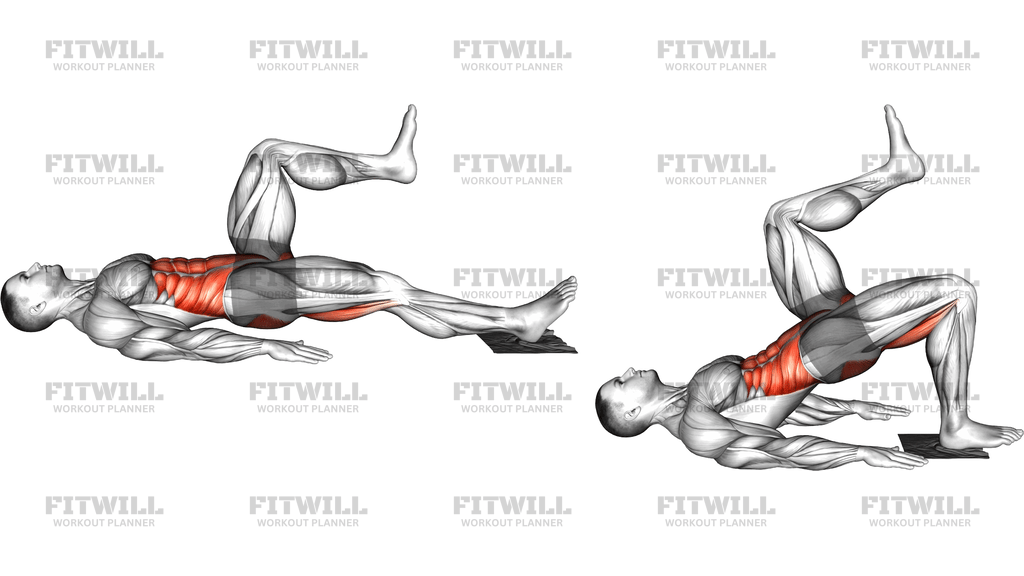
Instructions
- Lie on your back on a smooth floor with your arms flat at your sides and palms facing down.
- Place the heel of your working leg on a folded towel so the fabric sits under and around the heel, and bend your other knee up toward your chest or plant that foot flat for balance.
- Brace your abs and press your upper arms into the floor to create a stable base.
- Drive through the heel on the towel and lift your hips until your body forms a straight line from shoulders to knee.
- Keeping the hips high, bend your working knee and slide the towel toward your glutes until the knee is bent roughly 90 degrees.
- Pause briefly at the top with the knee bent and hips extended, feeling the hamstring and glute working together.
- Slowly slide the heel back out, resisting the leg's desire to straighten quickly, and stop just before the knee locks out.
- Exhale as you pull the heel in, inhale as you extend back out.
- Complete all reps on one leg, then reset the towel and switch sides.
- If your hips drop mid-set, rest and re-bridge rather than grinding through reps with a sagging pelvis.
Tips & Tricks
- If your hips sag toward the floor as the leg extends, shorten the range: stop the return a bit earlier and rebuild the bridge consciously each rep.
- A towel on carpet barely slides and forces you to yank the leg in; move to hardwood or tile, or swap the towel for furniture sliders.
- Do not let the working knee drift outward as you curl — keep the kneecap pointing at the ceiling so the hamstring does the work in line with the hip.
- Point your toes slightly up (dorsiflexion) to keep the heel planted in the towel; a floppy ankle lets the heel roll and slip out.
- The eccentric is the exercise: if the leg shoots back out in under a second, add a three-count return before adding reps.
- Keep the non-working leg still. Swinging it for momentum rocks the pelvis and steals tension from the hamstring you are training.
- Press the arms down harder when the rep gets tough — that extra base of support often saves the last two or three reps.
- If your lower back, not your hamstrings, feels the work, you are probably arching instead of bridging; squeeze the glutes to keep the pelvis tucked under slightly.
- Master the two-leg towel curl before the single-leg version; jumping straight to one leg usually means hip drop and shortened range.
Frequently Asked Questions
Which muscles does the Ring Single Leg Curl With Towel work?
The hamstrings are the primary movers, bending the knee and assisting hip extension. The glutes hold the bridge, while the lower back and core stabilize the pelvis throughout the slide.
Why use a towel instead of a leg curl machine?
The towel creates a low-friction sliding surface, so your own hamstring strength controls the leg in both directions. It loads the eccentric phase heavily, which many home setups cannot do without weights.
What floor surface works best for this exercise?
Smooth hardwood, tile, or laminate lets the towel glide properly. Thick carpet creates too much friction, so either find a slick surface or use furniture sliders instead of the towel.
Can beginners do the Ring Single Leg Curl With Towel?
Yes, but most beginners should start with the two-leg version, keeping both heels on towels and curling together. Move to the single-leg variation once you can hold a solid bridge for repeated controlled reps.
Why do my hips drop during the set?
Your glutes and core are fatiguing before your hamstrings do. Rest, re-bridge with a deliberate glute squeeze, and consider shorter sets until the hip position holds without coaching yourself every rep.
Should the non-working leg be bent or straight?
Either works, but bending that knee toward your chest shortens the lever and makes balancing the bridge easier. Keeping it extended on the floor is a harder stability option.
How many reps and sets should I do?
Start with 2-3 sets of 5-8 reps per leg, focusing on a slow return. Because the eccentric is so demanding, quality reps at lower numbers build more hamstring strength than grinding out sloppy high-rep sets.
Is the Ring Single Leg Curl With Towel safe for the lower back?
It is generally joint-friendly when the bridge position is held with glutes engaged rather than a lumbar arch. If you feel strain in the lower back instead of the hamstrings, reduce the range and reset your pelvic position before continuing.
What can I substitute if I have no towel or smooth floor?
Furniture sliders, a slick sock on hardwood, or a low-set ring under the heel all replicate the sliding action. A stability ball leg curl is a reasonable alternative that trains a similar knee-flexion pattern.