Cat Cow Circle
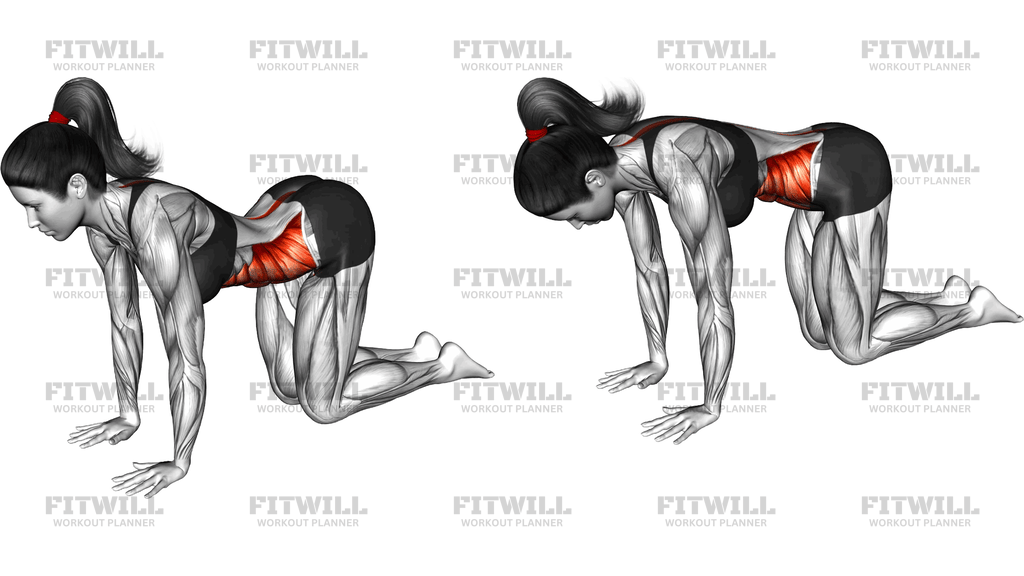
Cat Cow Circle is a mobility exercise performed on all fours that takes the classic cat cow spinal flexion and extension pattern and adds a circular, rotating component. Instead of simply arching and rounding straight back and forth, you roll the spine and pelvis in a continuous loop, drawing a circle with the midsection. The abdominals light up as you tuck the pelvis and round the back, and the muscles along the spine work as you lift the chest and tilt the tailbone in the opposite direction.
This movement is useful for nearly anyone with a stiff or tired back. Desk workers who sit for long hours, lifters who want to warm up before squats or deadlifts, and people easing back into training after a layoff all benefit from it. Because the circle adds rotation to flexion and extension, it reaches the obliques and the smaller segmental muscles of the spine that a straight cat cow can miss.
The setup is simple but matters. Hands under the shoulders, knees under the hips, spine neutral, weight spread evenly across the palms. If the hands drift forward or the knees sit too far back, the pelvis cannot tilt freely and the circle turns into a sloppy rock. Keeping the knees roughly hip-width and the toes on the floor, as shown in the starting position, gives you a stable base so the motion comes from the spine and pelvis rather than from shifting your whole body.
To execute well, move slowly and let each vertebra participate. Start the circle by tucking the tailbone under, rounding the low back, then the mid back, then the neck. Continue the loop by tilting the tailbone up, dropping the belly, lifting the chest and gaze, and rolling back into the rounded position. One full revolution should take several seconds. The breath leads the motion: exhale as you round and tuck, inhale as you arch and open.
Expect to feel a deep stretch through the abs on the rounded phase and a gentle extension through the chest and spine on the arched phase. There is no load, no speed requirement, and no rep target you need to chase. A common practice is five to ten circles in each direction, either as a morning mobility routine or as the first movement in a warm-up. If your knees are sensitive, pad them with a folded towel, and if any position causes sharp pain rather than a stretch, shrink the circle until the discomfort disappears.
[ Workout Log & Planner ]
Put your next workout in Fitwill
Keep your plan and training log ready when you are.


Instructions
- Place an exercise mat on the floor and kneel down, then set your hands on the mat directly under your shoulders with your fingers spread and pointing forward.
- Position your knees directly under your hips about hip-width apart, rest the tops of your feet on the mat with toes pointing back, and lengthen your spine so your back is flat from head to tailbone.
- Engage your core lightly and look down at the mat so your neck stays long and in line with your spine.
- Begin the circle by tucking your tailbone under, exhaling, and rounding your lower back, then mid back, letting your head drop last so you finish in a fully rounded cat position.
- Without pausing, continue the loop: tilt the tailbone up and back, let your belly sink toward the floor, press gently through your palms, and lift your chest forward into the cow position with your gaze slightly up.
- Roll from the arched position back into the rounded position in one smooth, continuous arc, as if your torso is tracing a circle viewed from the side.
- Inhale through the arching half of the circle and exhale through the rounding half so the breath drives the movement.
- Complete five to ten slow circles in one direction, then reverse and perform the same number of circles the opposite way.
- Finish by returning to a neutral spine, sitting your hips back toward your heels, and taking two or three easy breaths before standing up or moving to the next exercise.
Tips & Tricks
- Move at the speed of your breath, not faster. Rushing the circle flattens the curve and turns the exercise into a hip rock.
- The most common mistake is hinging only at the hips, swaying the torso back and forth while the low back stays locked. Focus on tilting the pelvis first and letting the rounding follow up the spine.
- Keep your arms straight but not rigid. Locked elbows plus shrugged shoulders steal the arch from your upper back, so press the floor away slightly and let the shoulder blades glide.
- If your wrists complain in the arched phase, shift a little more weight into your knees or make loose fists and support on the knuckles.
- Make the circle smaller before you make it bigger. A tight, precise loop through the mid spine beats a huge, loose swing of the whole torso.
- Pad your kneecaps with a folded towel if the mat is thin, since you will spend the whole set loaded on them.
- Do not crank your neck back at the top of the arch. Let the head follow the chest by one beat so the extension travels through the whole spine.
- If one direction of the circle feels noticeably stiffer, add a couple of extra reps that way rather than skipping it.
- Use this before heavy lower-body lifting to free up the hips and spine, but keep the range moderate in that context so you warm up rather than fatigue the stabilizers.
Frequently Asked Questions
What muscles does the Cat Cow Circle work?
The primary muscles are the abdominals, especially the rectus abdominis as you round, with the deep core assisting. The erector spinae along the spine and the obliques work during the arching and rotational parts of the circle.
How is Cat Cow Circle different from a regular Cat Cow?
A regular Cat Cow moves straight between rounded and arched positions, while the Cat Cow Circle rolls through those positions in a continuous loop, adding a rotational component that reaches the obliques and mid-back segments more fully.
How many reps of the Cat Cow Circle should I do?
Five to ten slow circles in each direction is a solid dose, whether you are warming up or doing standalone mobility work. Quality of the spinal wave matters far more than the rep count.
Is the Cat Cow Circle safe for beginners?
Yes, it is one of the most accessible spinal mobility drills because it is body-weight only and performed close to the floor. Beginners should start with a smaller circle and focus on feeling the pelvis tilt first.
Why does my lower back pinch when I arch during the Cat Cow Circle?
A pinching sensation usually means you are extending mostly at one segment instead of distributing the arch along the spine. Shrink the circle, soften the arch, and think about lifting the chest forward rather than dumping into the low back.
Should I breathe in or out during the Cat Cow Circle?
Exhale as you tuck the pelvis and round into the cat phase, and inhale as you tilt the tailbone up and expand into the cow phase. Coordinating breath with direction makes the motion smoother and more effective.
Can I do the Cat Cow Circle every day?
Yes, it is a gentle, unloaded movement that most people tolerate daily, especially as a morning routine or desk-break reset. If your back feels irritated afterward, reduce the range or frequency.
What can I substitute if kneeling is uncomfortable for the Cat Cow Circle?
You can perform a seated version on a chair, circling the pelvis and spine with hands resting on your knees, or do a standing version with hands on hips. The pattern of rounding and arching in a loop stays the same.
Should I use a mat for the Cat Cow Circle?
An exercise mat is recommended because you spend the entire set on your hands and knees. It cushions the kneecaps and gives your palms a non-slip surface to press into.
When is the best time to do the Cat Cow Circle in a workout?
It works best at the very start of a session as a warm-up for the spine, hips, and core, or on its own during mobility breaks. Doing it before squats, deadlifts, or any hinging pattern helps the back move freely under load.