Lying Crossed Legs Twist
The Lying Crossed Legs Twist is a supine rotational stretch performed on a mat with no equipment beyond your own body weight. You lie flat on your back with your arms spread into a T position, cross one knee over the other, and slowly lower the crossed legs toward the floor on one side while keeping both shoulders anchored down. The result is a deep, controlled rotation through the lumbar spine, obliques, and outer hips.
This movement is especially useful for people who spend long hours sitting, since prolonged sitting tends to tighten the hip rotators and the muscles along the sides of the lower back. It is also a common cool-down choice after running, cycling, or heavy lower-body training, when the glutes and outer hips feel dense and restricted. Because the floor supports your spine throughout, it is gentler on the lower back than standing rotational stretches and easier to modulate.
The primary area worked is the obliques on the side being lengthened, along with the deep hip rotators and glutes of the top leg. The lower back muscles on the stretched side, including the quadratus lumborum, also receive a meaningful release. The T-position arm placement keeps the chest and shoulders open and prevents you from cheating the stretch by rolling the whole torso toward the legs.
Setup matters here. Crossing the legs before you rotate changes the mechanics of the twist compared to a standard spinal twist with both knees bent together: the stacked knees create a longer lever and direct the stretch more specifically into the outer hip and waist. Keep the movement slow and deliberate rather than bouncing or forcing the knees down, and let the opposite shoulder stay heavy on the mat. If the shoulder wants to lift, you have gone further than your current rotation allows.
To perform it well, exhale as the legs lower, hold the end position while breathing steadily, and use each exhale to settle a little deeper if it feels appropriate. Then bring the legs back to center under control and repeat on the other side, since the two sides often feel noticeably different. Hold each side for 20 to 40 seconds, and avoid the movement if twisting provokes sharp lower-back pain rather than a comfortable stretch sensation.
[ Workout Log & Planner ]
Put your next workout in Fitwill
Keep your plan and training log ready when you are.


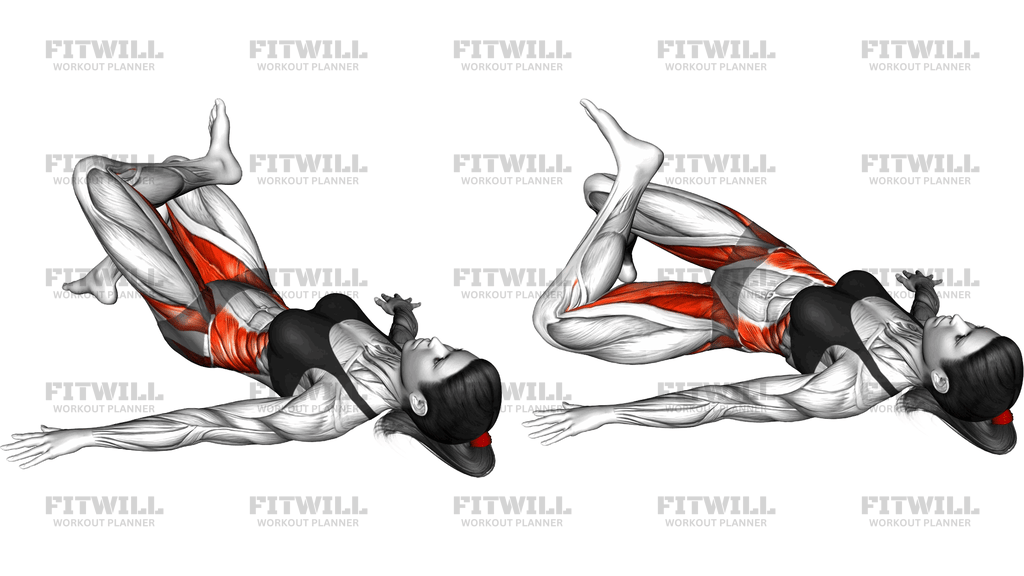
Instructions
- Lie flat on your back on an exercise mat with your legs extended and your arms spread out to the sides at shoulder height, palms facing down to form a T shape.
- Bend both knees and lift your feet off the floor until your hips and knees are at roughly 90 degrees.
- Cross your right leg over your left so the right knee rests on top of the left, keeping the knees stacked and feet relaxed.
- Gently brace your core to keep your ribcage and shoulders settled against the mat.
- Slowly lower both crossed knees toward the floor on your left side, letting the rotation come from your spine and hips rather than momentum.
- Stop when you feel a comfortable stretch along your right waist, outer right hip, and lower back, keeping both shoulders in contact with the mat.
- Hold the end position for 20 to 40 seconds, breathing slowly and letting each exhale soften the stretch slightly.
- Engage your core to draw the crossed knees back up to center with control.
- Switch the crossing so the left leg is on top, then repeat the rotation to the right side for the same hold.
- Return to center, extend your legs, and rest briefly before your next round.
Tips & Tricks
- If your top shoulder lifts off the mat as the knees drop, you are rotating past your available range; stop the descent a few degrees earlier and re-ground the shoulder.
- Do not force the knees all the way to the floor. The stretch comes from the rotation itself, and pushing the knees down often rolls the torso and loses tension in the obliques.
- Keep the knees stacked throughout. If the top knee drifts forward or separates, the twist shifts away from the outer hip and into the lower back.
- Placing a folded towel or low cushion under the downward knee can make the position comfortable for tighter hips without shortening the stretch.
- Avoid letting your head turn sharply to the opposite side; let the neck stay relaxed and neutral to protect it during the rotation.
- If your lower back complains during the twist, reduce the lever length by not pulling the knees as high toward the chest at the start.
- Breathe continuously through the hold. Holding your breath tenses the obliques and hip muscles you are trying to lengthen.
- Expect one side to rotate further than the other; match the hold time and end range to the stiffer side rather than copying the looser one.
- Perform this stretch after training or on warm muscles rather than as a cold first movement of the day for a smoother, deeper rotation.
Frequently Asked Questions
What muscles does the Lying Crossed Legs Twist stretch?
It primarily targets the obliques and the muscles along the side of the lower back, with strong involvement of the outer hip and glutes of the top leg. The chest and shoulders stay open because of the T-position arm placement.
Why cross the legs instead of twisting with the knees together?
Crossing the legs stacks the knees and directs the rotation more specifically into the outer hip and waist of the top leg. It also creates a longer lever, which makes the twist feel deeper at the same angle of rotation.
Is the Lying Crossed Legs Twist suitable for beginners?
Yes, it is one of the more accessible spinal rotations because the floor supports the back and you fully control the range. Beginners should simply lower the knees less far and prioritize keeping both shoulders on the mat.
My shoulders keep lifting off the floor during the twist. What should I change?
That usually means you are rotating beyond your current range or moving too quickly. Stop lowering the knees earlier, press the opposite palm gently into the mat, and let the shoulder settle back down before holding.
How long should I hold each side of the Lying Crossed Legs Twist?
Aim for 20 to 40 seconds per side, repeating one to three rounds. Longer, steady holds with relaxed breathing work better for these muscles than short, forced pulls.
Can I do this stretch every day?
Yes, gentle rotational stretching like this can be done daily, especially if you sit for long periods. Keep the intensity comfortable and avoid aggressive end-range pushing in every session.
What can I use instead if lying down is not an option?
A seated spinal twist or a standing rotational stretch can substitute, though they load the lower back differently. The supine version remains the safest option when you want full support for the spine.
Should I feel this in my lower back, and when is it a problem?
A mild stretch sensation along the side of the lower back is normal and expected. Sharp pain, pinching, or tingling down the leg is a signal to ease out of the position and reduce the range or stop.
Do I need any equipment for the Lying Crossed Legs Twist?
Only an exercise mat or another padded surface to lie on. A small towel or cushion under the descending knee is an optional comfort addition for tighter hips.