Inverted Row Under Table
The Inverted Row Under Table is a bodyweight horizontal row performed by hanging beneath a sturdy table, gripping the edge or the underside of the tabletop, and pulling your chest up toward it while your heels stay planted on the floor. It turns ordinary furniture into a rowing station, which makes it one of the most practical pulling exercises for home training, travel, or anyone without access to a bar, rings, or suspension trainer.
This movement trains the same basic pattern as a barbell row or a machine row: you pull your elbows back and down while squeezing the shoulder blades together. The main work comes from the upper back and lats, with strong assistance from the biceps and rear shoulders. Because your body has to stay rigid like a plank from shoulders to heels, your core, glutes, and legs work isometrically the entire time, so you get a surprising amount of trunk training bundled into a pulling exercise.
The setup is what makes or breaks this exercise. Table height determines your body angle, and your body angle determines the difficulty: the more horizontal you are under the table, the harder the pull, while bending the knees and keeping the feet closer to the table shortens the lever and makes it easier. The table also has to be genuinely stable. A lightweight table that slides or tips under load is the biggest safety concern with this movement, so test it with a partial pull before committing your full body weight.
To perform it well, lie back under the table and take a firm grip on the edge with your hands roughly shoulder-width apart. Brace your midsection, squeeze your glutes, and keep one straight line from your head to your knees or heels. Initiate each rep by driving your elbows down and back toward your hips rather than simply yanking with the arms, and aim your chest at the table edge. Lower yourself under control to a full hang so the shoulder blades are allowed to spread at the bottom of each rep.
The Inverted Row Under Table suits beginners building their first pulling strength, lifters who want extra upper-back volume without equipment, and desk-bound people who need more rowing to balance out all the pressing and sitting they do. It is also a useful stepping stone toward pull-ups, since it develops the lats and grip in a bodyweight context at a manageable difficulty level. If the table edge is uncomfortable on your fingers, a towel wrapped around it can improve the feel of the grip.
A few practical points keep this exercise safe and productive. Check that the table cannot slide, rock, or flip, and position your body so your head clears the edge as you pull up. Keep the neck neutral and lead with the chest rather than poking the chin toward the tabletop, and stop the set as soon as your hips start to sag, since a broken body position means the pulling muscles are no longer doing the work cleanly.
[ Workout Log & Planner ]
Put your next workout in Fitwill
Keep your plan and training log ready when you are.


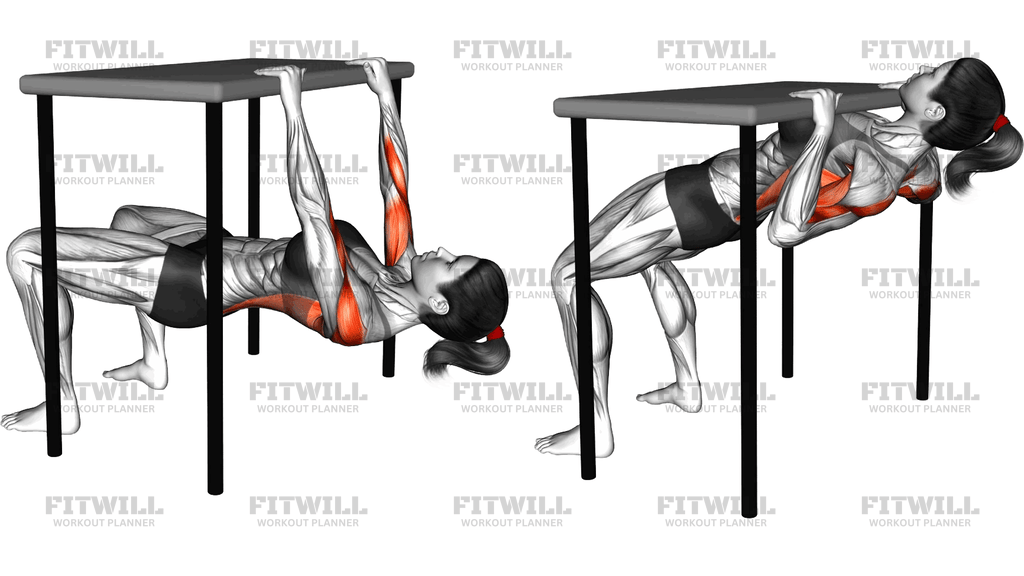
Instructions
- Find a sturdy, heavy table that will not slide or tip, and sit underneath it so the edge is above your chest.
- Grip the table edge firmly with both hands, shoulder-width apart, arms fully extended, and walk your feet out until your body forms a straight line from head to heels, resting on your heels.
- Squeeze your glutes and brace your abdominals so your hips do not sag toward the floor.
- Let your shoulder blades spread slightly as you hang, so every rep starts from a full stretch.
- Exhale and pull your chest toward the table edge by driving your elbows down and back, keeping them about 45 degrees from your torso.
- Pull until your chest nearly touches the edge and your shoulder blades are pulled together, holding the top for a beat.
- Inhale and lower yourself slowly with control until your arms are straight again.
- Keep your head in line with your spine and resist the urge to push your chin over the edge first.
- Complete all reps with the same body line, and reset your brace and hip position between reps if anything drifts.
- To make it easier, slide your feet closer to the table and bend your knees; to make it harder, straighten your legs and walk your heels further out.
Tips & Tricks
- Test the table with a firm tug and one partial pull before your first full rep; a table that slides on a smooth floor is the most common failure point in this setup.
- If your fingers ache from gripping the edge, wrap a towel over the edge and grip through it instead of skipping the exercise.
- A sagging hip is the most frequent mistake here: it usually means the body angle is too hard, so shorten the lever by bending your knees rather than grinding through a broken position.
- Think about pulling the table edge down toward your chest, not pulling your chin over it; this keeps the work on the upper back and lats instead of straining the neck.
- Stop each rep short of the arms-only hang where your shoulders shrug up by your ears; keep a slight width across the upper back between reps.
- If your grip gives out before your back does, your feet are probably too far forward for your current strength, so raise the body angle and rebuild from there.
- Pause for one full second with your chest at the edge on each rep; the squeeze at the top is where the mid-back work actually happens.
- Bare feet or flat-soled shoes both work, but keep your heels dug in so your legs contribute to the plank rather than sliding on the floor.
- Place your hands just outside shoulder width; gripping too wide under the table limits how high you can pull and stresses the shoulders.
Frequently Asked Questions
What muscles does the Inverted Row Under Table work?
It primarily targets the upper back and lats, with the biceps and rear shoulders assisting on every pull. Your core, glutes, and legs work isometrically to hold the straight body position throughout the set.
Is the Inverted Row Under Table suitable for beginners?
Yes, and it is one of the most beginner-friendly bodyweight pulling exercises. Because your body angle controls the resistance, beginners can bend the knees and keep the feet close to the table to reduce the load, then gradually straighten the legs as strength improves.
What kind of table do I need for the Inverted Row Under Table?
You need a solid, heavy table that will not slide, rock, or tip when your full body weight hangs from its edge. Test it with a partial pull first, and avoid lightweight folding tables or tables on slippery flooring.
Why do my hips sag when I do this exercise?
A sagging hip usually means the body angle is too demanding, so your core gives out before your pulling muscles do. Slide your feet closer to the table and bend your knees to make the hold easier, and focus on squeezing your glutes to lock in the plank position.
How is the Inverted Row Under Table different from a pull-up?
A pull-up is a vertical pull where you lift your full body weight straight up, while this is a horizontal pull at an angle you choose. That makes the table row much easier to scale and a good stepping stone toward your first pull-up.
What can I use if I do not have a suitable table?
Any sturdy horizontal edge at roughly hip-to-waist height works, such as a fixed railing, a bar in a power rack, or the edge of a heavy desk. A towel around the edge can improve grip comfort on hard surfaces.
How far should my feet be from the table?
The further your heels are from the table, the more horizontal your body becomes and the harder the pull is. Start with bent knees and feet close to the table, then extend your legs and walk your heels out as your strength allows.
Should I use an overhand or underhand grip on the table edge?
Both work. An overhand grip emphasizes the upper back, while an underhand grip brings the biceps and lats more into the pull, so you can alternate between sets.
How many reps should I do of the Inverted Row Under Table?
Aim for sets where you finish with solid form but feel challenged on the last two reps, typically 8 to 15 reps per set. If you cannot manage 8 clean reps with a straight body line, make the angle easier; if 15 feels easy, move your heels further out.