Dumbbell Russian Twist With Legs Floor Off
The Dumbbell Russian Twist With Legs Floor Off is a seated rotational core exercise performed in a V-sit position with your feet lifted clear of the ground. You hold a single dumbbell with both hands at your midsection and rotate your torso from side to side, touching or passing the weight toward the floor beside each hip. Holding the legs off the floor is what separates this version from the standard Russian twist: your hip flexors and lower abs must work continuously just to hold the position, on top of the rotational work the obliques are doing.
This movement trains the obliques as the primary rotators of the trunk, with strong support from the rectus abdominis and deep core muscles that keep your spine from collapsing as you lean back. Because the feet are elevated, the hip flexors — especially the iliopsoas and rectus femoris — stay under constant tension to hold your legs up. That makes this a demanding compound core drill rather than an isolated oblique exercise, and it highlights the trunk and thigh musculature you can see working throughout each rep.
The setup matters more here than in most ab exercises. With both your torso leaned back and your feet off the floor, your center of balance sits on a narrow point around your sitting bones and tailbone. If you start too far back or with too heavy a dumbbell, your lower back rounds, your breath shortens, and the rotation turns into a sloppy shoulder swing. A moderate lean-back of roughly 45 degrees, knees bent, and a weight you can control through the full arc give you the best combination of tension and control.
Execution should come from the ribcage and shoulders turning as one unit, not from the arms moving independently of the torso. Think of the dumbbell as glued to your chest — it travels because your trunk rotates, not because you swing it. Each rep ends when your chest has genuinely faced the side, and each return is controlled rather than dropped back to center.
This variation suits intermediate to advanced trainees who can already hold a stable V-sit for 20-30 seconds and perform standard Russian twists without feet lifting issues. It is a common fit in core finishers, martial arts and racket sport conditioning, and any program where anti-extension and rotational control matter. Work in sets of 8-16 rotations per side, and stop the set when your legs start dropping toward the floor — that is your signal the hip flexors and abs have given you everything they have for the moment.
[ Workout Log & Planner ]
Put your next workout in Fitwill
Keep your plan and training log ready when you are.


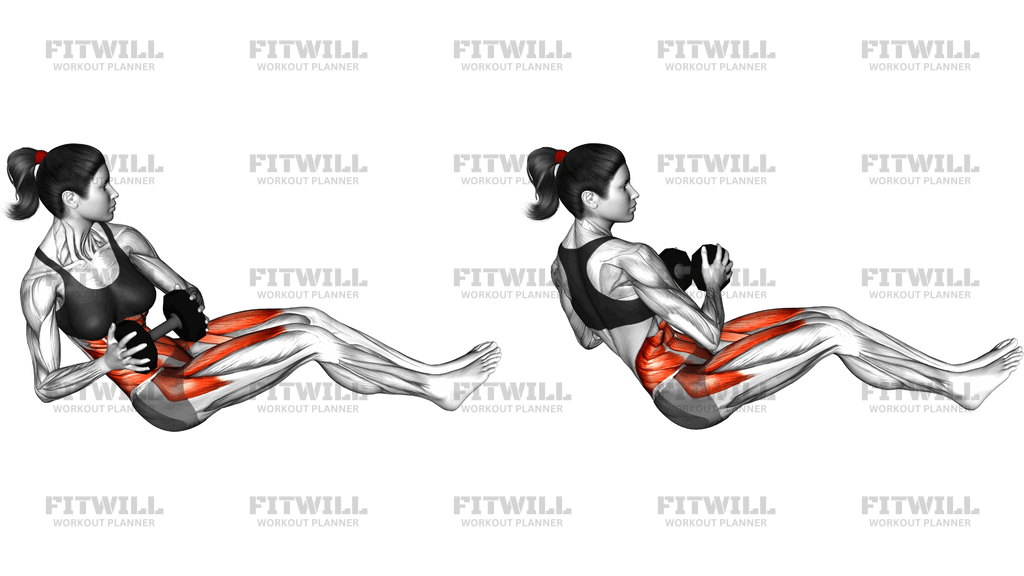
Instructions
- Sit on an exercise mat with your knees bent and your feet flat on the floor to start.
- Hold one dumbbell vertically with both hands wrapped around the top head, elbows bent, and bring it in close to your chest.
- Lean your torso back to roughly a 45-degree angle, brace your abs, then lift your feet off the floor so your lower legs hang relaxed and your weight balances on your sitting bones.
- Keep your chest tall and your spine long — do not let your lower back curl as you lean back.
- Exhale and rotate your torso to one side, turning your shoulders and ribcage together so the dumbbell moves beside your hip while your legs stay fixed in the air.
- Pause briefly at the end of the rotation, then inhale as you rotate with control through the center and over to the opposite side.
- Continue alternating sides in a smooth, even rhythm, keeping the dumbbell close to your body the entire time.
- Breathe steadily throughout — exhale on each rotation, inhale on the return — and never hold your breath.
- When you finish the set, lower your feet to the mat first, then sit upright before setting the dumbbell down.
- Rest, reset your brace, and begin the next set only when you can hold your feet off the floor for the full duration.
Tips & Tricks
- The most common breakdown in this version is the legs slowly sinking toward the floor as fatigue sets in — if your feet drop, end the set rather than finish the reps with a compromised position.
- Swinging the dumbbell quickly uses momentum instead of your obliques; a two-second rotation with a deliberate pause at each side is far harder than ten fast reps.
- If you feel it mostly in your hip flexors and the front of your thighs rather than your waist, your torso is probably too upright — lean back slightly more to load the abs.
- Do not let your lower back round into a C-shape; keep your chest lifted and imagine lengthening the crown of your head away from your hips.
- Start with a light dumbbell, around 5-10 pounds; because your feet are off the floor, the balance demand is high and a heavy weight will pull you off your center.
- Keep the dumbbell tight to your chest — holding it at arm's length multiplies the leverage against your shoulders and lower back without adding oblique work.
- Your eyes can follow the dumbbell through the rotation; this keeps your neck in line with your spine instead of craning it backward.
- Sitting on a slight pad or the edge of a folded mat can ease pressure on the tailbone if the bony contact becomes uncomfortable during longer sets.
- If you cannot hold your feet up with control, regress to feet-down Russian twists or a shorter lever with knees tucked tighter to your chest.
Frequently Asked Questions
Which muscles does the Dumbbell Russian Twist With Legs Floor Off work?
The obliques are the primary movers, rotating the trunk side to side. The rectus abdominis and deep core stabilize your leaned-back torso, while the hip flexors work hard the entire set to keep your feet off the floor.
Why keep the legs off the floor instead of doing a regular Russian twist?
Elevating the legs removes the stable base your heels would normally provide, so your abs and hip flexors must hold the V-sit position continuously. This raises the core demand considerably and adds a balance element the standard version lacks.
Is the Dumbbell Russian Twist With Legs Floor Off suitable for beginners?
It is generally too demanding as a starting point because of the V-sit hold. Beginners should build up with feet-down dumbbell Russian twists and timed V-sit holds before combining the two.
How heavy should the dumbbell be?
Choose a weight you can rotate with control for all planned reps without your legs dropping or your lower back rounding. For most people this is far lighter than the weight they could swing in a feet-down version.
Should my knees be bent or straight during the exercise?
Bent knees with relaxed lower legs, as shown, shorten the lever and make the V-sit easier to hold. Straightening your legs is a valid progression but dramatically increases hip flexor and lower ab demand.
How many reps should I do per set?
Eight to sixteen rotations per side works well, with the quality of the hold mattering more than the count. Once your feet sink or your rotation shortens, the set is over.
What should I do if my tailbone hurts during this exercise?
Sit on a padded mat or a folded towel to cushion the contact point, and make sure you are balancing on your sitting bones rather than rolling directly onto the tailbone. Persistent discomfort means you should switch to a supported variation.
Can I substitute a medicine ball or plate for the dumbbell?
Yes, any compact weight you can hold securely with both hands works, and a medicine ball is a common swap. Avoid anything bulky that forces the weight away from your chest, since that strains the shoulders and lower back.
Are Russian twists bad for the lower back?
When your abs stay braced and your spine stays long, the movement is well tolerated by most healthy trainees. Problems usually come from a rounded lower back, excessive speed, or a weight too heavy to control — so address those factors before dismissing the exercise.