Band Concentration Curl
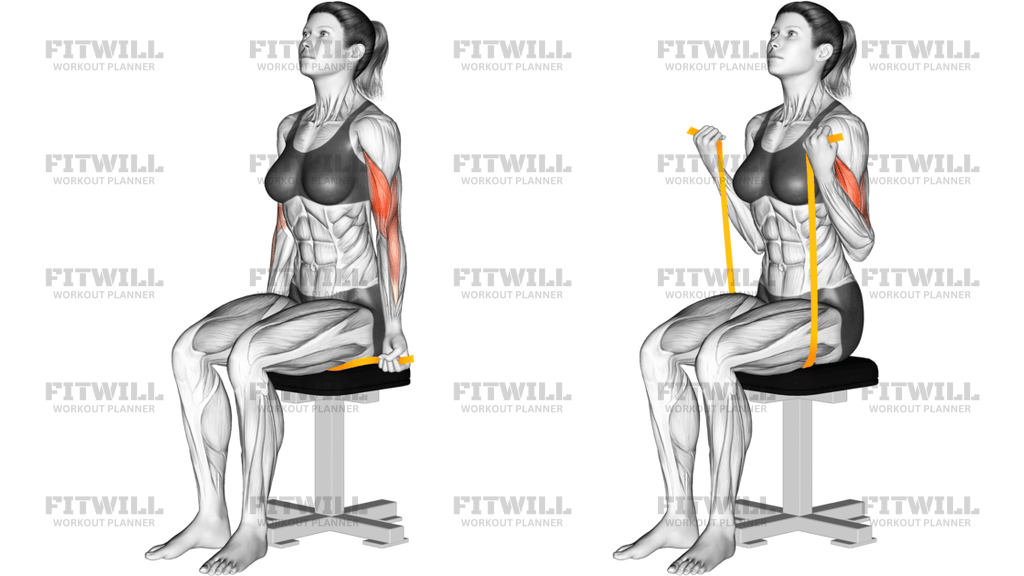
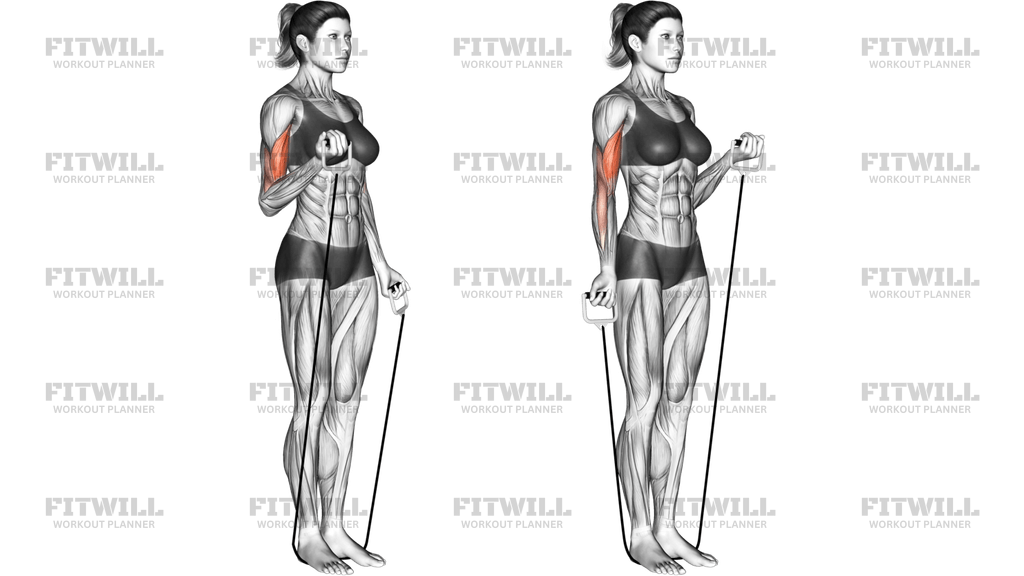
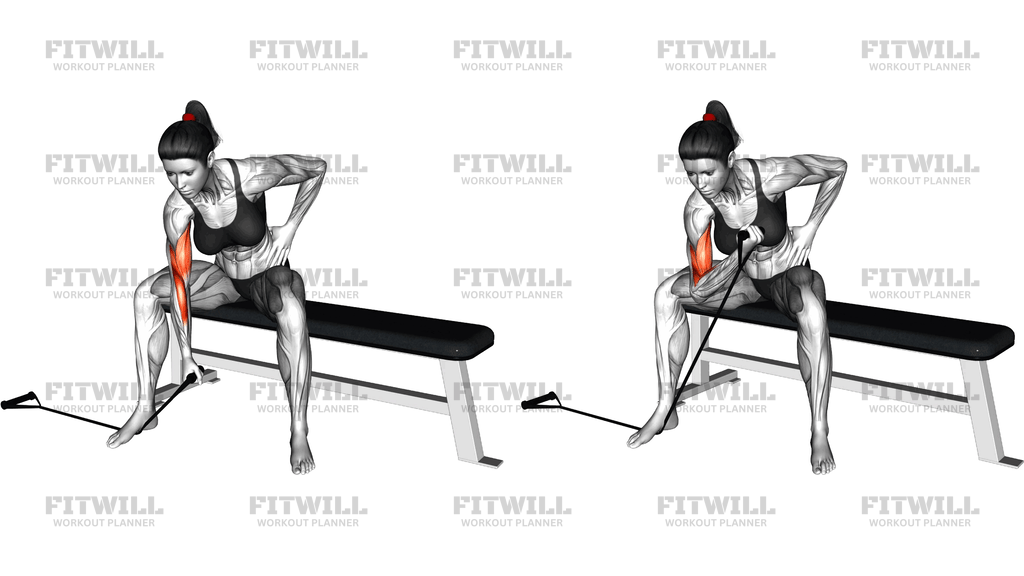
The Band Concentration Curl is a single-arm biceps exercise performed seated on a bench, with a resistance band anchored under the working-side foot and the back of the upper arm braced against the inner thigh. That braced position is what makes it a concentration curl: the elbow is pinned in place, so the biceps have to do the work without help from shoulder swing or body English. It is essentially the band-based version of the classic dumbbell concentration curl, trading the fixed weight of a dumbbell for resistance that gets heavier as the band stretches.
This movement suits a wide range of lifters. Beginners appreciate how the thigh brace locks in the form and makes cheating almost impossible, while more experienced trainees use it as a finishing movement to pump the biceps with strict, isolated tension. It is also a practical choice for home workouts or travel, since all you need is a loop or tube band with handles and something stable to sit on.
The primary target is the biceps brachii, with meaningful contribution from the brachialis underneath it and the brachioradialis and forearm flexors working to hold the handle. Because the band's tension peaks near the top of the curl, the hardest part of the rep lands right where the biceps are fully shortened, which gives a strong peak contraction you can deliberately squeeze.
Setup matters more here than in most curl variations. The band must be secured flat under the arch of the working foot so it cannot slip, and the torso needs to lean forward enough that the upper arm rests firmly against the inner thigh for the entire set. If the elbow drifts away from the thigh, the exercise turns into a loose seated curl and loses most of its isolating benefit.
Execution is simple but demanding: curl the handle up toward the chest in a smooth arc, squeeze hard at the top, then lower under control against the band's pull. Keep the working shoulder relaxed and down rather than shrugging toward the ear, and let the non-working hand rest on the opposite thigh or hip for balance. Two to four sets of 10 to 15 reps per arm works well, and matching tension between sides is as easy as adjusting how much slack you leave in the band before starting.
[ Workout Log & Planner ]
Put your next workout in Fitwill
Keep your plan and training log ready when you are.


Instructions
- Sit sideways on a flat bench with your feet planted wider than shoulder width and your torso leaned forward over your knees.
- Anchor the resistance band under the arch of your working-side foot so it lies flat against the floor and cannot slip, and grip the handle with that hand using an underhand grip, palm facing up.
- Press the back of your working upper arm firmly against the inside of your same-side thigh and let your free hand rest on your opposite thigh or hip for support.
- Start with your working arm fully extended toward the floor and take up the band slack so there is light tension before the first rep.
- Brace your core and keep your chest angled down toward the floor with your shoulders level and relaxed.
- Curl the handle up in a smooth arc toward your chest, keeping the elbow glued to the inner thigh and letting only the forearm move.
- At the top, when the biceps are fully shortened, pause for a beat and squeeze the muscle hard against the band's peak tension.
- Lower the handle back down slowly, resisting the band's pull until the arm is straight again.
- Exhale as you curl up and inhale as you lower the handle with control.
- Complete all reps on one arm, re-check the band's anchoring under the foot, then switch sides and repeat.
Tips & Tricks
- The most common fault is letting the elbow slide off the inner thigh as the set gets hard. Once that happens the shoulder starts assisting and the isolation is gone, so restart the set with lighter band tension if you cannot keep the arm braced.
- Do not shorten the range at the bottom. The band wants to yank your arm straight quickly, so decelerate the last few inches to keep tension on the biceps and protect the elbow joint.
- Choose a band you can fully curl without rocking your torso forward. The resistance rises sharply near the top, so a band that feels easy at the start of the rep can stall you at the top.
- Keep your wrist straight and neutral rather than curling the handle in with a bent wrist, which shifts work to the forearm flexors and strains the wrist under peak tension.
- If the band digs into your foot or feels unstable, wrap it once around the arch or place it flatter under the mid-foot. A slipping anchor mid-rep is the main safety risk in this setup.
- Sit low enough on the bench that your thigh slopes slightly downward toward the knee. This gives the band a clear path under the foot and stops the handle from catching on your leg.
- Avoid twisting your torso toward the working arm to finish reps. If your chest starts rotating, that is the signal the set is over rather than a reason to grind out extra reps.
- Match effort between sides by counting reps and checking the band's slack, not by feel alone. Switching to a different foot position changes tension and can make one arm work harder than the other.
Frequently Asked Questions
What muscles does the Band Concentration Curl work?
The biceps brachii is the prime mover, with the brachialis and brachioradialis assisting and the forearm flexors working to hold the handle. Because the band's tension peaks at the top, the fully shortened biceps get the strongest stimulus.
Why does the elbow need to stay against the inner thigh during the Band Concentration Curl?
Bracing the upper arm against the thigh removes shoulder movement and momentum, forcing the biceps to work alone through a fixed arc. If the elbow drifts away, the set becomes a loose seated curl and the isolating benefit is lost.
Is the Band Concentration Curl good for beginners?
Yes. The thigh brace guides the arm path and makes cheating difficult, which helps beginners learn what a strict curl feels like. Start with a light band and 10 to 12 reps per arm to learn the setup before adding tension.
How do I anchor the band correctly for the Band Concentration Curl?
Lay the band flat under the arch of your working-side foot with your foot planted firmly on the floor so it cannot slide. Check before every set, because a band that slips off the foot mid-rep can snap your arm down suddenly.
Why does the Band Concentration Curl feel hardest at the top of the rep?
Resistance bands get harder to stretch as they lengthen, so tension peaks right when your elbow is fully flexed. This is the opposite of a dumbbell, which is hardest near the middle of the curl.
Can I do the Band Concentration Curl without a bench?
You can sit on a sturdy chair, a box, or even the edge of a bed, as long as your feet are flat and your torso can lean forward with the upper arm braced against the inner thigh. The bench just provides a stable, comfortable seat.
What is a good substitute if I have no resistance band?
A dumbbell concentration curl from the same seated, thigh-braced position is the closest match. The feel differs slightly because the dumbbell is hardest mid-rep, but the muscle work and setup are nearly identical.
How many reps and sets should I do of the Band Concentration Curl?
Two to four sets of 10 to 15 reps per arm works well for most lifters, since bands favor controlled, higher-rep work. Adjust band tension so the last two or three reps are challenging without your elbow leaving the thigh.
Is it safe to use the Band Concentration Curl if my elbows are sensitive?
Bands are often easier on the elbow joint than free weights because tension is lowest at full extension, but stop if you feel sharp pain. Lower the band tension, slow the lowering phase, and keep the wrist straight to reduce stress on the joint.