Resistance Band Standing Straight Arms Pulldown
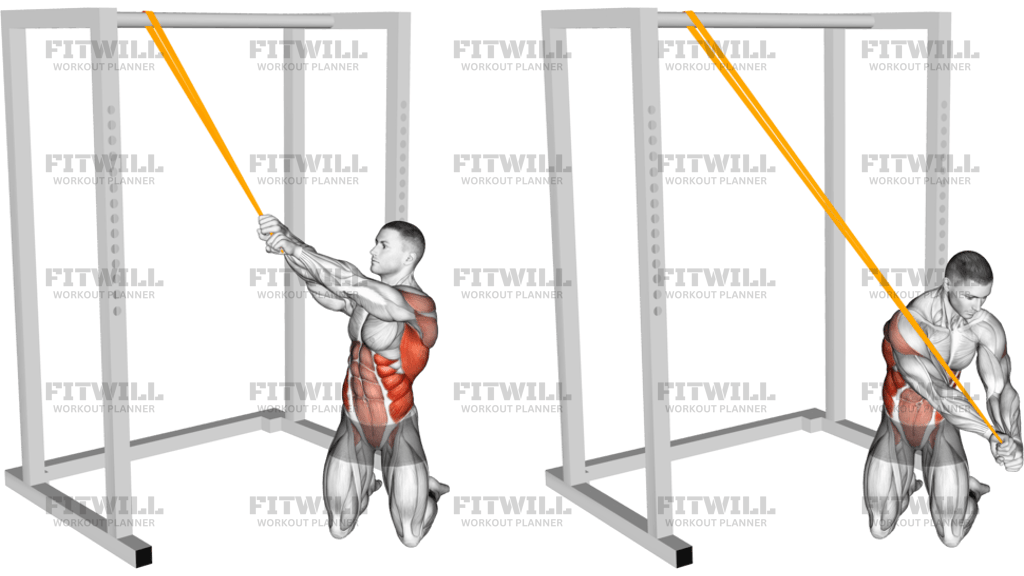
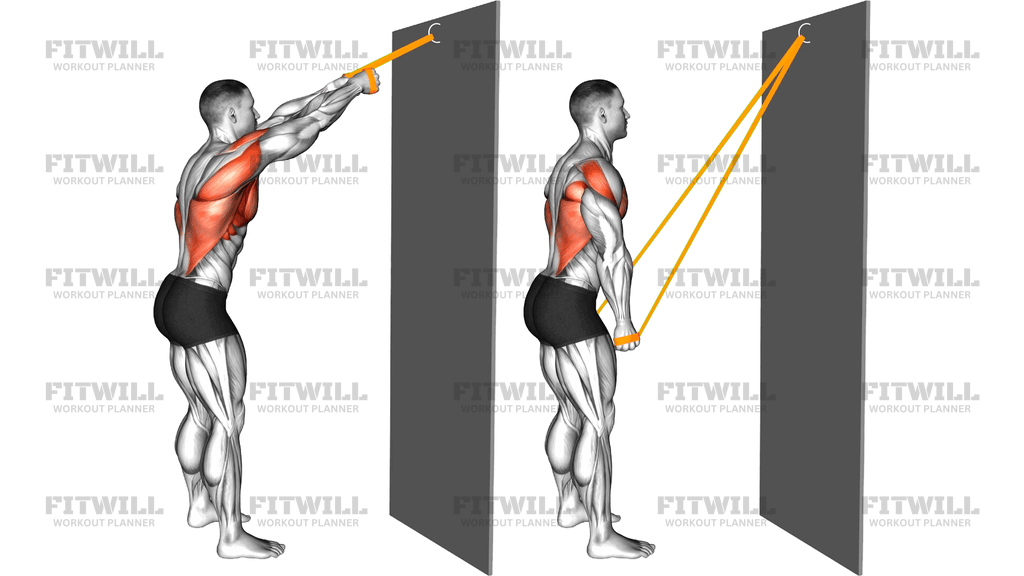
The Resistance Band Standing Straight Arms Pulldown is a lat-focused movement performed by anchoring a resistance band overhead and pulling it down to your thighs while keeping your elbows locked in a nearly straight position. Because the elbows stay extended, the lats have to do the work of driving the arms down and back, which is exactly what makes this exercise valuable — it isolates the largest muscles of the back without the biceps taking over the way they often do in rows and pulldowns.
This movement suits a wide range of lifters. Beginners can use it to learn how it actually feels to contract the lats, which is one of the hardest mind-muscle connections to develop. More experienced trainees use it as a finishing movement after heavy pulldowns or rows, as a warm-up to pre-fatigue and activate the back before pulling work, or as a home-based substitute when no cable machine is available. Since a band provides smooth, joint-friendly resistance that gets harder as it stretches, it is also a comfortable option for people managing cranky shoulders who find heavy loaded pulling aggravating.
Setup matters more here than it looks. The band needs a secure anchor above head height, and you need enough distance from the anchor that the band is already under light tension with your arms overhead. Stand facing the anchor point and take a staggered or hip-width stance. If you stand too close, the band goes slack at the top and the lats lose tension; too far away, and the top position becomes a fight just to hold your arms up.
Execution is a sweeping arc, not a push. From the overhead position, pull the band down and slightly back in a wide arc until your hands reach your thighs or hips, keeping your elbows almost straight the whole time. Think about driving your elbows down toward your back pockets rather than pulling with your hands. Pause briefly at the bottom, squeeze the lats, then let your arms rise back up under control along the same path.
Keep your torso tall and still throughout. A small forward lean at the start is acceptable, but swinging the trunk or bending sharply at the waist turns this into a momentum-driven movement and steals work from the lats. Because the band is anchored high and pulls down toward you, check that the anchor attachment is rated for the load and fully secure before your first rep — a slipping anchor behind your head is the main practical risk in this setup.
[ Workout Log & Planner ]
Put your next workout in Fitwill
Keep your plan and training log ready when you are.


Instructions
- Anchor a resistance band securely to a door, rack, or wall attachment above head height, and confirm the anchor cannot slip before you load it.
- Face the anchor and step back until the band has light tension while your arms are raised overhead, then grip the band with an overhand grip, hands roughly shoulder-width or slightly wider.
- Stand tall with feet hip-width apart or in a slight staggered stance, knees soft, and brace your abdominal muscles to keep your ribs from flaring up.
- Start with your arms extended overhead at an angle slightly in front of your body, elbows nearly locked and shoulders pulled gently down away from your ears.
- Exhale and pull the band down in a wide arc, leading with your elbows and keeping them straight, until your hands reach your thighs or hips.
- Pause for a moment at the bottom and squeeze your lats, feeling the shoulders press down and back.
- Inhale and slowly raise your arms back overhead along the same arc, resisting the band's pull instead of letting it snap your arms up.
- Stop just before your shoulders shrug up at the top so tension stays on the lats between reps.
- Complete your reps, then step toward the anchor and release the band with tension off before letting go.
Tips & Tricks
- The most common mistake is bending the elbows mid-rep, which converts the exercise into a biceps-driven pulldown. If your elbows keep bending, use a lighter band and focus on pushing your hands down as if pressing water away.
- Watch for trunk lean creeping in as the set gets hard. If your chest drops toward the floor to finish reps, the band is too heavy — reduce the tension and keep your torso vertical.
- Shrugging your shoulders at the top shifts work to the upper traps. Actively reach slightly upward before each rep so the shoulder blades stay depressed.
- Stand at a distance where the band is already taut with arms overhead. Slack at the start of each rep lets the lats rest and robs you of the stretch-position benefit.
- Try a slight backward lean of only a few degrees at the bottom if you want a stronger lat squeeze, but do not turn it into a row by pulling the band to your chest.
- Grip the band just firmly enough to hold it. Squeezing it hard recruits the forearms and can distract from the lat drive.
- Slower lowering phases work especially well with bands because the band's pull increases as your arms rise — take three to four seconds on the way up for a stronger stretch stimulus.
- If you feel this mostly in the front of the shoulders, your hands may be drifting forward of the body during the pull; keep the arc close to your torso plane.
Frequently Asked Questions
Which muscles does the Resistance Band Standing Straight Arms Pulldown work?
The lats are the primary mover, with support from the teres major, pecs, the long head of the triceps, and the rear shoulders. Because the elbows stay straight, the biceps contribute very little.
Why keep the arms straight instead of bending the elbows?
Straight arms remove the biceps and elbow flexors from the movement, forcing the lats to extend the shoulder. Even a small elbow bend turns it into a partial pulldown and dilutes the lat work.
Is the Resistance Band Standing Straight Arms Pulldown good for beginners?
Yes, and it is one of the best exercises for learning to feel the lats. Start with a light band, higher anchor tension, and strict straight arms before adding resistance.
How far should I stand from the band anchor?
Far enough that the band is already under light tension with your arms overhead, but not so far that holding the top position strains your shoulders. Adjust your distance to set the difficulty as well as the band thickness.
Can I use this exercise instead of cable straight-arm pulldowns?
It is a solid home alternative. The band's resistance increases as your arms rise, so the stretch feels lighter than on a cable, but the movement pattern and lat involvement are very similar.
Should my torso stay completely upright?
Stay tall with only a small, fixed forward lean if that feels natural. Any leaning or swinging that grows during the set means you are using momentum instead of the lats.
How do I know I am using my lats and not my triceps or traps?
You should feel a strong squeeze along the sides of your mid-back and under the armpits at the bottom. If you feel shrugging in the neck area, depress your shoulders before each rep; the triceps will feel mild engagement, which is normal.
Where should I place this in my workout?
It works well as a back warm-up before heavy rows or pulldowns, or as a strict finishing movement at the end of a back session when the bigger muscles are pre-fatigued.
Is anchoring the band overhead safe?
It is safe when the anchor is rated for the load and firmly fixed. Always test it with light tension first, face the anchor while pulling, and release the band by stepping toward it rather than letting go under stretch.