Seated Forward Reach Arms Interlock
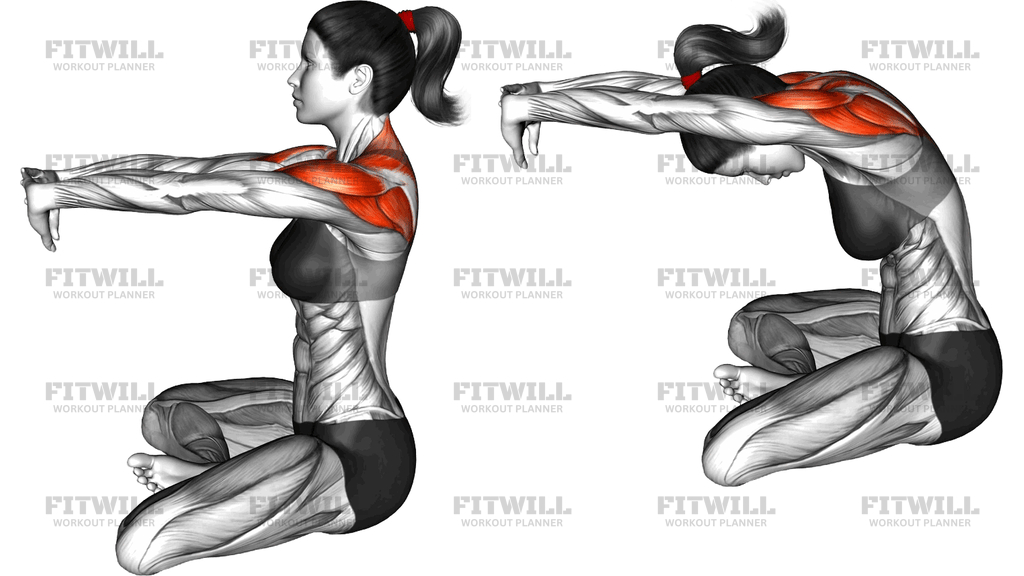
The Seated Forward Reach Arms Interlock is a body-weight stretch performed from a kneeling, sit-back-on-your-heels position. You interlace your fingers, turn the palms away from you, and press the arms straight out in front at shoulder height, then round the upper back and let the head drop slightly as you reach further away. The stretch targets the muscles between the shoulder blades, the mid and lower trapezius, and the rear shoulders, with a secondary release through the thoracic spine and lower back.
This is one of the most practical counter-positions for anyone who spends long hours sitting, typing, or driving. Those activities pull the shoulder blades forward and shorten the chest, leaving the upper back muscles lengthened and achy. Pressing the interlocked hands away while rounding forward does the opposite of that slouched posture: it spreads the shoulder blades apart and gives the rhomboids and trapezius a clean, isolated lengthening that is hard to reproduce with a simple arm swing.
Setup matters more here than it looks. Because you are kneeling with your hips settled onto your heels, the pelvis is anchored and cannot slide backward to fake the reach, so the rounding has to come from the spine itself rather than from hip movement. Keep the arms at shoulder height rather than letting them drift upward, and push through the heels of the hands, not just the fingertips. A small pad under the knees or ankles makes the position comfortable enough to hold without distraction.
To execute it well, think of pushing the floor away with your hands. Exhale as you press the palms out and let the upper back dome forward between the shoulder blades; the neck stays relaxed with the chin gently tucked. Hold the end position while breathing steadily, then ease back up to a tall kneel before the next repetition. The sensation should sit across the upper back and between the shoulder blades, never as pinching in the neck or sharp pulling anywhere.
Use it as a workday reset, a warm-up before rows and pulls, or a cool-down after pressing and overhead work. Two to four rounds of 20 to 30 seconds is usually enough. If kneeling bothers your knees or ankles, the same interlocked forward reach can be done seated on a bench or chair with feet flat, which keeps the stretch nearly identical while removing load from the lower legs.
Fitwill
Log Workouts, Track Progress & Build Strength.
Achieve more with Fitwill: explore over 9600 exercises with images and videos, access built-in and custom workouts, perfect for both gym and home sessions, and see real results.
Start your journey. Download today!




Instructions
- Kneel on the floor and sit your hips back onto your heels, resting the tops of your feet on the ground. Place a folded mat or towel under your knees or ankles if the pressure is uncomfortable.
- Interlace your fingers and turn the palms to face away from you, then extend both arms straight out in front at shoulder height so the elbows are fully straight but not locked hard.
- Sit tall for a moment with the crown of your head up and the shoulders relaxed away from the ears.
- Brace the core lightly to keep the hips stacked over the heels, since the pelvis should stay fixed while the spine moves.
- Exhale and push the palms forward and slightly upward as if reaching for a far wall, letting the upper back round so the shoulder blades spread apart.
- Allow the head to lower gently between the arms with the chin tucked, keeping the neck loose rather than craning it up.
- Hold the end position for 20 to 30 seconds, breathing slowly and letting the reach deepen slightly with each exhale.
- Reverse the movement by rounding back up one vertebra at a time until you are sitting tall again, arms still extended.
- Release the fingers, lower the arms, and shake them out briefly before resetting for the next repetition.
Tips & Tricks
- Push through the heels of the palms, not just the fingertips, or the wrists will take the strain before the upper back feels anything.
- The most common mistake is hinging at the hips and folding the whole torso toward the thighs. The hips stay planted on the heels; only the spine rounds.
- If you feel the stretch behind the shoulders but nothing between the blades, exaggerate the rounding and imagine pulling the belly button back while the arms stay high.
- Keep the arms at shoulder height. Letting them drift upward turns this into a lat and shoulder overhead stretch instead of the upper-back reach it is meant to be.
- Never yank the hands forward with a jerk. The reach should build gradually over the first few seconds of each hold.
- If the neck feels compressed, soften the chin tuck and think of lengthening the back of the head away from the shoulders instead of forcing the head down.
- Knee or ankle discomfort ruins the hold. Pad the joints first, or move the stretch to a chair so you can focus on the reach.
- Warm hands stretch better. Do a few arm circles or shoulder rolls before the first hold so the upper back is not cold.
- If your shoulders are very tight, bend the elbows slightly at first and straighten them over time rather than forcing full extension from day one.
Frequently Asked Questions
Which muscles does the Seated Forward Reach Arms Interlock stretch?
It primarily lengthens the rhomboids and the mid and lower trapezius between the shoulder blades, along with the rear shoulders. The rounding also gives a gentle release through the thoracic and lower back.
Why does the Seated Forward Reach Arms Interlock use interlocked fingers instead of open hands?
Interlacing the fingers lets you press the palms away against each other, which pushes the shoulder blades apart and deepens the stretch across the upper back. Open hands tend to let the arms soften and the reach lose tension.
Can I do the Seated Forward Reach Arms Interlock if kneeling hurts my knees?
Yes. Sit on a chair or bench with your feet flat on the floor and perform the same interlocked forward reach with the same rounding. The stretch on the upper back is nearly identical without the knee and ankle pressure.
How long should I hold the Seated Forward Reach Arms Interlock?
Aim for 20 to 30 seconds per hold and repeat two to four rounds. If you are using it after heavy pulling or pressing work, longer holds of 30 to 45 seconds feel good.
Should my hips move during the Seated Forward Reach Arms Interlock?
No. The hips stay settled on the heels the whole time, which anchors the pelvis and forces the rounding to come from the spine. If your torso is folding toward your thighs, the hips are doing work the upper back should be doing.
Is it normal to feel the Seated Forward Reach Arms Interlock in the wrists?
A mild pulling across the palms or wrists is common because the flexed wrists are under tension, but it should not be painful. Ease the pressure through the palms, bend the elbows slightly, or hold for shorter periods until the wrists adapt.
When is the best time to use the Seated Forward Reach Arms Interlock?
It works well as a midday reset for desk workers, as a warm-up before rows and pull-ups, or as a cool-down after pressing and overhead movements. Any time your upper back feels tight and slouched, it is a reasonable choice.
My neck feels strained during the Seated Forward Reach Arms Interlock. What should I change?
Stop forcing the head down. Keep a softer chin tuck and imagine the back of the head lengthening away from the shoulders so the neck hangs relaxed between the arms rather than being cranked into flexion.
Is the Seated Forward Reach Arms Interlock safe for beginners?
Yes, it is a low-load, self-paced stretch with no equipment. Beginners only need to respect two limits: keep the reach gradual rather than jerky, and stay within a comfortable stretch sensation rather than pushing into pain.