Resistance Band Drag Curl
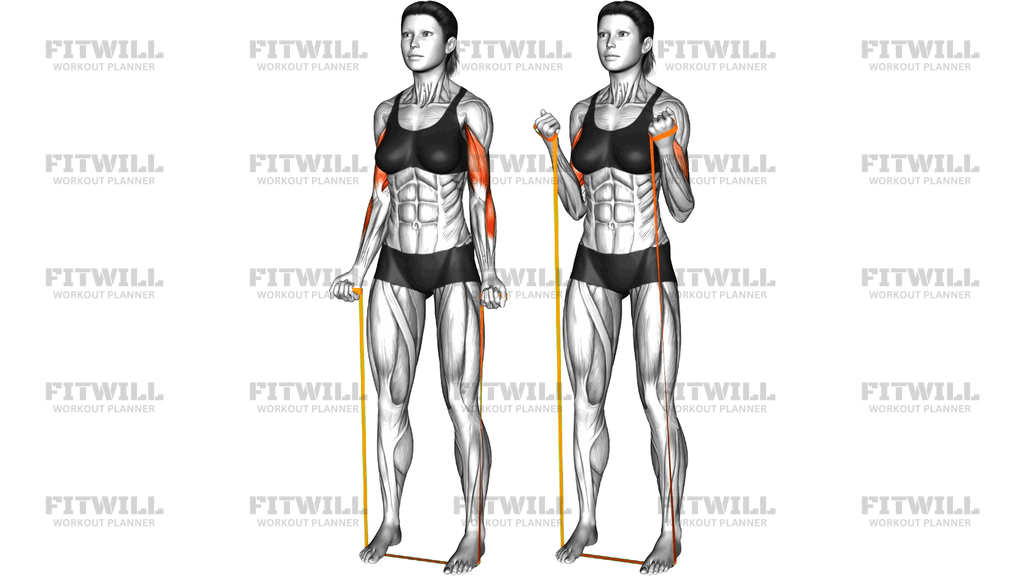
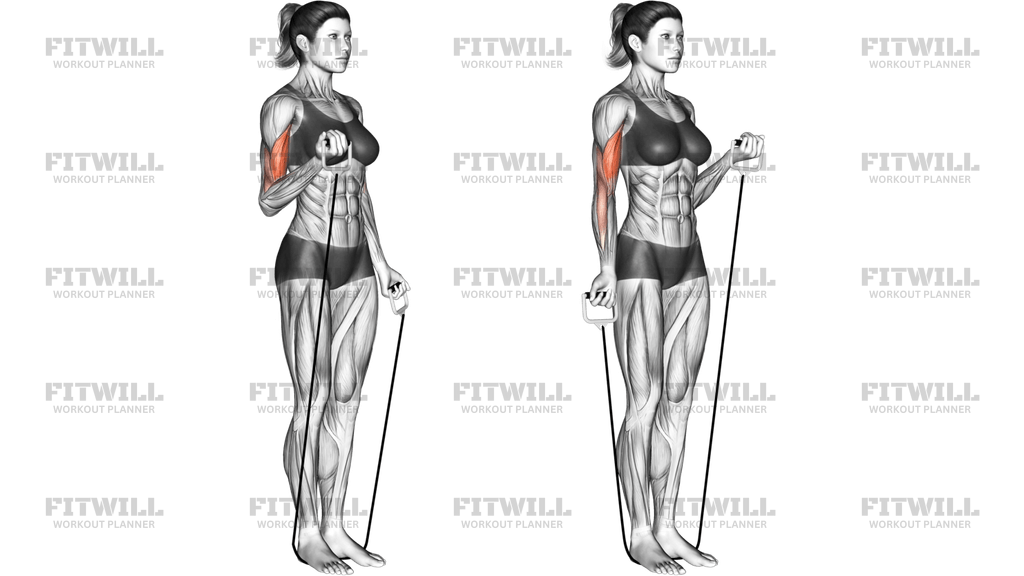
The Resistance Band Drag Curl is a standing biceps curl variation where the band runs under your feet and your elbows deliberately travel backward as you pull the handles up along the front of your body. Instead of swinging the hands forward and up in a wide arc like a traditional curl, you drag the handles straight up your torso, keeping them in contact with your body from hip to chest level. This path shifts tension to the long head of the biceps and keeps the elbows stacked under or slightly behind the hands throughout the rep.
This movement is a great fit for lifters whose front delts tend to take over during regular curls. Because the hands stay close to the body and the elbows track behind the torso, the shoulders have very little opportunity to assist, which forces the biceps and brachialis to do the work. It is also useful for home training, travel workouts, or anyone who wants a joint-friendly curl that provides rising resistance as the band stretches toward the top of each rep.
The muscles worked are primarily the biceps brachii, with strong involvement from the brachialis and brachioradialis in the upper arm and forearm. Because you are standing on the band, your legs, hips, and core work quietly to keep you tall and stable, and your forearms and grip handle the handles throughout the set. The peak contraction at the top, where the band tension is highest, is what makes this variation feel distinctly different from a dumbbell curl.
Setup matters more here than in most curls. The band must be anchored securely under both feet with even length on each side, and you need to stand tall with your shoulders pulled back. If you lean forward or let your elbows drift forward, the drag disappears and the exercise turns into an ordinary band curl with wasted tension. The band should be taut with your arms hanging straight down before the first rep begins.
To execute it well, pull your elbows straight back and up so the handles ride up the front of your thighs and torso toward your lower chest. Squeeze hard at the top, then lower the handles by first extending the elbows and letting the hands slide back down the same path. Control matters on the way down, since the band will try to yank your arms back to the start.
Common use cases include finishing a arm day with a strict, high-tension curl, adding volume without heavy loading, and teaching lifters what a true biceps contraction feels like without shoulder or momentum assistance. Keep the reps slow and the range honest: if your elbows have to punch forward to finish the rep, the band is too strong or your form is drifting.
[ Workout Log & Planner ]
Put your next workout in Fitwill
Keep your plan and training log ready when you are.


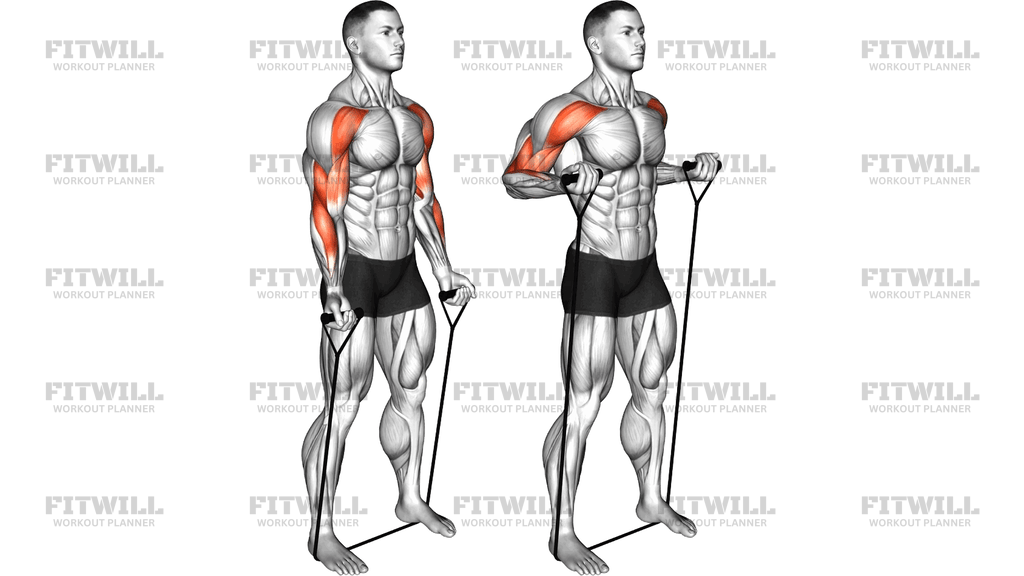
Instructions
- Stand with both feet planted in the middle of a resistance band, hip-width apart, with an even length of band on each side.
- Grip a handle in each hand with palms facing forward, arms fully extended at your sides so the band is already taut at the bottom.
- Stand tall, pull your shoulders back and down, and brace your core to stop your torso from rocking during the set.
- Begin the rep by driving your elbows straight back and up behind your ribs, letting the handles drag up the front of your thighs and torso.
- Keep the handles in light contact with your body the entire way up instead of letting them swing forward into an arc.
- Finish with your hands near your lower chest or upper abdomen and your elbows pointing back, then squeeze your biceps for a moment at the top.
- Lower with control by extending your elbows and letting the handles slide back down the same path until your arms are straight.
- Exhale as you curl up and inhale as you lower the handles back down.
- Complete your reps, then step off the band carefully one foot at a time rather than letting go under tension.
Tips & Tricks
- The most common mistake is curling in a wide forward arc like a standard curl. If the handles leave your torso, the movement loses its purpose, so reset and keep them touching your body.
- Do not let your elbows drift forward at the top to chase height. When the elbows punch forward, the biceps lose tension. Stop the rep where your elbows naturally sit back.
- If the band is too strong and pulls you forward at the start, widen your stance slightly or choke up on the handles to shorten the band and reduce slack on each side.
- Keep your wrists straight and knuckles forward. Bending the wrists inward to lift the handles shifts work to the forearms and shortchanges the biceps.
- Slow down the lowering phase. The band snaps back quickly at the bottom of a drag curl, and a two-second descent keeps tension on the biceps instead of your elbow joints.
- Check that the band sits flat under the middle of both feet. A band caught on your heel or the edge of your sole can slip during the set.
- Because the hands finish low near the chest rather than at shoulder height, the range looks shorter than a normal curl. That is correct; do not lift higher by leaning back.
- Use a lighter band than you would for standard band curls. The drag position shortens the biceps at the top, so the tension feels heavier than the band's rating suggests.
Frequently Asked Questions
What muscles does the Resistance Band Drag Curl work?
The biceps brachii is the primary mover, with strong support from the brachialis and brachioradialis. The forearms and grip work to hold the handles, and your core stabilizes you while standing on the band.
Why do my elbows move backward during the Resistance Band Drag Curl?
That backward elbow travel is the defining feature of the exercise. It keeps the upper arm behind the torso, which loads the long head of the biceps and prevents the front delts from taking over the movement.
Is the Resistance Band Drag Curl good for beginners?
Yes, as long as you start with a light band. The movement is strict and self-correcting because the handles must stay in contact with your body, but beginners should master the upright torso position before adding tension.
How is the Resistance Band Drag Curl different from a regular band curl?
In a regular band curl the hands swing forward and up in an arc away from the body. In the drag curl the handles slide up the front of your torso and the elbows travel back, which removes momentum and shoulder assistance.
Should my hands reach shoulder height at the top of the Resistance Band Drag Curl?
No. The top position is roughly lower chest or upper abdomen height, with the elbows pulled back behind the ribs. Trying to lift the hands to shoulder height forces the elbows forward and forward-leaning posture.
Can I replace barbell drag curls with the Resistance Band Drag Curl?
Yes, it is a solid substitute. The band version offers rising tension toward the peak contraction and is easier on the wrists and elbows, though the resistance profile differs from a barbell loaded with constant weight.
Why does the band pull me forward when I start the Resistance Band Drag Curl?
The band is either too strong or too short for your height. Widen your stance, use a lighter band, or choke up on the handles to create slack at the starting position so your arms can hang straight down.
How many reps should I do for the Resistance Band Drag Curl?
Because the strict path limits how much load you can use, moderate to higher rep ranges of roughly 10 to 15 controlled reps per set work well. Prioritize a slow lowering phase over adding band tension.
Is it safe to stand on the resistance band during this exercise?
It is safe if the band is anchored flat under the middle of both feet and inspected for wear before use. Always keep a grip on the handles until you have stepped off, and never release a stretched band under tension.