Bodyweight Standing T Spine Press
The Bodyweight Standing T Spine Press is a mobility drill that targets the thoracic spine — the twelve vertebrae running through your mid and upper back. You stand tall with your hands placed behind your head and your elbows out wide, then press the elbows up and back toward the ceiling, letting the upper back extend over your stable lower body. It is one of the simplest ways to restore extension to an area that modern sitting habits tend to lock into a rounded, forward posture.
This movement is especially useful for people who spend long hours at a desk, drivers, students, and anyone whose upper back has drifted into a slouched position. It also serves lifters well: squatting, pressing, and even deadlifting all demand enough thoracic extension to keep the chest tall under load. If your upper back rounds when you rack a barbell or your shoulders cave forward during overhead work, this drill is a practical daily addition.
The work happens primarily through the mid-back musculature — the trapezius group and the rhomboids between the shoulder blades — while the shoulders and the muscles that control the shoulder blade assist as the elbows travel upward. Because the hands stay cradled behind the head, the neck stays supported and the movement is driven from the spine and shoulder blades rather than from yanking on the head or neck.
Setup matters more than it looks. A shoulder-width stance with soft knees and a light brace through the trunk gives the thoracic spine a stable base to extend from; without that base, the movement leaks into the lower back and you lose the effect where you want it. Keep the ribs from flaring and the hips from pushing forward as you press — the extension should feel like it opens the chest and lifts the sternum, not like an arch in the low back.
To perform it well, move slowly and deliberately. Press the elbows as high and as far back as they will travel without the lower back taking over, pause briefly at the top to feel the stretch across the chest and the contraction between the shoulder blades, then lower with control. The range will improve over weeks of practice, and forcing it rarely speeds that up.
Use this drill as a warm-up before upper-body training, as a movement break during the workday, or as part of a posture-focused routine. A couple of sets of eight to twelve controlled repetitions is enough for most people, and because it requires no equipment and very little space, it travels well to the office or home.
[ Workout Log & Planner ]
Put your next workout in Fitwill
Keep your plan and training log ready when you are.


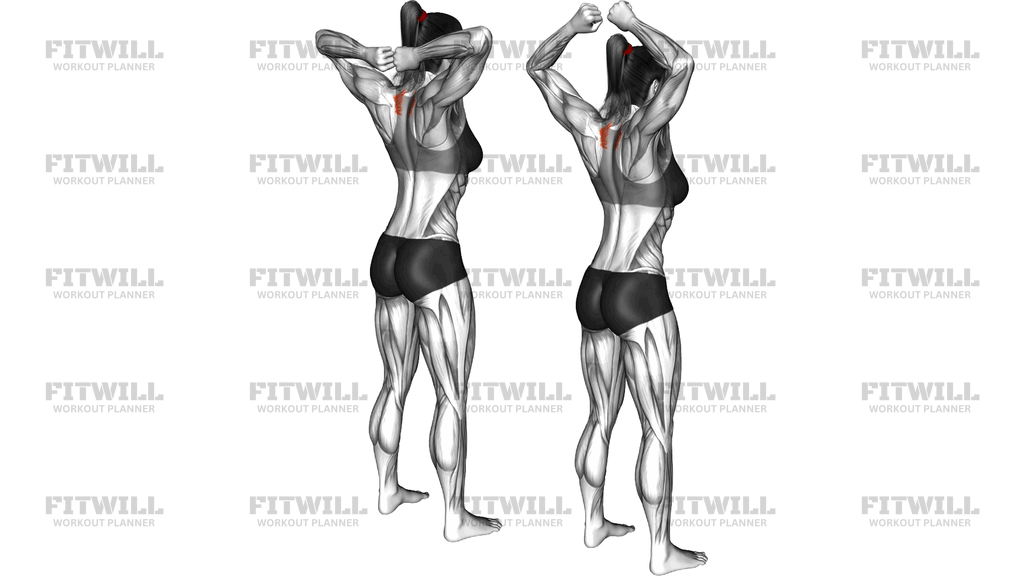
Instructions
- Stand with your feet about hip-width apart, weight spread evenly across both feet, and let your arms hang relaxed for a moment to settle your posture.
- Place both hands behind your head with the fingers interlaced or simply cupping the base of the skull, and draw the elbows out to the sides so they point outward at roughly ear height.
- Soften the knees slightly, engage the trunk lightly, and tuck the ribs down so your lower back is not already arched before you move.
- On an exhale, press both elbows upward and slightly backward toward the ceiling, letting the upper back extend and the chest lift as the arms rise past your head.
- Continue until the elbows point toward the ceiling and you feel a stretch through the chest and a firm squeeze between the shoulder blades.
- Pause at the top for one to two seconds, keeping the neck long and avoiding any pull on the head with your hands.
- Lower the elbows back down to the starting position under control, resisting the urge to simply drop them.
- Breathe out as you press up and inhale as you return, keeping the breath steady throughout the set.
- Complete eight to twelve repetitions, reset your stance and rib position between sets if you feel the lower back taking over.
Tips & Tricks
- The most common mistake is arching the lower back to fake extra range. If you feel the movement in your low back, re-tuck the ribs and shorten the range until the work returns to the upper back.
- Never pull on your head or neck with your hands. The hands are there to support the skull, and the elbows should do all of the driving.
- If your elbows drift forward as you press, the shoulders are compensating for a stiff upper back. Slow the tempo down and focus on leading the press with the elbows, not the hands.
- A quick check for the right feeling: at the top of the press your biceps should be near your ears and your chest should feel open, not compressed.
- Keep the knees soft rather than locked. Locking the knees tends to push the hips forward and encourages that low-back arch you are trying to avoid.
- If standing feels unstable or you keep leaning backward, try the same press with your back near a wall, heels a few inches away, so the wall gives you feedback if you arch.
- Move with the breath: pressing up on an exhale usually lets you reach a little more extension than pressing while holding your breath.
- Do not chase range with speed. A two-second press with a brief hold builds more usable mobility than ten fast reps.
- If one elbow presses higher than the other, note which side lags and add a few extra slow single-side repetitions on that side after your balanced sets.
Frequently Asked Questions
Which muscles does the Bodyweight Standing T Spine Press work?
The primary area is the upper back, particularly the trapezius group and the rhomboids between the shoulder blades, which control the shoulder blades as the elbows press up. The rear shoulders assist, and the trunk works lightly to keep the ribs and hips from moving.
Is this a strength exercise or a stretch?
It functions as an active mobility drill — you strengthen the mid-back through a controlled range while simultaneously stretching the chest and front shoulder tissues. It fits best in warm-ups and posture routines rather than as a main strength lift.
Why do I feel the Bodyweight Standing T Spine Press in my lower back?
That usually means your thoracic spine is not extending enough, so the lumbar spine is compensating with an arch. Re-tuck the ribs, brace lightly, reduce the range, and focus on pressing the elbows back rather than simply reaching up.
Can beginners do this exercise?
Yes, it is very beginner friendly since it uses no equipment and only your natural range of motion. Start with a smaller range and eight repetitions, and expect the range to improve steadily over a few weeks.
How is this different from just doing an overhead press without weight?
An unloaded overhead press mostly trains the shoulders, while the hands-behind-head position and the deliberate backward elbow path here direct the movement into thoracic extension. The goal is opening the upper back, not pressing overhead as far as possible.
How often should I do the Bodyweight Standing T Spine Press?
Because the load is light and the range is self-limited, daily practice is reasonable, especially if you sit for long periods. Two to three sets of eight to twelve reps, before training or during work breaks, covers most needs.
My elbows will not go very far back — is that a problem?
Limited elbow travel usually reflects stiffness in the upper back and chest, which is exactly what this drill addresses. Stay within a comfortable range and progress gradually; forcing the elbows back only creates strain in the shoulders or neck.
What can I substitute if this position bothers my neck or shoulders?
Try the same pressing motion with the hands unclasped and held loosely beside the ears, or perform a wall slide with your forearms against a wall. Both keep the thoracic extension focus with less demand on the shoulder and neck position.
Should I keep my hands interlaced behind my head?
Interlacing is fine as long as the hands support the skull rather than pull on the neck. If interlacing pulls your shoulders into an awkward position, simply rest the fingertips lightly behind the head without linking the fingers.