Sitting Scapular Adduction On Stability Ball
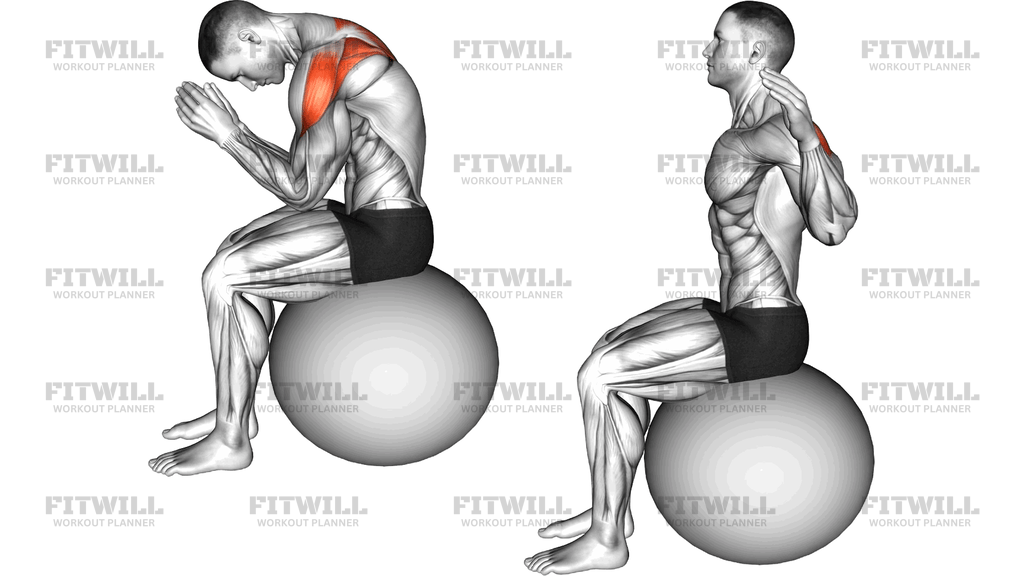
Sitting Scapular Adduction On Stability Ball is a bodyweight activation exercise that targets the muscles responsible for pulling your shoulder blades together. You sit upright on a stability ball with your feet planted on the floor, press your palms together in front of your chest with your elbows lifted, and then draw the elbows back and down while squeezing the shoulder blades toward each other. Because no external load is involved, the movement works through deliberate muscular tension and controlled positioning rather than heavy resistance.
This exercise is especially useful as a warm-up before upper-body pulling work, as a corrective drill for people whose shoulders roll forward from long hours at a desk, and as a low-load activation tool for those learning to feel their upper back muscles. The rhomboids and middle trapezius do most of the work during the squeeze, while the rear shoulders assist and the core works quietly to keep you balanced on the unstable surface of the ball.
The stability ball is what separates this from the same drill done on a bench. Sitting on a moving surface forces your trunk to stay engaged, so you cannot coast through the reps or borrow momentum from your lower back. The ball also makes it obvious when your posture drifts: if you start wobbling or leaning, that is feedback that the movement is being driven from the wrong place.
To execute it well, start by rounding slightly forward with your chin tucked, palms pressed together and elbows pointing forward at shoulder height. From there, sit tall, spread the elbows apart, and pull them back and down as if trying to pinch something between your shoulder blades. Pause briefly in that open position, then slowly round forward again to the start. The entire arc should be slow and smooth, with the squeeze at the back being the focal point of every rep.
Keep the pressure between your palms constant throughout, because releasing the hands tends to let the shoulder blades drift apart and turns the drill into an empty arm movement. Stay upright through the spine, keep the ribs stacked over the pelvis, and avoid shrugging toward your ears. If you cannot feel your upper back working, slow the tempo down further rather than pressing harder with the arms.
Because it loads very little weight through the joints, this movement suits beginners, office workers, older trainees, and anyone rehabbing general shoulder-girdle stiffness, provided it stays pain-free. Two or three sets of ten to fifteen controlled reps, either before pulling exercises or as a standalone posture break during the day, is a practical starting point.
[ Workout Log & Planner ]
Put your next workout in Fitwill
Keep your plan and training log ready when you are.


Instructions
- Sit on a stability ball with your feet flat on the floor about hip-width apart and your knees bent roughly 90 degrees.
- Press your palms together in front of your chest in a prayer position and raise your elbows so they point forward at about shoulder height.
- Round your upper back slightly, tuck your chin toward your chest, and let your shoulder blades drift apart to set the starting position.
- Brace your core lightly and keep your feet grounded so the ball stays steady beneath you.
- Sit tall, spread the elbows apart, and pull them back and down while keeping the palms pressed together, squeezing your shoulder blades toward each other.
- Hold the squeezed position for one to two seconds with your chest open and your head in line with your spine.
- Slowly round forward again, separating the shoulder blades and returning the elbows to point forward, over two to three seconds.
- Exhale as you pull the elbows back and inhale as you return to the rounded start position.
- Keep constant pressure between your palms from start to finish of every repetition.
- Complete your set, then step carefully off the ball and roll your shoulders a few times to reset before the next set.
Tips & Tricks
- The most common mistake is turning this into a chest squeeze only. If your elbows never travel backward, your shoulder blades are not adducting — think about pinching a pencil between the blades instead of just pressing the hands.
- Do not let your elbows drop toward your ribs as you pull back. Keeping them at or near shoulder height keeps the middle traps and rhomboids in the driving seat.
- If the ball rolls or wobbles on every rep, widen your stance and place your feet firmly through the floor. A stable base lets you focus on the upper back instead of balance.
- Avoid shrugging your shoulders toward your ears during the squeeze. If your neck feels tense, lower the elbows an inch and consciously relax the upper traps.
- Rushing the return is a frequent fault. The backward rounding phase should take at least as long as the pull, giving the shoulder blades a full excursion.
- Keep the pressure between your palms moderate and steady. Pressing as hard as possible shifts tension into the chest and arms and dulls the upper-back feel.
- Sit on the front third of the ball rather than dead center. This gives your hips a slight forward tilt and makes it easier to keep an upright spine.
- If your lower back arches hard when you sit tall, reduce the range and aim for a tall-but-neutral spine rather than a big chest lift.
Frequently Asked Questions
Which muscles does Sitting Scapular Adduction On Stability Ball work?
The primary muscles are the rhomboids and middle trapezius, which pull the shoulder blades together. The rear shoulders assist, and the core works to keep you balanced on the stability ball.
Why is this exercise done on a stability ball instead of a bench?
The unstable surface forces your trunk to stay engaged and gives you instant feedback if your posture drifts. It also makes it harder to cheat with momentum, so the upper back has to do the work.
Is Sitting Scapular Adduction On Stability Ball suitable for beginners?
Yes. There is no external load, so a beginner can focus entirely on learning to feel the shoulder blades move. If balancing on the ball feels difficult at first, practice the same hand position while seated on a sturdy chair until the squeeze feels familiar.
Why do I start rounded forward with my chin tucked?
Beginning rounded with the shoulder blades spread gives them a full range to travel through. Starting from the open position already would leave almost no adduction to perform and little muscular work.
How hard should I press my palms together?
Use moderate, steady pressure — enough to keep contact firm, but not a maximum squeeze. Over-pressing recruits the chest and arms and can mask the upper-back contraction you are trying to feel.
How many reps and sets should I do?
Two to three sets of ten to fifteen slow repetitions works well, either as a warm-up before rows or pulldowns or as a standalone posture drill. Quality of the squeeze matters far more than the rep count.
What can I use instead of a stability ball?
The same palm-press and scapular squeeze can be done seated on a bench or chair. You lose the balance demand on the core, but the upper-back activation remains very similar.
I feel this in my neck and shoulders near my ears. What am I doing wrong?
You are most likely shrugging as you pull back. Lower the elbows slightly, relax the tops of your shoulders, and focus on pulling the blades down and together rather than up toward the head.
Can I add resistance to this movement over time?
Progress first with slower tempo, longer holds, and more reps before adding load. If you want extra challenge later, a light band looped around the shoulders can add tension, but keep the palm-press position and form identical.
Is this exercise safe if my ball is the wrong size?
Use a ball that lets you sit with knees bent close to 90 degrees and feet flat on the floor. A ball that is too tall or too soft will tilt your hips and make an upright spine much harder to hold.