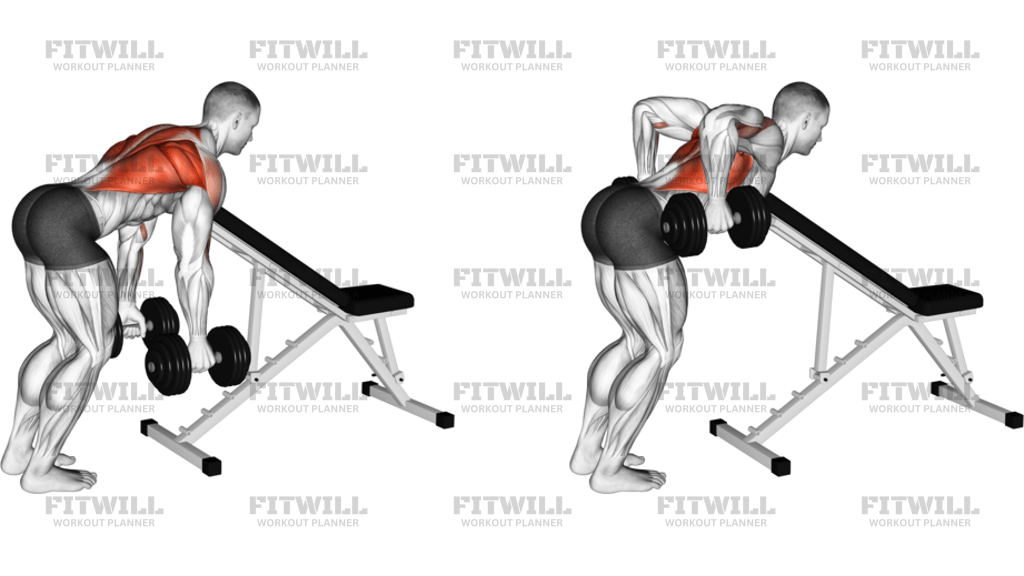
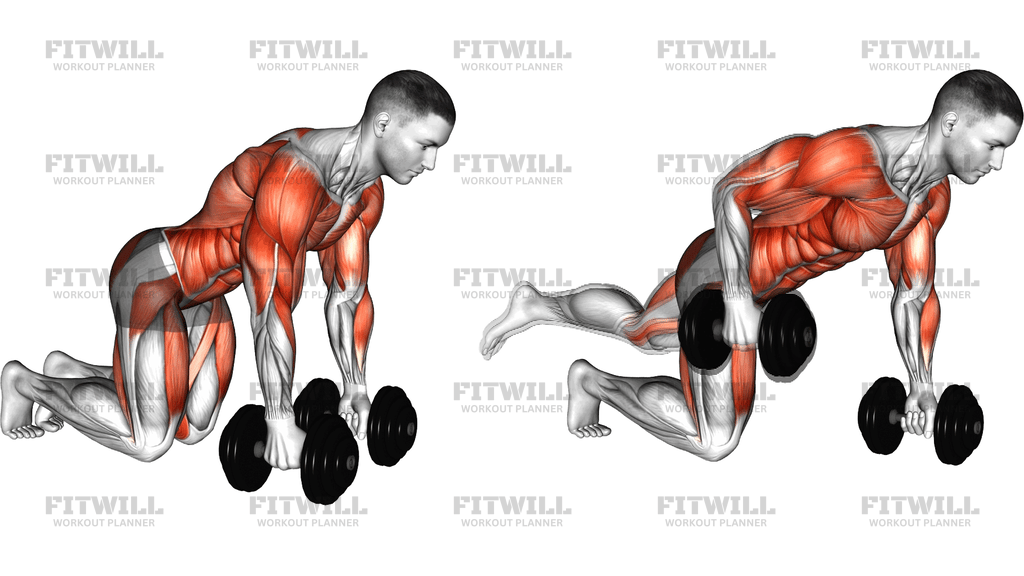
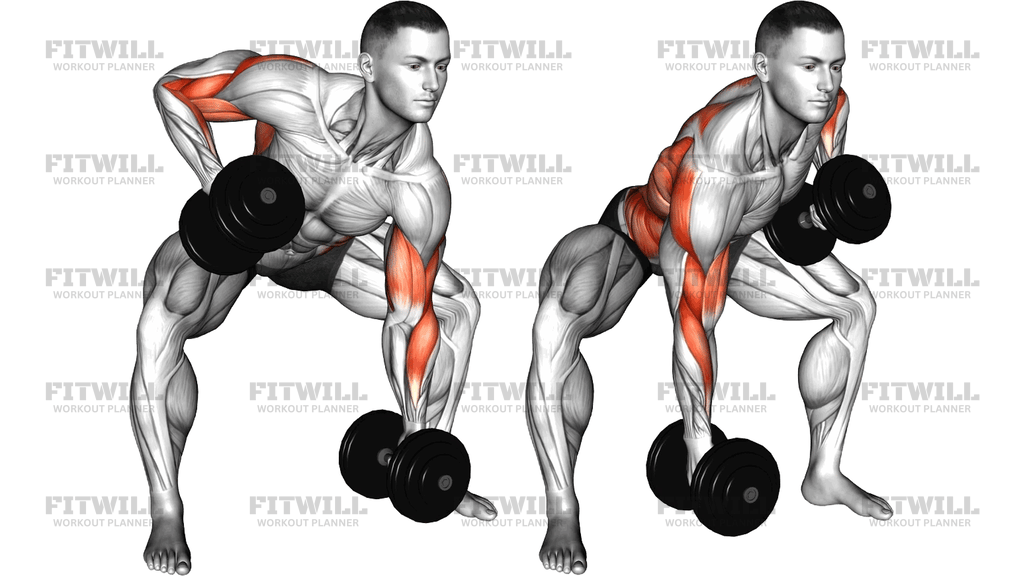
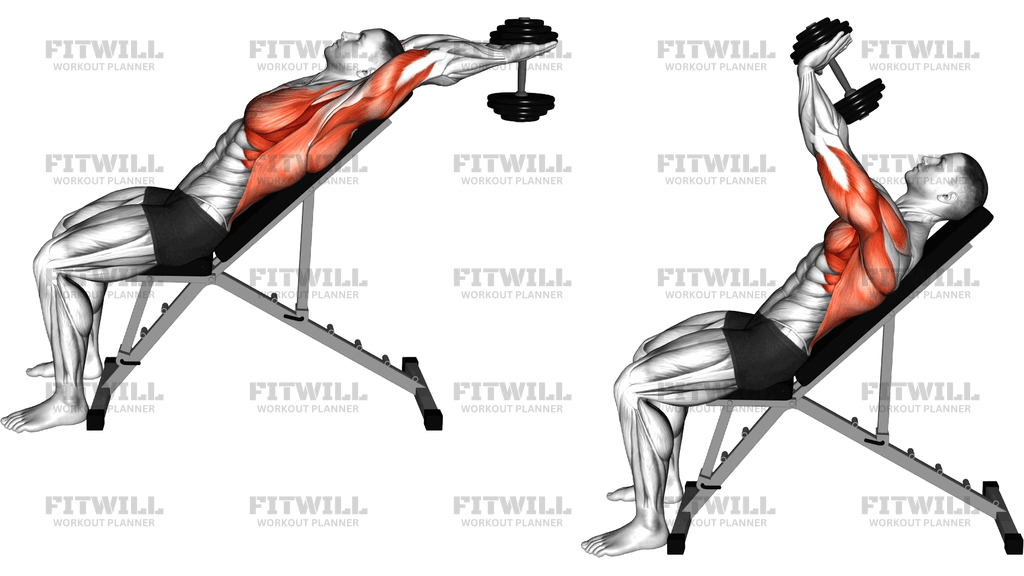
Dumbbell Renegade Row On Stability Ball
The Dumbbell Renegade Row On Stability Ball is a challenging hybrid of a rowing movement and an anti-rotation core exercise. Instead of rowing from a flat plank with both hands on dumbbells, you support one arm on a stability ball while pulling a dumbbell with the other. That single change makes the whole setup far less stable than a standard renegade row, because your support hand is resting on a surface that wants to roll away from you.
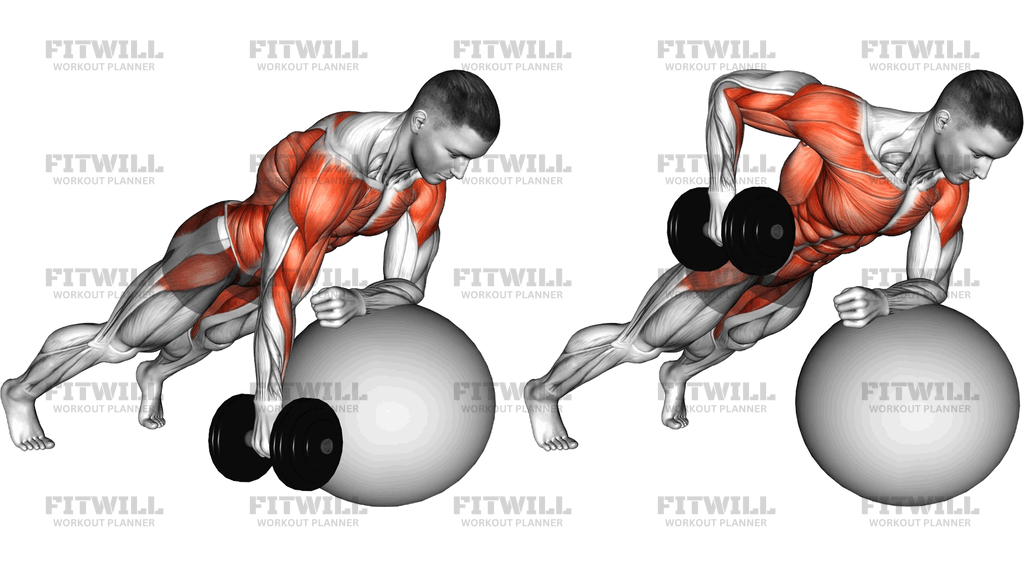
The body position is a wide, staggered plank: your support forearm rests on top of the ball, your working hand grips a dumbbell that hangs under your shoulder, and your feet stay planted on the floor with one foot offset forward to give you a wider, more controllable base. From there, the action is a single-arm row — you pull the dumbbell up toward your hip, keep your shoulders square to the floor, and lower it back down under control.
This movement trains far more than the lats. The rowing arm works through the lats, rhomboids, middle traps, rear shoulders, and biceps, while the rest of the body fights the rotational pull. Your obliques, transverse abdominis, glutes, and legs all contribute to keeping your hips level, and the support arm gets constant stabilizing work from the shoulder girdle down through the wrist. Because the ball shifts under load, even light dumbbells feel demanding.
This variation suits lifters who already own solid renegade rows or single-arm planks and want a new anti-rotation stimulus. It is popular in functional strength and athletic conditioning settings, since resisting rotation while rowing mirrors real-world demands better than machine rows ever will. It is also a compact option: one ball, one dumbbell, and a small patch of floor.
Setup and size of equipment matter a lot here. Choose a stability ball that lets you hold a plank with the ball roughly under your support shoulder, not so large that your torso angles sharply upward. Start with a light dumbbell — often half of what you would use for a normal renegade row — because the unstable support point, not the weight, is the limiting factor. If your hips sag, twist, or the ball wanders, drop the load before adjusting anything else.
The main execution priorities are simple but strict: square hips, a braced trunk, and a row path that stays close to the ribs. Rowing the dumbbell wide, letting the shoulder on the support side collapse into the ball, or snapping the weight up with momentum are the fastest ways to lose the position. Treat this as a stability exercise first and a pulling exercise second, and it rewards you with better trunk control and a stronger, cleaner one-arm row.
[ Workout Log & Planner ]
Put your next workout in Fitwill
Keep your plan and training log ready when you are.


Instructions
- Place a stability ball on a nonslip floor and position a dumbbell under the space where your working shoulder will sit.
- Grip the dumbbell with one hand in a neutral palm-facing-in grip, then walk your feet back and rest your opposite forearm on top of the ball so your support shoulder sits over it.
- Set your feet in a staggered stance, one foot slightly forward and wider than hip width, so your base can resist rotation.
- Brace your abs, squeeze your glutes, and form a straight line from head to heels; press your support forearm down into the ball to steady it.
- Row the dumbbell up toward the side of your ribs, driving your elbow back and close to your torso while keeping your chest facing the floor.
- Pause briefly at the top with your shoulder blade pulled toward your spine and your hips still square.
- Lower the dumbbell slowly back to the floor under control, taking twice as long on the descent as on the pull.
- Exhale as you row the weight up and inhale as you lower it, keeping your breath steady without holding it.
- Complete all reps on one side, set the dumbbell down safely, then reset your grip and stance before switching to the other arm.
Tips & Tricks
- Widen your staggered foot stance before you widen your grip or reduce the weight — most rotation problems trace back to a base that is too narrow.
- Keep your support shoulder active by pressing down into the ball; letting it sink turns the exercise into a passive hang and destabilizes the whole setup.
- Use hex or flat-sided dumbbells only. Round or adjustable dumbbells can roll or spin under your hand, which is a real hazard in a one-armed support position.
- Aim the row at your lower ribs, not your armpit. Pulling high lets the elbow flare and twists your chest open, which defeats the anti-rotation purpose.
- Keep your neck long by looking at a spot on the floor just ahead of your hands; craning up shortens the back of your neck and tilts your whole plank.
- If the ball drifts sideways during the row, you are pulling with your trunk instead of your back — lighten the dumbbell and focus on moving only the working arm.
- Master the static hold first: get into position and hold a steady plank on the ball for 20-30 seconds with no rowing before adding reps.
- Do not rush the lowering phase. The eccentric is where your hips are most likely to rotate, and slowing it down doubles the core demand without extra weight.
- Train your weaker side first and match the reps with your stronger side so you do not build a side-to-side imbalance.
Frequently Asked Questions
Which muscles does the Dumbbell Renegade Row On Stability Ball work the most?
The lats and upper back handle the row, while the obliques, deep core, and glutes work hard to stop your hips from rotating. The support shoulder and forearm also work continuously to control the stability ball.
Why use a stability ball instead of doing renegade rows from a regular plank with two dumbbells?
The ball removes a stable support point, so your trunk and the supporting shoulder have to resist both rotation and the ball's movement. This makes the anti-rotation demand much higher at the same dumbbell weight.
Is the Dumbbell Renegade Row On Stability Ball suitable for beginners?
Not as a starting point. Beginners should first build a solid plank, a stable two-dumbbell renegade row, and comfort supporting on a stability ball, then combine them with a very light dumbbell.
How heavy should the dumbbell be for this exercise?
Start with roughly half the weight you can row confidently from a supported position. If your hips twist or the ball slides, the load is too heavy regardless of how strong your pull feels.
Why do my hips rotate during the row?
Rotation usually comes from a foot stance that is too narrow, a dumbbell that is too heavy, or rowing the elbow out wide instead of back toward the ribs. Widen your staggered stance, reduce the load, and keep the pull tight to your torso.
What kind of dumbbell should I use?
Use a hex or flat-sided dumbbell that cannot roll or rotate in your hand. Adjustable dumbbells with loose plates or round dumbbells can shift under load and compromise your only stable grip.
What can I substitute for the Dumbbell Renegade Row On Stability Ball?
A standard two-dumbbell renegade row, a single-arm dumbbell row from a bench, or a plank position single-arm row with feet widened all train similar muscles with less stability demand.
How high should I pull the dumbbell?
Row to the side of your lower ribs with your elbow tracking back close to your torso. Pulling toward the armpit or chest flares the elbow and opens your torso, turning the row into a rotation exercise.
Is it safe if the stability ball moves during the set?
Small wobbles are normal, but if the ball rolls out from under your forearm or your shoulder loses its position, set the dumbbell down and reset. Never try to save a collapsing set by catching yourself one-handed while holding weight.
How many reps and sets should I do?
Two to three sets of 6-10 controlled reps per side works well, keeping the emphasis on stability rather than max load. Rest enough between sides to reset your brace before switching arms.