Dumbbell Single Leg Standing Shoulder Press
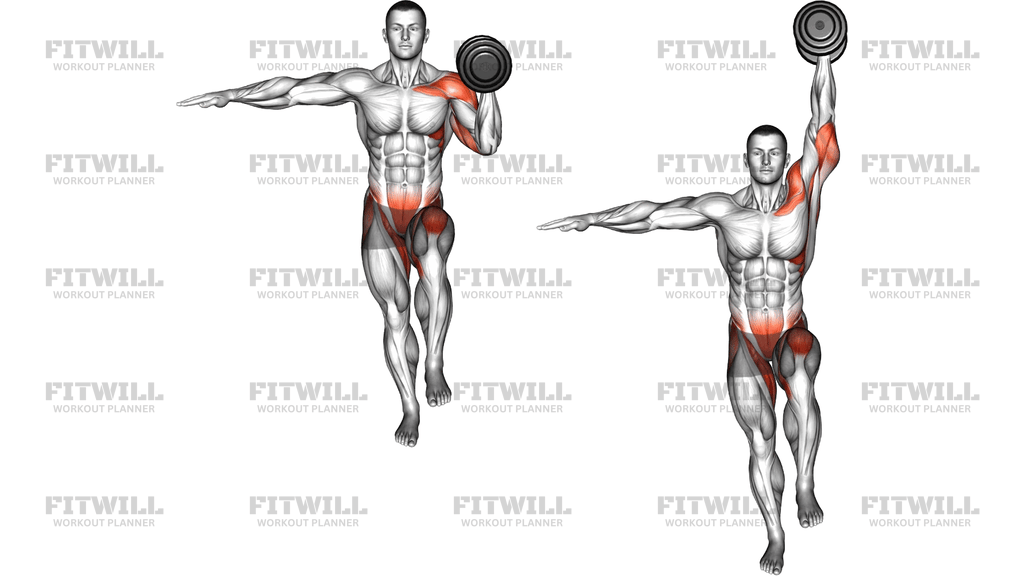
The Dumbbell Single Leg Standing Shoulder Press is an overhead press performed while balancing on one leg. You hold a single dumbbell at shoulder height on the same side as your standing leg, lift the opposite knee up in front of you, and press the weight straight overhead while your free arm reaches out to the side for balance. The result is a shoulder press that doubles as a balance and anti-rotation drill for your entire trunk.
What makes this variation valuable is the demand it places on stability. With one foot off the floor, your base of support shrinks dramatically, and the offset load pulls you toward the working side. Your hip stabilizers on the standing leg, along with your deep core and obliques, have to work constantly to keep your ribcage stacked over your pelvis and stop your torso from leaning or twisting as the dumbbell travels overhead.
The primary work still comes from the front and side of the shoulder, with the triceps finishing the lockout, but the core and hip musculature take on a much larger supporting role than in a standard two-legged press. Because the press is unilateral, each side has to do its own work, which helps expose and eventually correct side-to-side differences in pressing strength and control.
This movement suits lifters who already own a solid two-legged dumbbell press and want to add a balance and core challenge without adding load. It appears in general strength circuits, athletic training programs, and rehabilitation-adjacent settings where single-leg stability and overhead control are being rebuilt together.
Setup matters here more than with a regular press. Pick a lighter dumbbell than you would use for a seated or two-legged press, find your single-leg stance before you start pressing, and keep the raised knee lifted for the whole set. If you cannot hold the stance steady, the press becomes sloppy and the shoulder work suffers.
Execute it by pressing the dumbbell up in a straight or slightly arcing path until your arm is fully extended over your shoulder, then lower it under control back to the starting position. Keep your ribs down, squeeze the glute on the standing leg, and avoid letting your torso sway or your hips drop. Start with one set per side and build volume gradually, since the balance demand fatigues you in ways a normal press does not.
Fitwill
Log Workouts, Track Progress & Build Strength.
Achieve more with Fitwill: explore over 9600 exercises with images and videos, access built-in and custom workouts, perfect for both gym and home sessions, and see real results.
Start your journey. Download today!




Instructions
- Stand tall and transfer your weight onto one leg, keeping a soft bend in the standing knee.
- Hold a dumbbell in the hand on the same side as your standing leg, raised to shoulder height with your palm facing forward and your elbow tucked slightly in front of your ribs.
- Lift the knee of your free leg up in front of you to roughly hip height, and extend your opposite arm straight out to the side at shoulder level for balance.
- Brace your core, pull your ribs down, and squeeze the glute of the standing leg to lock in your pelvis before pressing.
- Press the dumbbell straight up overhead until your arm is fully extended and the weight sits directly over your shoulder, not out in front.
- Pause briefly at the top with your bicep near your ear and your torso level.
- Lower the dumbbell under control back to shoulder height, resisting the pull of the weight toward your working side.
- Exhale as you press up and inhale as you lower the dumbbell, keeping your breathing steady throughout.
- Complete all repetitions on one side while holding the single-leg stance, then lower the free leg, reset, and switch to the other arm and leg.
Tips & Tricks
- Choose a weight you could press comfortably for a two-legged set — the balance requirement, not shoulder strength, will usually be the limiting factor.
- If you wobble immediately, fix your foot first: grip the floor with your toes, and press through the big toe and heel rather than rocking toward the outside of the foot.
- A common mistake is letting the raised leg drop toward the floor as the dumbbell goes up — keep that knee lifted at hip height for every rep so the hip and core work stays constant.
- Watch for the torso leaning away from the dumbbell at lockout; if this happens, the weight is too heavy or your obliques are fatigued, so reduce the load or reps.
- Keep the pressing path vertical over your shoulder. Pressing the dumbbell out in front of your body shifts stress to the front delt and pulls your center of gravity forward, making balance harder.
- Drift your eyes to a fixed spot on the wall ahead of you; tracking a stationary point noticeably steadies the single-leg stance.
- Your free arm is a steering tool — reach it out wide when you feel yourself tipping toward the dumbbell, and bring it slightly closer in as your balance improves.
- If standing balance is the bottleneck, start by practicing the knee-raised stance with no weight, then add a very light dumbbell before progressing to a real press.
- Rest 30 to 60 seconds between sides, since fatigue on the first side degrades balance and form on the second.
Frequently Asked Questions
Which muscles does the Dumbbell Single Leg Standing Shoulder Press work?
The front and side of the shoulder do the main pressing work, with the triceps extending the arm at lockout. Because you are on one leg, your core, obliques, and the hip stabilizers of the standing leg also work hard to keep you upright and level.
Why should the dumbbell be held on the same side as the standing leg?
Holding the weight on the working side keeps the load stacked over your base of support, which makes the press trainable. The offset still challenges your obliques and hip stabilizers to prevent sideways lean and rotation.
Is the Dumbbell Single Leg Standing Shoulder Press suitable for beginners?
It can be, but only with a light dumbbell and realistic expectations — the balance demand is the hard part. If you are new to pressing or single-leg training, master a standard two-legged dumbbell press and unweighted single-leg balance holds first.
How heavy should the dumbbell be for this exercise?
Use noticeably less than you would for a seated or two-legged press. A good starting point is roughly half your usual single-arm press weight, and progress only when you can keep your torso completely level through every rep.
What is the most common mistake in the Dumbbell Single Leg Standing Shoulder Press?
Letting the raised leg lower toward the floor or dropping the hips as the dumbbell tires. This removes the balance and core challenge and turns the set into a sloppy half-press, so keep the knee lifted and the standing glute engaged from first rep to last.
My balance fails before my shoulders do — what should I do?
That is normal early on. Practice the stance without weight, hold onto a wall or rack lightly for the first few sessions, or press a lighter dumbbell, and your single-leg stability will catch up within a few weeks.
What can I use instead of the Dumbbell Single Leg Standing Shoulder Press?
A two-legged single-arm standing dumbbell press keeps the unilateral and anti-rotation work with less balance demand, while a half-kneeling single-arm press removes the balance element almost entirely. Progress to this standing single-leg version as those become easy.
Should I keep my raised knee bent and lifted the entire set?
Yes. Holding the knee at roughly hip height keeps your hip flexors and core engaged and your center of mass consistent. Setting the foot down between reps turns it into a different, easier exercise.
Is this exercise safe for the lower back?
When performed with a braced core, ribs down, and a moderate weight, the load on the spine stays modest. The risk comes from heavy weights that force your torso to lean or twist, so prioritize a level torso and controlled reps over load.
How many reps and sets should I do?
Two to three sets of 6 to 10 controlled presses per side works well for most lifters. Because balance degrades with fatigue, stop the set when your form wobbles rather than grinding out extra reps.