Lying Reverse Twist
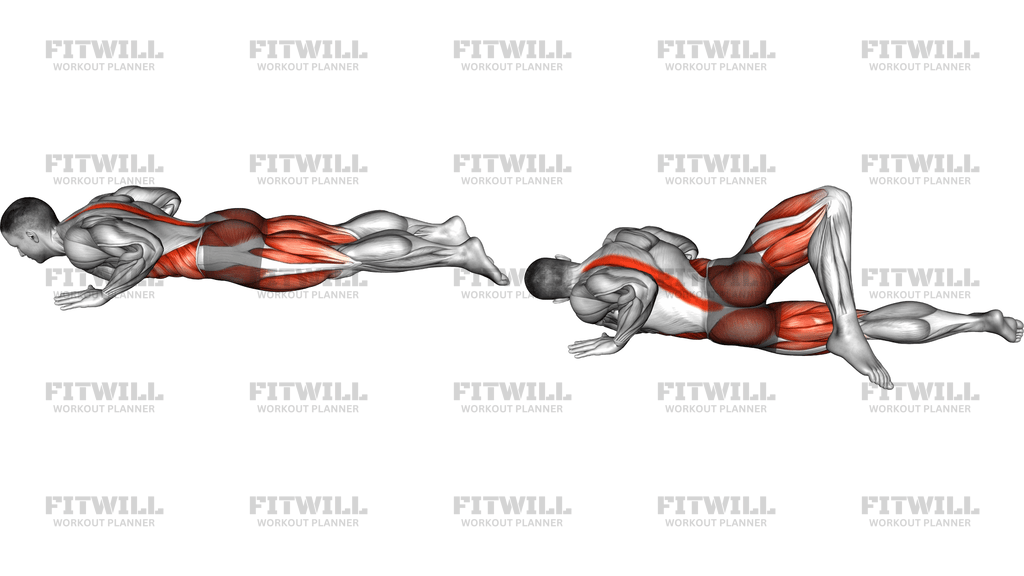
The Lying Reverse Twist is a floor-based rotational movement that takes your knees from one side of your body across to the other while your shoulders and arms stay pinned to the floor. Unlike a standard lying twist, where you simply lower your knees to one side and hold, the reverse version travels through the midline from side to side, which puts a continuous rotational demand on the obliques and the deeper muscles that stabilize the spine.
This movement is especially useful for anyone who feels stiff through the midsection after long days of sitting, or for lifters who squat, deadlift, and press heavy and need to restore rotation in the trunk. It also works well as a finisher on core days or as part of a morning mobility routine, because it mobilizes the thoracic and lumbar spine together while gently lengthening the glutes and the muscles along the lower back.
The setup matters more than people expect. Lying flat on your back with your arms spread out at shoulder height anchors the upper body, and that anchor is what forces the rotation to come from your spine and hips rather than from your shoulders sliding around. Keep your knees bent at roughly ninety degrees as you move them, since straightening the legs shifts the work toward the hamstrings and makes the twist harder to control.
To perform it well, move slowly and let your breath set the pace. Lower your knees toward the floor on one side, pause briefly, then draw them back up through the center and continue over to the opposite side without resting. The tendency is to rush through the middle, which is exactly where the obliques do the most work, so treat the transition as the main part of the exercise rather than the endpoints.
Because the lumbar spine rotates a limited amount, some movement naturally comes from the mid back, and that is fine. What you want to avoid is slamming your knees to the floor or letting your opposite shoulder peel up. If your shoulder lifts, reduce the range until you can keep it down. Most people do best with eight to twelve controlled passes per side, either as a dynamic warm-up drill or as a slow hold-and-switch stretch at the end of a session.
[ Workout Log & Planner ]
Put your next workout in Fitwill
Keep your plan and training log ready when you are.


Instructions
- Lie flat on your back on an exercise mat with your legs extended and your arms spread straight out to the sides at shoulder height, palms facing down.
- Lift both legs and bend your knees to about ninety degrees so your shins are parallel to the floor; this is your starting position.
- Press your upper back and both shoulders firmly into the mat and brace your trunk lightly before you begin moving.
- Lower both knees together toward the floor on your right side, keeping the knees stacked and the angle at the hips constant.
- Let the knees approach the floor but stop before your opposite left shoulder starts to lift off the mat.
- From that side position, draw your knees back up through the center and continue the rotation over toward your left side without pausing at the top.
- Keep the movement slow and even, taking about two to three seconds for each half of the rotation.
- Exhale as the knees lower to one side and inhale as they travel back across the middle.
- Complete eight to twelve continuous passes, alternating sides, then lower your legs one at a time and rest before your next set.
Tips & Tricks
- If your knees never reach the floor, do not force them down; the range improves over weeks, not within a single set.
- The most common mistake is the opposite shoulder lifting as the knees drop. Pin your palm down and shorten the range until the shoulder stays anchored.
- Keep the knees bent at ninety degrees throughout. Letting the legs straighten turns the movement into a hamstring stretch and reduces the rotational control you are training.
- Do not let your head turn sharply ahead of your knees; rotate your gaze gently in the opposite direction of the knees only if it feels comfortable on your neck.
- If your lower back feels pinched rather than stretched, place a folded towel or low cushion under your hips to tilt the pelvis slightly and reduce the end-range demand.
- Avoid swinging the legs for momentum. A pass driven by momentum skips the midline where the obliques actually work.
- On a hard floor, a mat is worth using because your shoulder blades and sacrum bear your weight the entire time.
- Move slower than feels necessary. Most people get more from six slow passes than from fifteen quick ones.
- If one side feels noticeably tighter, spend an extra hold on that side rather than adding more total reps.
Frequently Asked Questions
What muscles does the Lying Reverse Twist work?
It primarily targets the obliques along the sides of your trunk, with the deeper spinal rotators, glutes, and muscles of the lower back assisting as the knees travel from side to side.
How is the Lying Reverse Twist different from a regular lying twist?
A regular lying twist lowers the knees to one side and holds there, while the reverse version rotates the knees continuously from one side across the midline to the other, keeping the obliques working through the entire path.
Is the Lying Reverse Twist suitable for beginners?
Yes, because it uses only body weight on a mat and the range is self-selected. Beginners should simply reduce how far the knees lower and focus on keeping both shoulders on the floor.
Why do my knees not touch the floor during the Lying Reverse Twist?
Limited rotational range in the hips, thoracic spine, or lower back is normal, especially if you sit a lot. Work within a comfortable range and it usually improves with consistent practice.
Should I keep my knees bent or legs straight?
Keep the knees bent at about ninety degrees. Straight legs make the movement heavier and shift the sensation toward the hamstrings and lower back rather than controlled trunk rotation.
Can I use the Lying Reverse Twist as a warm-up?
Yes, it works well as a dynamic warm-up drill before training, and it can also be done slowly with pauses at each side as a relaxation stretch after a workout.
My lower back aches when I do the Lying Reverse Twist. What should I change?
Reduce the range so the knees stop well short of the floor, and try elevating the hips slightly on a folded towel. The movement should feel like a broad stretch or controlled rotation, not a sharp pull.
What can I substitute if lying on the floor is uncomfortable?
A standing version with the arms braced against a wall or doorway works a similar rotation, or you can perform a seated trunk twist on a bench with the feet planted.
How many reps of the Lying Reverse Twist should I do?
Eight to twelve continuous side-to-side passes per set is a solid range, either for one or two sets as a warm-up or three sets as a standalone core mobility drill.