Dumbbell Front Raise (Version 3)
The Dumbbell Front Raise is a standing isolation movement where you lift two dumbbells straight out in front of your body until your arms reach shoulder height, then lower them back down under control. Unlike the alternating version, both arms rise together in the same rep, which demands a little more from your core to keep your torso from swaying as the weight moves forward. It is one of the most direct ways to load the front delts through their primary function: shoulder flexion.
This lift is useful for anyone whose pressing work has outpaced their raising work. Bench presses and overhead presses already train the front delts hard, but a dedicated raise lets you isolate them through a long, clean arc without the triceps or chest taking over. It fits well at the end of a shoulder or upper-body session, or as a supplemental movement for lifters who want rounder, more complete-looking shoulders.
The main muscles at work are the anterior deltoids at the front of each shoulder. The clavicular head of the chest assists as the arms come up, the upper traps help once your arms near shoulder level, and the side delts and core stabilize throughout. Because the resistance arm lengthens as you raise the dumbbells, the hardest part of the rep is the top half, so lighter weight than you might expect is usually the right call.
Setup matters more than it looks. Standing tall with feet about hip-width apart, a dumbbell in each hand at your sides, and a neutral to pronated grip sets the joint path. Your spine position is the anchor: if your ribs flare and your low back arches as the weights rise, the movement stops isolating the shoulders and starts stressing the lumbar area. Brace your abs lightly and think about lifting the dumbbells with your shoulders, not your hands.
To execute well, raise the dumbbells forward and slightly inward until they reach shoulder height with your arms roughly parallel to the floor, keeping your elbows nearly straight but not locked. Pause for a beat at the top, then lower over two to three seconds instead of letting gravity win. If you find yourself leaning back to finish reps, that is the signal to drop the load. Two to four sets of 10 to 15 reps with strict form builds the front delts far better than heavy, swinging reps ever will.
A common use case is pairing this with lateral raises in the same session so the front and side heads of the delts get balanced attention. It also works well as a warm-up primer before pressing, using very light dumbbells for higher reps to get blood into the shoulder without pre-fatiguing it.
[ Workout Log & Planner ]
Put your next workout in Fitwill
Keep your plan and training log ready when you are.


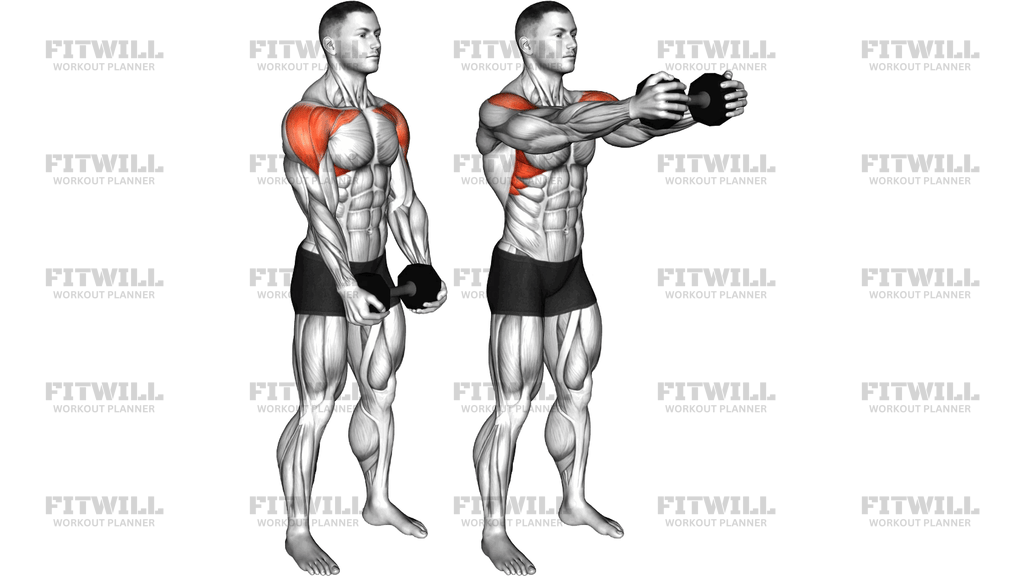
Instructions
- Stand upright with your feet about hip-width apart, holding a dumbbell in each hand at your sides with a neutral grip, palms facing your thighs.
- Roll your shoulders back and down, keep your chest tall, and soften your knees slightly so your legs are stable but not locked out.
- Brace your abdominal muscles and pull your ribs down slightly so your lower back stays neutral before the first rep.
- Keeping your elbows nearly straight, raise both dumbbells forward and up together on a smooth arc in front of your body.
- Stop when your arms are parallel to the floor at about shoulder height, with your palms turned down or slightly toward each other, and hold that top position for one second.
- Lower the dumbbells along the same arc over two to three seconds until they are back at your thighs with control.
- Exhale as you raise the weights and inhale as you lower them, keeping the breathing rhythm steady across the set.
- Keep your torso completely still throughout; do not lean back or use a hip thrust to help the weights up.
- Complete all reps with both arms moving together, then set the dumbbells down and reset your posture before the next set.
Tips & Tricks
- Choose a weight you can lift to shoulder height without your torso moving; if you rock backward as the dumbbells rise, drop down by 10 to 20 percent.
- Stop the raise at shoulder height rather than lifting the dumbbells overhead, because going higher shifts the work to your traps and turns it into a different movement.
- Keep a tiny bend in your elbows the whole time; locking the arms hard stresses the elbow joint, while bending them too much shortens the lever and invites the biceps to take over.
- Think about leading with your wrists and hands, not your elbows. Letting the elbows drift up ahead of the hands turns the rep into a partial upright row.
- If your lower back aches during the set, squeeze your glutes lightly and tighten your abs before each rep to lock your pelvis in place.
- Use a slow three-second lowering phase for a few sets; the front delts get a lot of stimulus from the eccentric portion that most lifters rush through.
- Slightly rotating your pinkies up at the top can improve the squeeze in the front delts, but keep the rotation small so the movement stays a raise, not a press.
- Avoid shrugging as the dumbbells reach the top; if your shoulders creep toward your ears, cue yourself to press your shoulder blades down while you lift.
Frequently Asked Questions
Which muscles does the Dumbbell Front Raise work?
The primary mover is the anterior deltoid at the front of each shoulder. The upper chest assists during the lift, and the upper traps, side delts, and core contribute to stability and control.
Should I raise both dumbbells at the same time or alternate arms?
In this version both arms rise together, which loads the front delts symmetrically and challenges your core to prevent torso sway. Alternating arms lets you use slightly heavier weights but involves more overall body movement.
How high should I lift the dumbbells?
Lift until your arms are roughly parallel to the floor at shoulder height. Raising much higher shifts the emphasis to your upper traps and reduces the isolation on the front delts.
Why do I feel my lower back during the Dumbbell Front Raise?
That usually means your torso is leaning back or your ribs are flaring to help lift the weight. Brace your abs, squeeze your glutes, and reduce the dumbbell weight until your spine stays still for every rep.
Is the Dumbbell Front Raise good for beginners?
Yes, it is a simple single-joint movement that is easy to learn. Beginners should start with light dumbbells in the 2 to 8 kilogram range and focus on raising to shoulder height without any torso movement.
How heavy should the dumbbells be for this exercise?
Front raises use much lighter loads than presses because the lever arm grows longer as your arms rise. Pick a weight you can control for 10 to 15 strict reps; if you cannot pause at the top without swinging, it is too heavy.
Can I do the Dumbbell Front Raise if I already bench press and overhead press?
You can, and many lifters do, but keep the volume modest since pressing already trains the front delts hard. Two to three sets at the end of a shoulder session is usually plenty.
What can I use instead of dumbbells for a front raise?
A cable handle with a straight-arm pulldown-to-front-raise motion, a resistance band anchored under your feet, or a plate held in both hands all work. The key is matching resistance that rises as your arm reaches horizontal.
Should my palms face down or face each other during the raise?
Either grip works. A palms-down grip biases the front delts slightly more, while a palms-facing grip can feel more comfortable on the shoulders; choose whichever lets you keep your elbows relaxed and your wrists neutral.
Is it safe to do Dumbbell Front Raises with shoulder pain?
Sharp pain in the front of the shoulder is a signal to stop and reduce the range or the weight. If discomfort persists across sessions, have a qualified professional assess your shoulder before continuing.