Dumbbell Standing Shoulder Press To Pec Dec
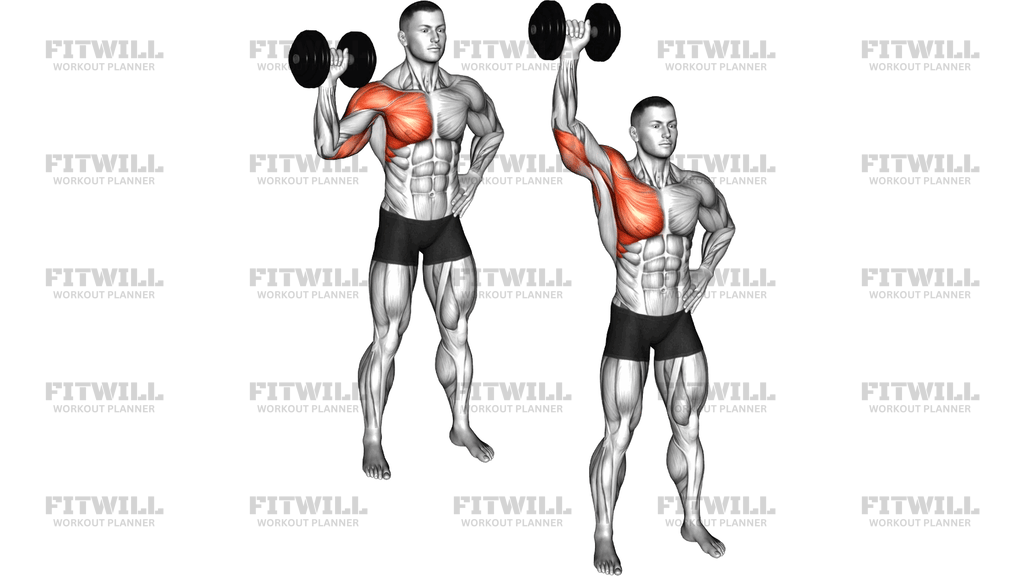
The Dumbbell Standing Shoulder Press To Pec Dec is a hybrid single-arm press that follows an arced path instead of a straight vertical one. You begin with the dumbbell held at chest height near your body's midline — the same finishing position your hands would reach on a pec deck machine — and press the weight up and out along a diagonal arc until the arm is extended overhead, slightly out to the side. From there you reverse the arc and bring the dumbbell back down toward the center of your chest. Because the path crosses from midline to overhead, the movement blends a shoulder press with a chest fly-style sweep in one continuous motion.
This exercise is useful for lifters who want to train the front delts and upper chest together without switching machines or adding a second movement. The diagonal path loads the clavicular head of the pectoralis major as the arm moves away from the body, while the front shoulder does most of the pressing work. The triceps extend to finish the lockout, and the core works the entire time to keep your torso upright while a single dumbbell pulls slightly to one side.
The setup matters more here than in a standard press. With one arm working and the other hand free at your hip, any lean, twist, or rib flare changes the arc and shifts tension away from the chest and shoulders. Planting your feet, bracing your midsection, and keeping your torso square gives the dumbbell a stable base to travel from, so the muscles you are targeting actually do the work.
Execution is about tracing the arc, not just moving the weight up. Think of the dumbbell sweeping outward as it rises, like the arm of a pec deck opening, rather than traveling straight up beside your head. At the top, the palm faces forward and the biceps ends up near your ear. On the way down, follow the same curve back to the starting point near your chest, keeping the elbow under control rather than letting gravity dump the weight.
This movement fits well as a secondary pressing exercise on shoulder or upper-body days, or as a finisher when you want extra work for the upper chest and front delts after heavier pressing. Because it is unilateral, it also exposes side-to-side differences in strength and control. Use a lighter dumbbell than you would for a regular one-arm shoulder press — the arced path and single-arm balance demand more coordination, and the value comes from a clean path, not a heavy load.
[ Workout Log & Planner ]
Put your next workout in Fitwill
Keep your plan and training log ready when you are.


Instructions
- Stand with your feet about hip-width apart and hold one dumbbell at chest height in front of your body, palm facing inward toward your midline, elbow bent and pointing out to the side.
- Rest your free hand on your hip and square your shoulders and hips so your torso does not twist toward the working arm.
- Brace your core, pull your ribs down, and squeeze your glutes to create a stable base before you move.
- Press the dumbbell up and out along a diagonal arc, letting the weight travel away from your body's midline as it rises.
- Finish with your arm nearly straight overhead and angled slightly out to the side, palm facing forward and the dumbbell roughly over your ear.
- Pause for a beat at the top without shrugging your shoulder toward your ear.
- Reverse the same arc on the way down, guiding the dumbbell back toward the center of your chest until your elbow is bent at shoulder height again.
- Exhale as you press up and out, and inhale as you lower the dumbbell back along the arc.
- Complete all reps on one arm, then switch the dumbbell to the other hand and repeat, matching the reps and keeping your torso equally square on the second side.
Tips & Tricks
- The most common mistake is turning this into a regular shoulder press by pushing straight up beside your head. The dumbbell should drift away from your midline as it rises — if it never moves outward, you are skipping the chest portion of the arc.
- Start lighter than your usual one-arm press weight. The diagonal path removes some of your strongest pressing leverage, and a weight that is too heavy will collapse the arc into a straight push.
- Keep your hips and shoulders facing forward the entire set. When the weight gets hard to press, the torso often rotates toward the working arm, which shortens the arc and steals work from the chest and front delts.
- Do not let your lower back arch as the dumbbell goes overhead. If your ribs flare and your spine extends, tighten your brace and slightly tuck your pelvis before continuing.
- Keep your elbow from flaring fully out at the bottom. It should stay roughly at shoulder height with your upper arm supported, not dropped behind your torso where the shoulder capsule is loaded awkwardly.
- Control the return more than the press. Because the dumbbell comes back toward your chest on a curved path, letting it free-fall on the way down is where most form breakdowns and shoulder strain happen.
- Keep your wrist stacked over your elbow at the top. A wrist that bends back under load is a common issue on arced pressing movements and is easy to fix by gripping the handle firmly and lining the knuckles up with the forearm.
- If your shoulder pinches at the top of the arc, reduce the outward angle slightly so the dumbbell finishes more directly over your shoulder rather than far out to the side.
- Match your weaker arm's rep count and effort, and start your sets with that side so fatigue does not widen any left-right difference.
Frequently Asked Questions
Which muscles does the Dumbbell Standing Shoulder Press To Pec Dec work?
The front shoulders do most of the pressing, and the upper chest works through the outward arc of the path. The triceps extend the lockout, and your core stabilizes your torso against the single-sided load.
Why does the dumbbell move in an arc instead of straight up?
The curved path is what makes this a hybrid movement — the dumbbell starts near your chest midline, similar to where pec deck handles meet, and sweeps outward as it rises. That arc loads the chest in a way a standard vertical shoulder press does not.
Is the Dumbbell Standing Shoulder Press To Pec Dec suitable for beginners?
Yes, as long as a light dumbbell is used and the arc is learned slowly. Beginners often press straight up out of habit, so practicing the sweeping path with minimal weight first makes the movement far more effective.
How heavy should the dumbbell be for this exercise?
Use noticeably less weight than you would for a regular one-arm shoulder press. The diagonal path and single-arm balance reduce leverage, so a moderate dumbbell with a clean arc beats a heavy one pressed straight up.
What is the most common mistake in the Dumbbell Standing Shoulder Press To Pec Dec?
Collapsing the arc into a straight vertical press. If the dumbbell never travels away from your midline on the way up, the chest contribution disappears and the exercise becomes a plain shoulder press with extra balance demand.
Can I do this exercise with both arms at the same time?
It can be done with two dumbbells, but the single-arm version shown here is the standard setup. One arm at a time makes it easier to keep the arc honest, lets your free hand rest on your hip for balance, and highlights any side-to-side strength difference.
Where exactly should the dumbbell start and finish?
Start with it at chest height near your body's midline, elbow bent and out to the side, and finish with your arm nearly straight overhead angled slightly outward, palm facing forward, with the dumbbell roughly over your ear.
What can I substitute if I do not feel it in my upper chest?
Slow the outward portion of the arc down and slightly reduce the top-end angle so the dumbbell sweeps farther from midline. If that still does not work, an incline dumbbell press or a low-to-high cable fly targets the same upper-chest fibers more directly.
My shoulder feels uncomfortable at the top of the press. Should I stop?
Bring the top position in slightly so the dumbbell finishes more directly over your shoulder, reduce the weight, and make sure your wrist stays stacked. If discomfort persists, switch to a standard pressing variation and get the movement assessed before continuing.