Dumbbell Drive Front Raise
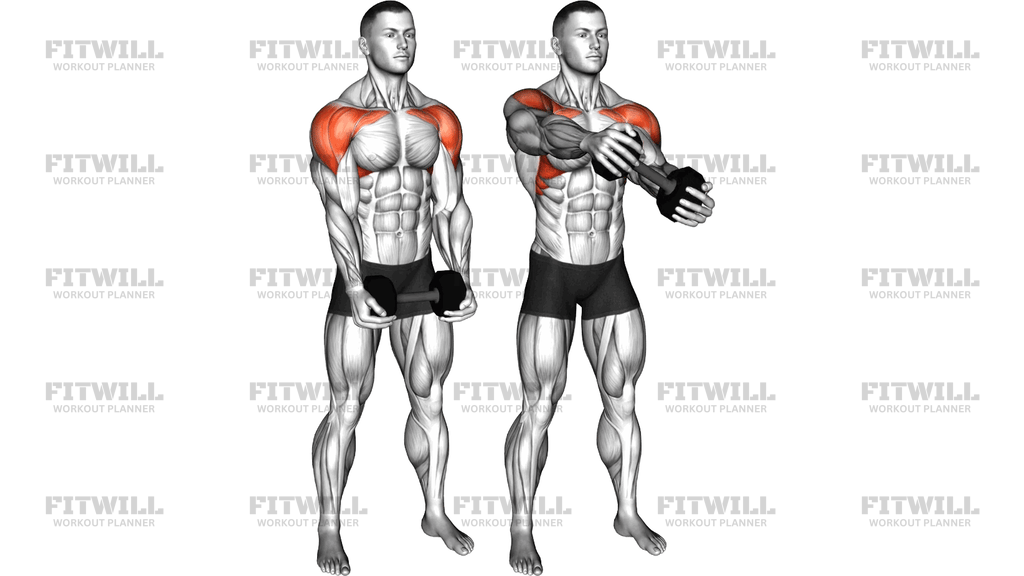
The Dumbbell Drive Front Raise is a standing front raise variation where you hold two dumbbells pressed together end to end, palms facing each other, and lift them straight out in front of your body to shoulder height. Because the dumbbells stay in contact with each other throughout the lift, your hands work as a single unit, which encourages a straight, symmetrical pressing path and keeps both arms honest about how much work each one is doing. The grip is neutral rather than overhand, so your shoulders sit in a naturally comfortable position with no forced internal rotation at the top.
This movement primarily targets the front delts, with real assistance from the upper chest fibers as the arms approach shoulder height, and light support from the traps and core as they stabilize your torso. It fits well as an accessory lift on shoulder days, as a finisher after pressing work when the front delts are already warm, or as a main isolation movement for anyone whose overhead pressing strength lags because their front delts lack direct training.
Setup matters more than most people assume. Standing with your feet about hip-width apart, a soft bend in the knees, and the dumbbells resting against your thighs keeps your center of gravity settled before the first rep. If you start leaning back or swinging, the front raise quickly becomes a momentum exercise and the shoulders stop doing the lifting. Brace your abs lightly and think of the movement as happening only at the shoulder joint.
To execute it well, keep the elbows nearly straight but never locked, and raise the dumbbells in a smooth arc until your arms are roughly parallel to the floor or just slightly below it. Pause briefly at the top without shrugging, then lower under control over two to three seconds rather than letting gravity yank the weights down. The lowering phase is where a large share of the muscle-building stimulus comes from, so treat it with the same respect as the lift itself.
A practical safety note: because the load hangs forward of your body at the top, the lower back works to keep you upright. Keep the weight moderate, resist the urge to arch back as the arms rise, and stop the set the moment your torso starts tilting backward or the dumbbells drift apart. If you cannot keep the weights touching through the top half of the rep, the dumbbells are probably too heavy.
[ Workout Log & Planner ]
Put your next workout in Fitwill
Keep your plan and training log ready when you are.


Instructions
- Stand with your feet about hip-width apart and hold a dumbbell in each hand with a neutral grip, palms facing your body.
- Press the two dumbbells together end to end in front of your thighs so they stay in contact, and let your arms hang straight down with a soft bend in the elbows.
- Draw your shoulders back and down, brace your core lightly, and set your gaze straight ahead so your head stays neutral.
- Exhale and raise the dumbbells straight out in front of you, keeping them pressed together and your elbows nearly locked.
- Stop when your arms reach shoulder height, or just slightly below, and hold that top position for a short count without shrugging your shoulders up.
- Inhale and lower the dumbbells along the same vertical path over two to three seconds until they rest back against your thighs.
- Keep your torso upright and your knees slightly bent throughout so the load stays on the shoulders rather than the lower back.
- Reset your grip and brace at the bottom of each rep, then continue for the desired number of repetitions before setting the dumbbells down.
Tips & Tricks
- If the dumbbells drift apart as your arms rise, your grip is failing or the weight is too heavy; squeeze the plates together deliberately or drop to lighter dumbbells.
- A common mistake is swinging the weights with a hip snap to get them moving. If your torso rocks backward on the lift, slow the tempo down and cut the load until you can lift without it.
- Resist shrugging at the top. If your shoulders creep toward your ears, think about pushing the dumbbells forward and slightly away instead of up.
- Do not chase extra height. Raising the dumbbells well above shoulder height shifts work toward the traps and reduces the tension on the front delts.
- Keep a small bend in the elbows the entire time. Fully locked elbows at the bottom make the lift feel harder on the joint without adding anything to the shoulders.
- Because both hands share one path, this movement exposes side-to-side imbalances quickly. If one arm drops lower or lags, spend a few weeks on single-arm front raises before returning to it.
- Control the descent. Two to three seconds down keeps constant tension and prevents the shoulder joint from being jerked at the bottom of each rep.
- Place this exercise after your heavier presses in the session rather than before, so fatigue from front delt isolation does not weaken your main lifts.
Frequently Asked Questions
Which muscles does the Dumbbell Drive Front Raise work?
The front delts do most of the lifting, with the upper chest assisting as the arms reach shoulder height. The traps and core work in a supporting role to stabilize the torso and shoulder blades.
Why should the dumbbells stay pressed together during the Dumbbell Drive Front Raise?
Keeping them in contact forces both arms to travel the same path and lifts at the same speed, which makes imbalances obvious and prevents one arm from cheating. It also promotes a clean, straight raise instead of a wandering arc.
Is the neutral grip in the Dumbbell Drive Front Raise easier on the shoulders than an overhand grip?
For most people, yes. The palms-in position avoids forcing the shoulder into internal rotation at the top of the lift, which is why many lifters with cranky shoulders tolerate it better than a strict overhand front raise.
How high should I raise the dumbbells?
Raise them to about shoulder height, where your arms are parallel to the floor. Going much higher shifts the emphasis toward the traps and away from the front delts without adding benefit.
Can beginners do the Dumbbell Drive Front Raise?
Yes, it is a simple movement to learn. Beginners should start with light dumbbells, focus on keeping the weights together and the torso still, and master the controlled lowering phase before adding load.
What is the most common mistake in this exercise?
Using body English to swing the weights up, usually by arching the lower back or snapping the hips forward. If your torso moves to start the lift, the weight is too heavy for your front delts to handle honestly.
What can I use if I do not have two dumbbells for the Dumbbell Drive Front Raise?
A single dumbbell held with both hands under the top head works as a close substitute, as does a plate pinched between the hands. Cable front raises with a handle are another option if a dumbbell rack is busy.
How many sets and reps should I use for the Dumbbell Drive Front Raise?
Two to four sets of 10 to 15 reps works well for most lifters, since the front delts respond to controlled volume rather than max loads. Keep the last two or three reps challenging but free of swinging.
Is it safe to do the Dumbbell Drive Front Raise with lower back issues?
The standing position does load the lower back as it holds you upright against the forward-hanging weight. Keep the load light, brace your abs on every rep, and stop if your back takes over from your shoulders; a seated version on a bench can reduce the demand.