Lever Reverse Seated Shoulder Press
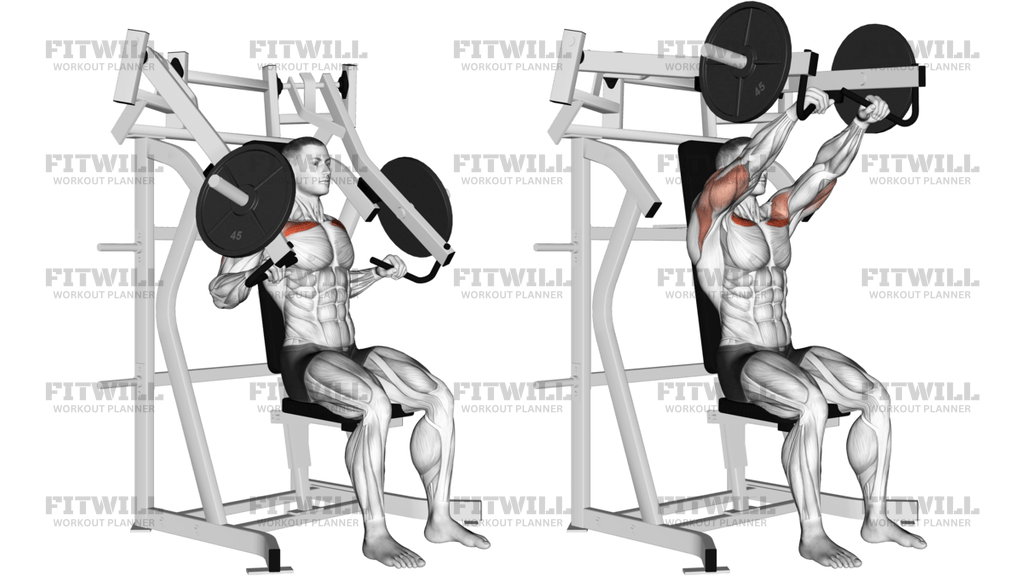
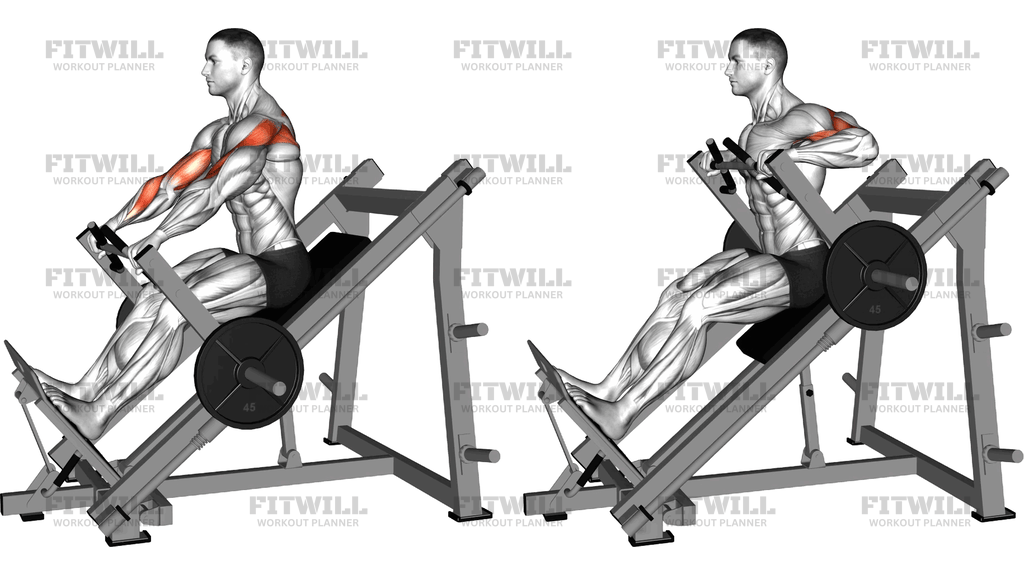
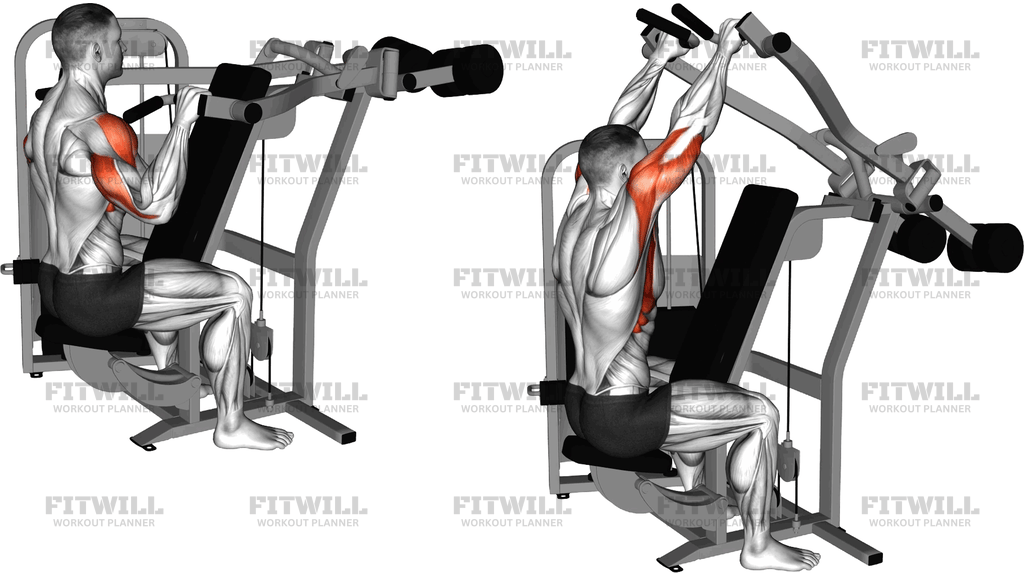
The Lever Reverse Seated Shoulder Press is a plate-loaded machine press performed while seated with your back braced against an angled pad, pressing independent lever arms from shoulder height to full extension overhead. The "reverse" positioning refers to the seat orientation: you sit facing into the machine so the levers travel behind and slightly in front of your head line, with the resistance driven through a fixed lever arm rather than free weights. This setup creates a guided, arcing path that closely matches how the shoulders naturally press.
The main work falls on the front delts, with the side delts assisting as the arms move up and out, and the triceps finishing each rep as the elbows extend. Because the machine stabilizes the load for you, the upper traps and rotator cuff still contribute, but they are not forced to balance a barbell or dumbbells. That makes this press a solid choice for building pressing strength with less demand on joint stabilization.
Setup matters more on this machine than most people realize. The seat height determines where the handles start relative to your shoulders. If the seat is too low, the levers start below shoulder level and each rep begins with a stressful stretch at the shoulder joint. If it is too high, you shorten the range and lose tension at the bottom. Adjust the seat so the handles sit roughly at ear or mid-face height when you are seated tall with your back flat against the pad.
Execution is straightforward but easy to rush. Grip the handles with palms facing forward, brace your core against the pad, and press the levers up until your elbows are extended without locking them hard. The levers should converge slightly as they rise, following the machine's built-in arc. Lower under control until your elbows drop just below shoulder level, then drive into the next rep. Exhale on the press, inhale on the way down.
This exercise fits well as a primary pressing movement on shoulder day, especially for lifters who want overhead pressing volume without the setup and spotting demands of a barbell. It is also a common pick in rehabilitation-style or return-to-lifting programs precisely because the path is fixed and the weight can be incremented in small jumps. More experienced lifters often use it as a finisher after free-weight pressing to exhaust the delts safely near the end of a session.
From a safety standpoint, the seated position with a supportive pad keeps your lower back from arching excessively, which is one of the most common problems in standing overhead work. Keep your ribs down, avoid bouncing the weight out of the bottom, and never sacrifice seat height just to move more load. If one arm fatigues faster than the other, the independent levers will expose it, so keep both sides moving through the same range rather than letting the stronger arm set the pace.
[ Workout Log & Planner ]
Put your next workout in Fitwill
Keep your plan and training log ready when you are.


Instructions
- Sit facing into the machine with your back, shoulders, and hips in full contact with the angled back pad.
- Adjust the seat height so the machine handles line up at ear to mid-face height while you sit tall.
- Grip each handle with a pronated grip, palms facing forward, elbows bent and positioned just below shoulder level.
- Plant your feet flat on the floor about hip-width apart and brace your abdominal muscles to keep your ribs from flaring.
- Press both levers upward and slightly inward along the machine's arc until your arms are extended but your elbows are not locked.
- Pause briefly at the top with the handles over the midline of your body, keeping tension in the shoulders.
- Lower the levers in a slow, controlled descent until your elbows fall just below shoulder level.
- Exhale as you press up and inhale as you lower the weight back down.
- Complete all reps without letting the levers slam into the bottom rest position, then set the stack down fully before releasing the handles.
Tips & Tricks
- Check the seat height before every session; even one pin position changes whether the handles start at your shoulders or drag your elbows well below them.
- If you feel pinching at the front of the shoulder at the bottom, reduce the depth of each rep so your elbows stop at shoulder level instead of dropping past it.
- Do not let your head jut forward as you press; keep the back of your head against the pad so the levers travel around it, not in front of your face.
- The independent levers will drift if one side is stronger. Watch your weaker arm in the side mirror and match its depth and speed rather than letting the strong arm lead.
- Keep your wrists stacked over your elbows throughout the press. Bent-back wrists are a sign the grip is too wide or the load is too heavy.
- Stop each rep just short of a hard elbow lockout. Full lockout shifts tension from the delts to the joints and gives the triceps a rest between reps.
- Control the negative for two to three seconds. Because the machine path is fixed, the eccentric is where most of the shoulder-building work happens, and rushing it wastes that.
- If your lower back arches off the pad at the bottom, the weight is likely too heavy or your seat is set too low. Reduce load and revisit the seat pin before continuing.
Frequently Asked Questions
What muscles does the Lever Reverse Seated Shoulder Press work?
The front delts do most of the pressing, with the side delts assisting as the arms rise. The triceps extend the elbows at the top, and the upper traps help stabilize the shoulder girdle throughout the movement.
How high should I set the seat for the Lever Reverse Seated Shoulder Press?
Set the seat so the handles sit at about ear to mid-face height when you are seated tall against the pad. This lets each rep start with your elbows just below shoulder level instead of hanging far below it.
Is the Lever Reverse Seated Shoulder Press good for beginners?
Yes. The fixed lever path removes the balance and stabilization demands of a barbell or dumbbell press, so beginners can focus on pressing mechanics and build overhead strength with a low risk of the load drifting off course.
Why does my lower back arch when I use this shoulder press machine?
Arching usually means either the seat is too low, forcing you to lean back to reach the handles, or the weight is heavy enough that you are extending your spine to help press. Sit tall, keep your ribs down, and reduce the load if the arch persists.
Can I press one arm at a time on the Lever Reverse Seated Shoulder Press?
On most leverage shoulder press machines the levers are independent, so single-arm presses are possible. Keep your torso square against the pad and brace firmly, since pressing one side can pull you into rotation.
Should I lock out my elbows at the top of the Lever Reverse Seated Shoulder Press?
Extend fully but stop just short of a hard, aggressive lockout. Full extension ensures complete range, while slamming into lockout transfers tension away from the delts and onto the elbow joint.
How does this machine press compare to a barbell overhead press?
The machine guides the arc and supports your back, so it loads the delts and triceps with less demand on stabilizers and the lower back. A barbell press builds more overall stability, but the machine lets you train the pressing muscles harder with less fatigue elsewhere.
How deep should I lower the handles on the Lever Reverse Seated Shoulder Press?
Lower until your elbows drop just below shoulder level, which is roughly where your fists line up near your ears. Going much deeper than that pushes the shoulder into a stretched position under load that many lifters do not tolerate well.
What can I substitute if my gym does not have a leverage shoulder press machine?
A seated dumbbell shoulder press on an upright bench is the closest free-weight equivalent, and a pin-selected machine shoulder press or Smith machine press also covers the same movement pattern with a guided path.
Is it safe to go heavy on the Lever Reverse Seated Shoulder Press?
It is one of the safer ways to press heavy overhead because the back pad and fixed path support you, but form still breaks down under excessive load. Keep your back against the pad, control the descent, and increase the weight only when every rep stays clean.