Weighted Plate Stagged Stance Romanian Deadlift
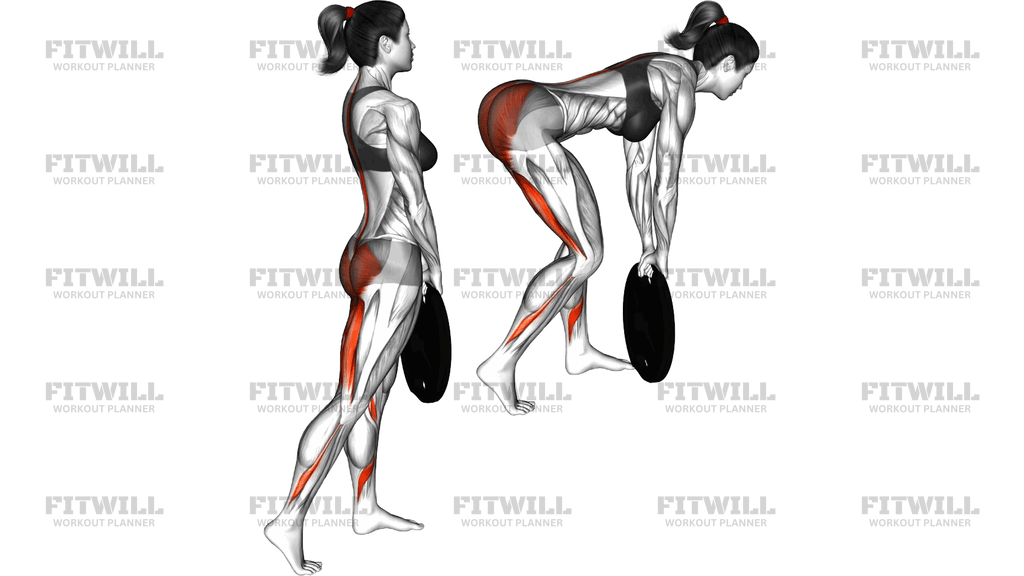
The Weighted Staggered Stance Romanian Deadlift is a hip hinge variation that sits between a conventional two-legged Romanian deadlift and a full single-leg version. You stand with one foot a short step in front of the other, most of your weight on the front leg, and hold a weight plate in front of your thighs as you push your hips back and fold forward over the front leg. The rear foot stays on the ball of the foot with the heel lifted, which gives you just enough support to load the hips heavily without the balance demands of standing entirely on one leg.
This setup makes the exercise a great middle step for lifters who feel stable Romanian deadlifts in their lower back rather than their glutes and hamstrings, but who are not yet ready for single-leg work. The staggered stance narrows your base and shifts the load onto the front leg, so each side of your hips has to do its share of the work. That helps clean up left-to-right strength differences and teaches you to hinge through one hip at a time, which carries over to running, lunging, and stepping movements.
The main muscles working are the glutes and hamstrings of the front leg, with the gluteus maximus doing most of the driving as you stand back up. The hamstrings lengthen under load on the way down and help pull you upright. Your lower back works isometrically to keep your spine neutral, the adductors and hip stabilizers on the standing leg keep your knee and pelvis aligned, and the calf of the trailing foot stays active because the heel never touches the floor.
Holding a plate rather than a barbell or dumbbells changes the feel of the movement in a useful way. The plate sits close to your body and pulls straight down, which keeps the resistance near your midline and makes it easier to feel the hinge at the hips instead of the knees. Because the load is modest compared to a barbell setup, this version suits lifters who want strict technique, higher reps, or a focused glute and hamstring finisher without heavy spinal loading.
Execution comes down to one idea: the torso and the rear leg move like a see-saw around the hip of the front leg. Push your hips back, let the plate slide down the front of your thigh, and let your rear heel rise as your chest lowers. Stop when you feel a strong stretch along the hamstring of the front leg, usually with your torso somewhere near parallel to the floor, then drive the front foot down and squeeze the glute to return to standing.
Keep the front shin nearly vertical and the knee softly bent but not traveling far forward. If your back rounds, your front heel lifts, or the plate drifts away from your legs, the weight is too heavy or the hinge is too shallow. Start with a light plate and moderate depth, and only progress the load once the pattern feels smooth and controlled from top to bottom.
[ Workout Log & Planner ]
Put your next workout in Fitwill
Keep your plan and training log ready when you are.


Instructions
- Stand holding a weight plate with both hands by its rim, arms relaxed and hanging in front of your thighs.
- Take a short staggered stance: one foot planted flat about 20-30 centimeters ahead of the other, the rear heel lifted so the rear foot rests on the ball of the foot.
- Shift roughly 80-90 percent of your weight onto the front leg and soften both knees slightly.
- Brace your core, pull your shoulders back, and set your spine in a neutral position with your chest tall.
- Push your hips back and hinge forward, letting the plate slide down the front of your thigh while the rear knee tracks down toward the floor.
- Lower until you feel a firm stretch in the hamstring of the front leg, keeping the plate close to your leg and your back flat.
- Drive through the heel and midfoot of the front leg and squeeze the glute to stand back up, bringing the plate back to your thigh.
- Exhale as you rise, and inhale as you hinge down, keeping your breathing steady and your brace consistent.
- Complete all reps on one side, then switch legs so the opposite foot is forward and repeat.
Tips & Tricks
- If your lower back rounds at the bottom, cut the depth rather than adding weight, depth should stop where your hamstring stretch ends, not where the plate reaches the floor.
- Keep the plate in light contact with your front leg through the whole descent; if it swings away, you are hinging around the shoulder instead of the hip.
- The rear heel should stay lifted for every rep. If it keeps dropping, widen the stagger slightly until your balance improves.
- Think about pushing the floor away with the front foot on the way up rather than lifting your chest with your lower back.
- Do not let the front knee cave inward. Actively press the knee slightly outward so the knee tracks over the middle of the foot.
- Keep the bend in the front knee constant. If the knee straightens as you lower, the exercise drifts from a hinge toward a stiff-leg deadlift.
- Move slowly on the way down, about two to three seconds, since the stretch phase is where the hamstrings get most of the stimulus.
- Start with a light plate you can hold comfortably by the rim. A plate that is too heavy to grip cleanly will pull your shoulders forward and round your upper back.
- Grip the plate by its edge with fingers over the rim and keep your arms straight but relaxed, the arms are hooks, not lifters.
Frequently Asked Questions
Which muscles does the Weighted Staggered Stance Romanian Deadlift work the most?
The glutes and hamstrings of the front leg do most of the work, with the gluteus maximus driving you back up to standing. The lower back, adductors, and the calf of the rear foot work as stabilizers throughout the set.
Why hold a weight plate instead of a barbell or dumbbells?
A plate sits close to the body and loads the hinge with a modest, easy-to-control weight, which makes it easier to learn the hip pattern cleanly. It is a practical option when you want strict form or higher reps without heavy spinal loading.
How far apart should my feet be in the staggered stance?
A short split works best, roughly one foot-length between the front and rear foot, with the rear heel lifted and your weight mostly on the front leg. A stance that is too wide turns it into a lunge-like position and takes tension off the front hamstring.
Is this exercise suitable for beginners?
Yes, provided you start with a very light plate or no weight and master the hinge first. The staggered stance gives more balance support than a single-leg deadlift, making it a good progression toward one-sided work.
How deep should I lower the plate?
Lower until you feel a strong stretch along the front leg's hamstring, which for most people is when the torso approaches parallel to the floor. Going lower by rounding the back adds no benefit and only shifts stress to the spine.
Should my rear knee bend during the movement?
The rear knee bends slightly and lowers toward the floor as you hinge, but it is passive support, not a working joint. Keep the rear foot on the ball of the foot and let the front hip do the hinging.
My balance falls apart on the rear toes. What should I fix?
Widen the stagger a little, keep your eyes on a fixed point ahead of you, and make sure the plate stays against your leg. Drifting the plate away from the body is the most common cause of losing balance in this setup.
Can I do the Weighted Staggered Stance Romanian Deadlift with a dumbbell or kettlebell instead?
Yes, the same stance and hinge work well with a dumbbell or kettlebell held in front of the thigh, and a single-sided dumbbell hold adds an extra anti-rotation challenge for the core.
How many reps and sets should I use?
Two to four sets of 8-12 reps per side works well for strength and muscle, while 12-15 reps per side suits a lighter, technique-focused session. Rest briefly between sides so your balance stays sharp.
Is it safe for my lower back?
When the hinge is performed with a neutral spine, a braced core, and a weight you can control, the load on the lower back is reasonable and the back muscles simply hold position. Stop the set if you feel your back rounding or any sharp discomfort, and reduce the depth or weight.