Cable Forearm Pronation
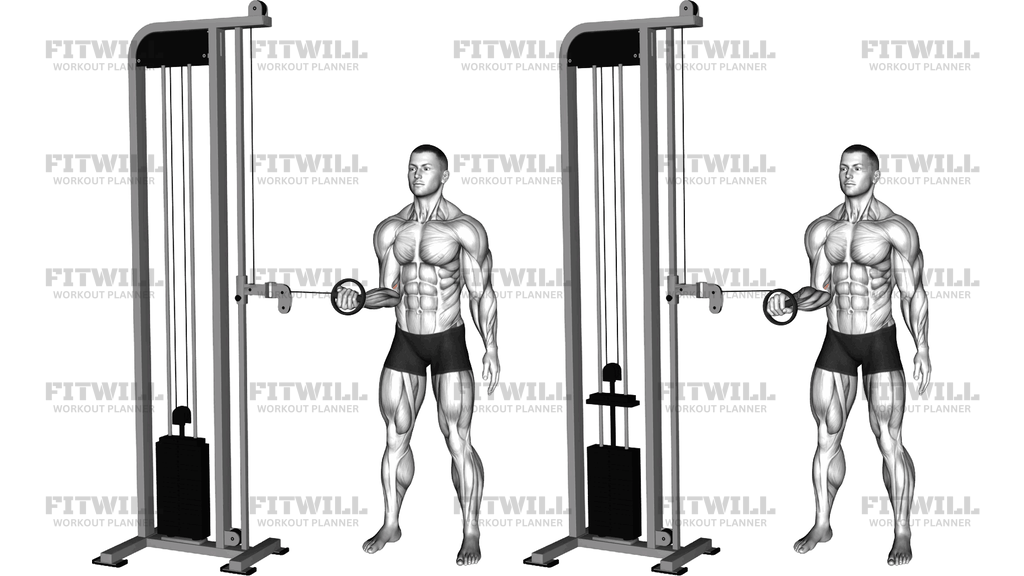
Cable Forearm Pronation is a targeted isolation exercise for the muscles that rotate the forearm so the palm turns from up to down. You stand beside a cable machine with the pulley set around waist height, hold a single handle with one hand, and pin your elbow against your side at roughly ninety degrees. From there, you rotate your forearm inward against the cable's resistance until your palm faces the floor, then rotate back under control.
This movement trains the pronator teres and pronator quadratus along with the surrounding forearm musculature that supports gripping, twisting, and carrying. Most arm work covers flexion and extension at the elbow and wrist, but rotation gets ignored, and that is exactly where this exercise earns its place. Stronger pronation carries over to tennis, baseball, climbing, golf, martial arts, and any lifting style that demands a secure, resilient grip.
It is especially useful for people rehabbing or bulletproofing the elbow after forearm strain, for racket-sport players who load the forearm with rotational force, and for lifters who want balanced forearm development to support heavy pulls. Because the cable provides smooth, consistent tension through the entire arc of rotation, the muscle stays loaded at every angle, which is difficult to achieve with a dumbbell.
Setup matters more here than in most arm exercises. The pulley height should match your hand height with your elbow bent at your side, so the cable pulls horizontally across your body rather than upward or downward. Keep the upper arm glued to your torso; if the elbow drifts forward or away from your ribs, the rotation starts coming from the shoulder and the forearm stops doing the work.
Execution should be slow and rotational, not pulled. Turn the forearm by rotating from the hand and forearm, letting the handle travel across the front of your body until your palm faces down, pause briefly, then rotate back until the palm faces up or neutral. The range is relatively short, so controlling both ends of the movement and avoiding any wrist flicking is what makes the set productive.
Keep the load light to moderate. Forearm rotators are small muscles, and the elbow joint takes the stress when the weight gets ambitious. Work each side separately, match the number of reps on both arms, and treat this as a precision exercise at the end of an arm or upper-body session rather than a heavy lift.
[ Workout Log & Planner ]
Put your next workout in Fitwill
Keep your plan and training log ready when you are.


Instructions
- Set the pulley of the cable machine to roughly waist height and attach a single handle.
- Stand sideways to the machine with the working arm nearest the pulley, feet about hip-width apart, and grab the handle with your palm facing up or toward the machine.
- Pull the handle slightly away from the stack to remove slack, then tuck your upper arm against your ribs and bend your elbow to about ninety degrees.
- Brace your core and keep your shoulders square and level so your torso does not twist during the rotation.
- Exhale as you rotate your forearm inward, turning your palm from up to down so the handle travels across the front of your body.
- Pause for a moment at the fully pronated position with your palm facing the floor, keeping your elbow pinned in place.
- Inhale as you slowly rotate your forearm back until your palm faces up again, resisting the cable the entire way.
- Complete all reps on one arm, then switch sides and stand facing the opposite direction so the other arm works against the same setup.
- Reset your stance between sets, check that the cable has no slack at the start of each rep, and keep the motion smooth rather than jerky.
Tips & Tricks
- Keep the elbow bent and fixed at your side for the whole set; the moment it swings forward, the shoulder takes over and the forearm rotators lose tension.
- Start with a lighter weight than you would use for wrist curls. Rotation is a small range, and heavy loads tend to make people wrench the handle with the wrist instead of rotating the forearm.
- Do not flick or snap the wrist at the end of the turn. The palm should rotate down smoothly, not whip.
- If the cable drags across your thigh or hip, adjust your distance from the machine so the handle clears your body through the whole arc.
- Keep the wrist firm and neutral in extension, neither collapsed nor hyperextended, so rotation happens at the forearm and not at the wrist joint.
- Match reps and weight between arms. Most people have one noticeably stronger rotating side, and balancing them matters more than adding load.
- Pause for one second at full pronation to avoid bouncing out of the end range with momentum from the cable.
- Stand tall with ribs stacked over hips; leaning toward or away from the stack changes the resistance curve and shortens the working range.
- Place this exercise after heavier grip or arm work in your session, since the rotators fatigue quickly and sloppy rotations strain the elbow.
Frequently Asked Questions
Which muscles does Cable Forearm Pronation work?
It primarily targets the pronator teres and pronator quadratus, the forearm muscles that turn the palm downward, with supporting work from the wrist flexors and grip muscles.
Why use a cable instead of a dumbbell for forearm pronation?
A cable keeps steady tension through the entire rotational arc, while a dumbbell's resistance comes only from gravity and fades at certain angles. The cable also allows the rotation to pull across the body, which matches the natural path of pronation.
How high should I set the pulley for Cable Forearm Pronation?
Set it at roughly waist or elbow height so the cable pulls horizontally while your elbow stays bent at your side. If the cable angles up or down, the forearm loses tension at one end of the range.
Can beginners do Cable Forearm Pronation?
Yes, and it is actually a good beginner exercise because the light, guided resistance makes it easy to learn the rotation. Start with the lowest workable weight and focus on keeping the elbow pinned to your ribs.
Why does my elbow hurt during Cable Forearm Pronation?
This usually means the weight is too heavy or the rotation is being forced with a wrist snap instead of a controlled forearm turn. Reduce the load, slow the tempo, and keep the wrist firm; if discomfort persists, stop and have it assessed.
How many reps and sets should I do of Cable Forearm Pronation?
Two to three sets of twelve to twenty controlled reps per arm works well, since the rotators are small endurance-oriented muscles. Prioritize a full, smooth range over load.
What is the most common mistake in Cable Forearm Pronation?
Letting the elbow drift forward or away from the torso so the shoulder and wrist do the turning. Fix it by wedging the upper arm against your ribs and checking that only the forearm rotates throughout the set.
What can I substitute if my gym has no cable machine?
A single dumbbell held like a hammer with weight on one end, rotated from palm-up to palm-down over a bench or knee, trains the same motion. Resistance bands anchored at waist height also work with a similar handle grip.
Should I also train forearm supination?
Yes, pairing Cable Forearm Pronation with a supination exercise keeps the rotational muscles balanced around the elbow and wrist, which is a sensible approach for anyone doing regular grip or racket-sport training.
Is Cable Forearm Pronation good for tennis or golf elbow issues?
It is often used as a controlled strengthening drill for the forearm rotators once irritation has settled, because the cable allows light, smooth loading through the exact rotational range those sports demand. Do not train through active elbow pain.