Seated Back Press
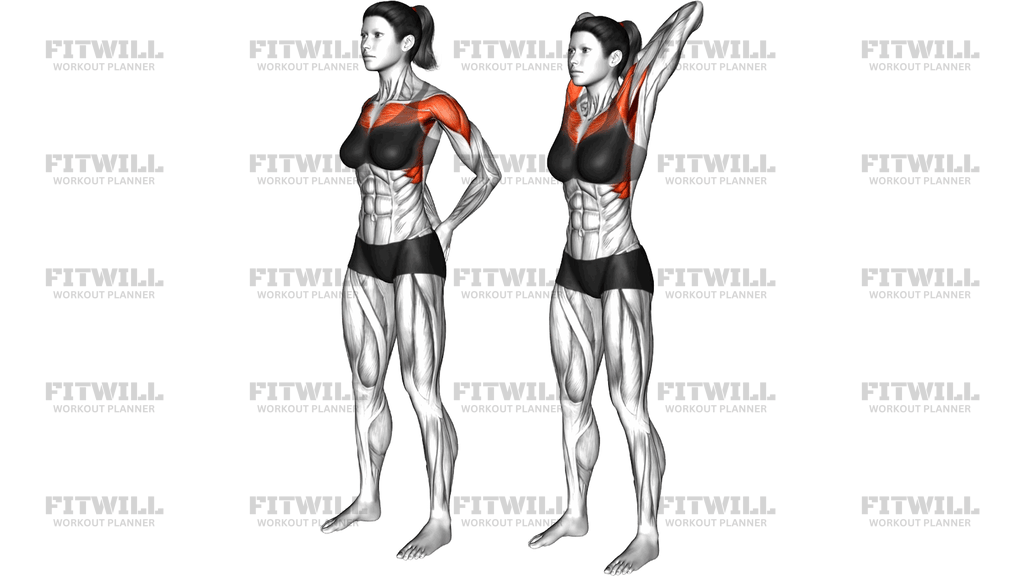
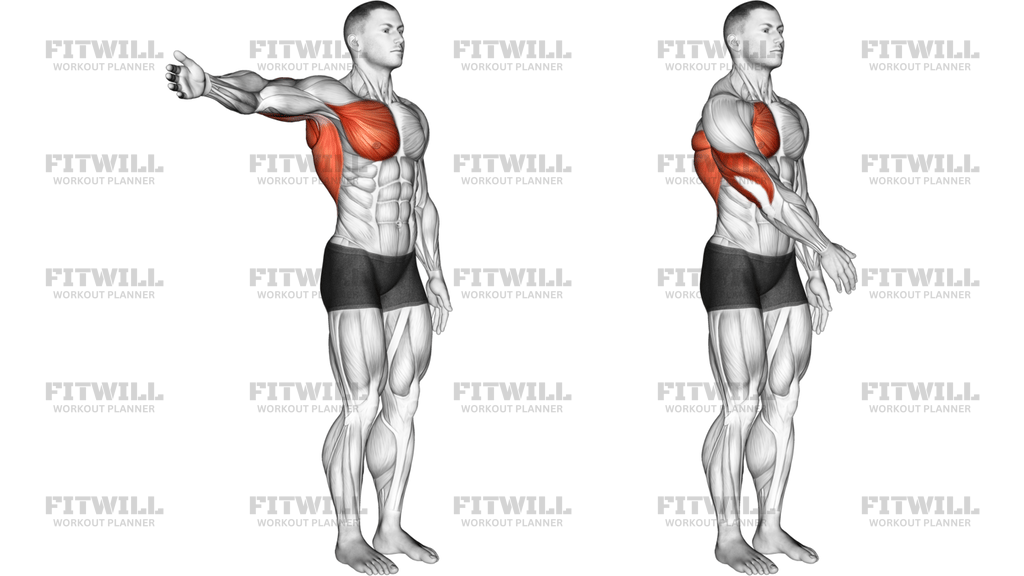
The Seated Back Press is a bodyweight movement performed from an upright kneeling seat, where you start with both arms fully extended overhead and press them down and back until your elbows finish at your sides. Because there is no external load, the exercise relies entirely on deliberate muscle tension, making it a pure control drill for the lats and the muscles that pull the shoulder blades down and together.
The kneeling base is what separates this from a standing version. Sitting back onto your heels locks your hips and legs out of the equation, so any movement you create has to come from the shoulders, arms, and upper back. That makes the exercise especially useful for people who tend to shrug or arch their way through pulling movements, since there is nowhere for the compensation to hide.
The main work is done by the lats as they drive the upper arms down toward your torso, with the rhomboids and mid and lower traps pulling the shoulder blades back and down behind you. The rear shoulders assist the motion, and the muscles along the spine work to keep you tall through the entire rep. The biceps and forearms stay involved only as the elbows bend on the way down.
Setup matters more than it looks. An upright spine, stacked over the pelvis, gives the lats a fixed anchor to pull against. If you let the chest drop or the ribs flare forward as the arms come down, you shorten the range the lats actually work through and shift stress into the lower back. Keep the neck long and eyes forward so the upper traps do not take over.
This drill fits well as a warm-up before pulldowns, rows, or pull-ups, as a corrective exercise for shoulder blade control, or as a low-load back activation option for anyone training without equipment. It is also a practical teaching tool: the pattern it grooves — driving the elbows down and back while keeping the torso tall — is the same pattern that makes every other vertical and horizontal pull more effective.
Keep the pace slow and the tension honest. Squeeze the arms down as if you were pulling a heavy bar to your chest, pause briefly with the elbows at your sides, and control the arms back up overhead. If you cannot feel your lats working, slow down further and focus on drawing the shoulder blades toward your back pockets rather than simply bending the elbows.
[ Workout Log & Planner ]
Put your next workout in Fitwill
Keep your plan and training log ready when you are.


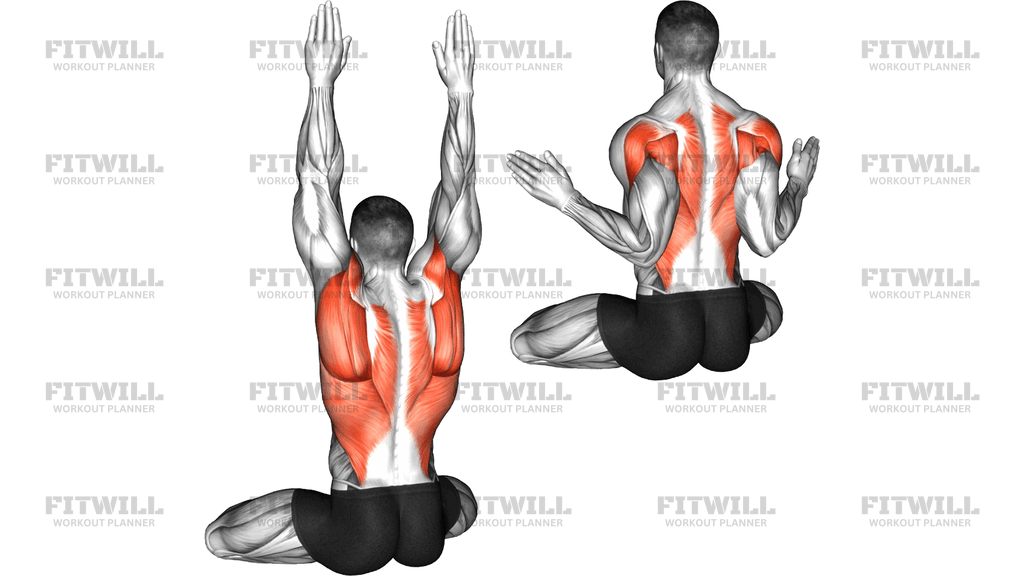
Instructions
- Kneel on the floor and sit your hips back onto your heels, with the tops of your feet flat on the ground and your knees about hip-width apart.
- Sit tall so your shoulders stack directly over your hips, and rest your hands on your thighs to find a neutral, upright spine before starting.
- Raise both arms straight overhead with your palms facing forward or slightly inward, elbows fully extended, and your ribs pulled down so your lower back is not arched.
- Brace your core lightly and keep your neck long with your eyes forward, avoiding any lift of the shoulders toward your ears.
- Press your arms down and slightly back as if pushing something heavy away above you, letting your elbows bend out to the sides as your hands travel down.
- Finish with your elbows at or just behind your sides, hands around lower-chest height, and squeeze your shoulder blades down and together for a one-second hold.
- Reverse the path under control, straightening your elbows and letting your arms rise back to the fully overhead start position without shrugging.
- Exhale as you press your arms down, and inhale as you return them overhead.
- Complete your reps, then release your hands to your thighs and reset your seated posture before the next set.
Tips & Tricks
- If you feel this only in your biceps, your elbows are bending too early — think about driving the upper arms down first and letting the elbows fold as a result.
- Shrugging at the start of the press means the upper traps are dominating; depress the shoulder blades slightly before the arms move at all.
- Do not let your ribs flare or your lower back arch as the arms go overhead — pull the front of the pelvis and the ribs toward each other to keep the torso a solid anchor.
- A common mistake is collapsing the chest forward as the elbows come down; imagine a string pulling the crown of your head toward the ceiling for the entire rep.
- If sitting on your heels is uncomfortable on the knees, place a folded towel or cushion between your calves and thighs rather than leaning forward to compensate.
- Create tension even without weight by pressing your palms outward against imaginary resistance — the harder you pretend to push, the more the lats light up.
- Keep the hands from drifting behind the head at the top; the arms should finish in line with or slightly in front of your ears.
- The pause at the bottom is where the exercise earns its value — skipping it and bouncing through the rep turns a back drill into an arm swing.
- Tempo is your loading tool here: try a two-second press, one-second hold, and three-second return before adding anything else to the movement.
Frequently Asked Questions
Which muscles does the Seated Back Press work?
The lats do the primary work of driving the upper arms down, supported by the rhomboids and mid and lower traps as they pull the shoulder blades back and down. The rear shoulders assist, and the spinal muscles work to hold you upright.
Why is this done kneeling instead of standing?
Sitting back onto your heels removes the hips and legs from the movement, so you cannot use momentum or lower-body lean to cheat the press. This forces the shoulders and upper back to do all the work and makes compensation easy to spot.
Is the Seated Back Press suitable for beginners?
Yes, and it is arguably best learned early because it teaches the elbow-down-and-back pulling pattern without any load. Beginners should focus on slow tempo and feeling the shoulder blades move rather than counting reps.
Can I use the Seated Back Press as a warm-up?
It works very well before pulldowns, pull-ups, or rows because it activates the lats and primes the shoulder blade control those lifts require. Two or three sets of ten slow reps is usually enough.
I only feel my arms working — what am I doing wrong?
You are most likely just bending and straightening the elbows instead of pressing the upper arms down toward your torso. Cue yourself to drive the elbows toward your back pockets and keep the hands relatively light.
How can I make the Seated Back Press harder without equipment?
Slow the tempo, extend the bottom hold to two or three seconds, or add a brief isometric squeeze where you press your elbows back against light hand tension. Increasing time under tension matters far more than rep count here.
What should I do if kneeling hurts my knees or ankles?
Place a cushion or folded mat between your heels and hips, or sit on a low block to reduce the knee bend. You can also perform the same arm pattern standing with your back against a wall if kneeling is not workable.
Can the Seated Back Press replace rows or pulldowns?
No — without external resistance it cannot provide the overload those exercises deliver for strength and muscle growth. Treat it as an activation, warm-up, or control drill that makes your loaded pulling work better.
How many reps and sets should I do?
For activation or warm-up purposes, two to three sets of eight to twelve slow reps with a brief hold at the bottom works well. Since there is no load, muscle fatigue rather than joint stress will usually be the limiting factor.